




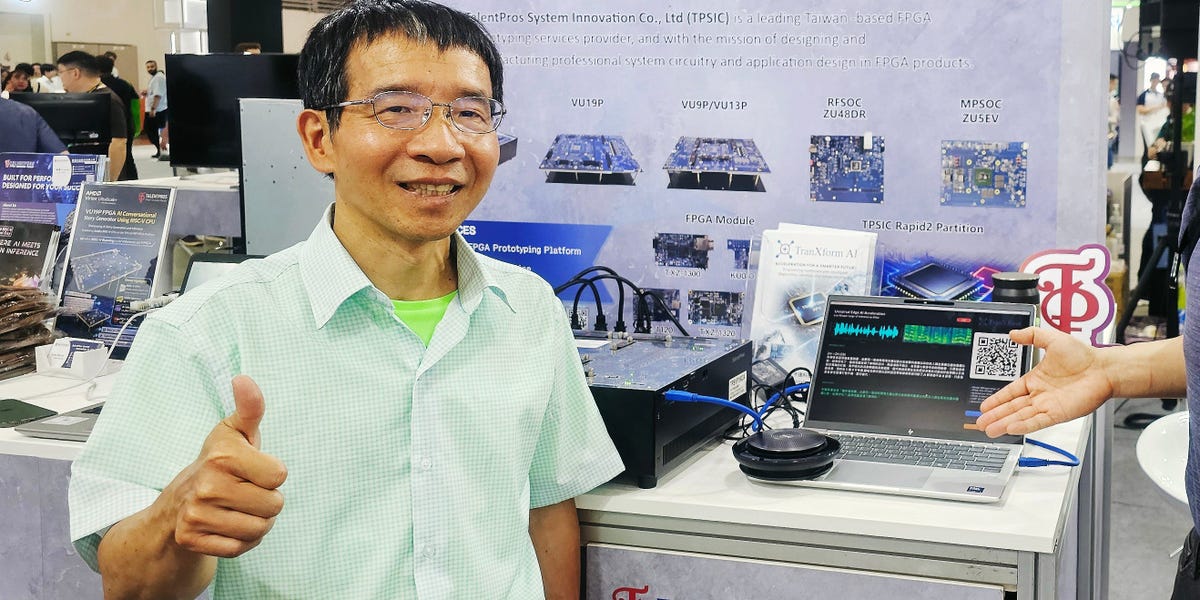
Stephen Huang had spent decades building chips in Silicon Valley when ChatGPT’s launch convinced him the market was ready for the AI chip company he had long considered building.
By then, Huang had worked on MediaTek’s GPUs, Apple’s Face ID technology, and at an Amazon AI chip team.
When ChatGPT burst onto the scene in late 2022, Huang became convinced the industry had reached a turning point. “I felt the market had arrived,” he said.
So at 55, Huang decided to start over.
In 2024, he founded Tranxform AI, a Taiwan-based AI chip startup developing power-efficient processors designed to run AI models outside large data centers.
The company now employs about 40 people and is preparing its first chip, which Huang expects to be ready next year.
The CEO is among a growing number of entrepreneurs chasing opportunities created by the AI boom. Unlike many founders building companies around large language models, however, he spent decades designing chips before launching his own startup.
But Huang never viewed age as a disadvantage.
“Morris Chang started TSMC in his 50s,” he said, referring to the founder of Taiwan Semiconductor Manufacturing Company, who founded the world’s largest contract chipmaker at 55.
In fact, Huang believes age may be on his side, arguing that hardware startups often favor experience in ways software startups do not.
Semiconductor design is a long game, he said. Building a system-on-a-chip — the integrated processor that powers devices ranging from smartphones to AI systems — requires balancing countless tradeoffs across hardware and software, a skill that can take decades to develop.
“To build a good SoC, you need experience,” Huang said. “Otherwise, you would not know how to balance different operations.”
Huang’s startup adventure was not an obvious one.
Before founding Tranxform, he had a stable career and a comfortable income in the US. Building the company meant taking a significant risk and spending most of his time in Taiwan, a decision his family initially struggled to accept.
As Tranxform grew and reached key milestones, his family’s attitude changed. “Today, they are proud of what we have accomplished,” he said.
The timing also helped. Huang’s two sons were adults when he founded the company. One works in the technology industry, while the other recently graduated from university.
“Having them become independent has made it easier for me to dedicate the time and energy needed to build Tranxform,” he said.
Huang said he believed the risk was worth taking because demand for specialized AI hardware would continue growing as companies looked for faster and more energy-efficient ways to run increasingly complex models.
Huang’s optimism comes as investors pour fresh capital into AI hardware.
Venture funding for AI and machine-learning chip startups rose over 70% to $16.2 billion in 2025 from the year before, according to PitchBook. However, the number of deals fell to 232 from 266 in the same period as investors increasingly wrote bigger checks to a smaller cohort of potential breakout companies.
This year, funding stood at $9.9 billion as of June 22, with deal counts at 87, per PitchBook.
Returning home
While AI drew Huang toward entrepreneurship, Silicon Valley’s intensifying talent wars made him rethink where to build his company.
His years in Silicon Valley taught him how difficult it was for startups to compete with tech giants such as Google, Apple, and Nvidia for engineering talent.
“We kept training people, and they got poached,” he said.
Huang built his company in the Taiwanese chip hub of Hsinchu, where he believed he could assemble a more stable engineering team.
One of those recruits was his college classmate Way-Shing Lee, who joined Tranxform as chief technology officer last year after retiring from the US chip giant Qualcomm.
Now, startup life has replaced the stability of Huang’s previous career with fundraising, recruiting, customer meetings, and constant technical problem-solving.
“Starting a company is very hard,” Huang said. “You have to find business partners. You have to sell your story. You have to find funding.”
Huang said Tranxform is preparing for its next fundraising round, declining to disclose details.
The company is still in the early stages of licensing and generates little revenue, he said.
Still, Huang believes the biggest opportunities in AI remain ahead.
The AI industry is “probably just getting started,” he said.
Read the full article here