



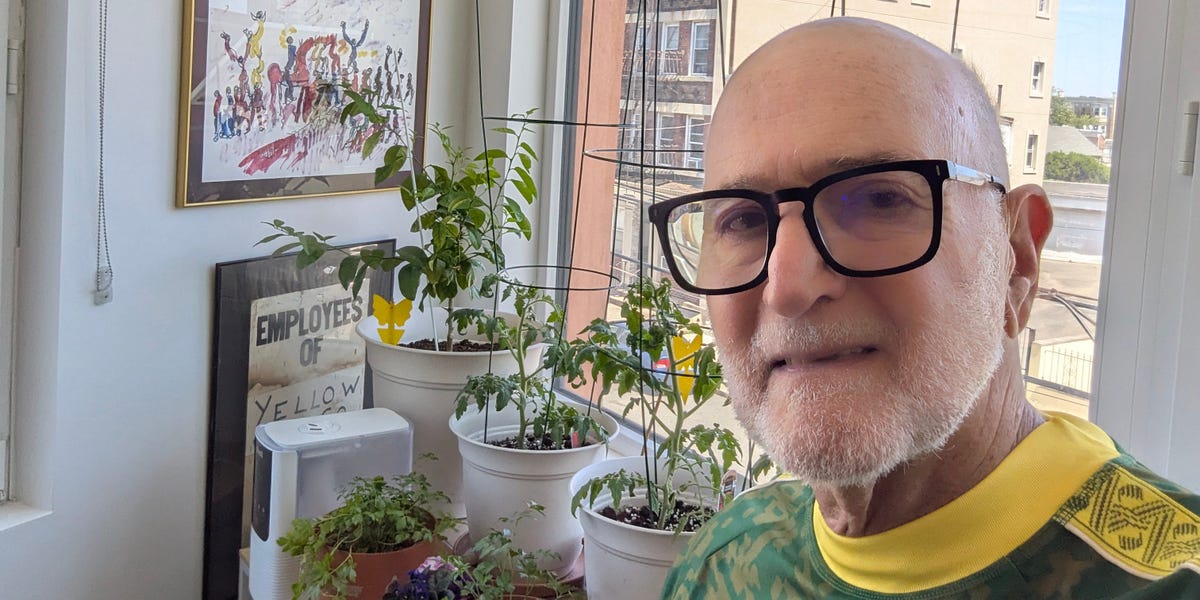
This as-told-to essay is based on a conversation with John Goldstein, a 75-year-old retiree in Newark, New Jersey. The interview has been edited for length and clarity.
Like the vast majority of retired people in our country, I live on a fixed income.
I live with my partner, who is also retired and on a fixed income, and it’s not a choice to think a lot about the cost of food.
And it’s not just the cost of food. The costs of housing and healthcare have had a huge impact on us. Paying the Medicare premium eats up whatever cost-of-living adjustment Social Security provides.
I don’t think I’m very different in that respect from lots of retired people on a fixed income when prices are going up. People’s incomes are not anywhere close to keeping up with inflation.
Food costs are a big part of what we can control
We can’t control the cost of healthcare, but with food, a lot of it is discretionary.
I have friends who like hanging out at the bar, and that ends up costing a lot of money. We don’t do that anymore.
We used to eat at restaurants four or five times a month. Now it’s maybe four or five times a year.
My partner was pescatarian when we met 14 years ago, and giving up meat has saved us a lot of money. If we were still eating meat, we probably would have stopped because the price has gone up so much.
I’ve also changed how and where I shop for groceries.
The local Portuguese markets, when I moved here to Newark 15 years ago, were the cheapest markets around. They’re now like Whole Foods, with prepared foods and expensive products.
I used to go to Whole Foods once in a while, too, and now I go there maybe twice a year, if there’s something I can’t find anywhere else.
Now I do a weekly trip to ShopRite and am careful to track coupons and deals.
I typically spend about $150 a week, with about a third on fresh produce, a third on dairy products like yogurt and cheese, and a third on pantry staples like nuts, beans, olive oil, and whatever else I might need to cook a meal.
The other day I was shopping because all the kids and grandkids were visiting, and I think my grocery bill was $250, and I had saved almost $100 from coupons.
I’ve also found smaller ways to save.
We used to eat a lot of fresh fish, but that’s gotten really expensive, so I end up buying flash-frozen filets or canned fish.
We also started eating a lot more beans for protein instead of fish. Canned beans were like $1 a can, but the same amount of dried beans is around $0.25, so that’s a significant savings.
We don’t buy packaged goods like cookies and cereal, and we buy very little processed food.
I’m also growing some tomato plants and some herbs and spices. Instead of buying a bunch of cilantro, parsley, and basil at the store and having most of it spoil before I ever use it, I can pick what I want.
I don’t think I’m saving a lot of money with the garden. It mainly gives me the pleasure of having a nice, flavorful homegrown tomato.
We don’t spend a lot, but we still eat well
We’re frugal, but living well does not require spending a lot of money. We live extremely well. We eat great meals and do it on a very reasonable budget.
I love to cook, which is an important piece of this.
The happy place for me is when I can cook and watch a soccer match at the same time. Life doesn’t get much better than that.
If you can accept that changes — in what you’re buying, in what you’re cooking, or in what you’re eating — are not punitive, but that they are choices that you’re making, you can find ways to make those choices very desirable.
I’m also well aware that this doesn’t work for everybody, but getting over the fear of cooking and things not being perfect in the kitchen is important.
Don’t be afraid that you might burn something. You will burn some things.
Don’t be afraid that sometimes it’s not going to turn out perfectly, because sometimes it won’t.
Even if you’ve eaten the same things for many years, don’t be afraid to try something new and look around for inspiration.
When I do have a meal in a restaurant that I think is incredible, I’ll say, “I can do that at home. I’ll figure it out.”
I once went to this restaurant in San Francisco that had trout stuffed with spinach and feta, and it was delicious. Ten years later, I was still thinking about it, so I taught myself how to debone a trout.
It doesn’t have to be so complicated, of course, but it’s not terribly expensive, and it tastes really great.
Breaking the chains of the food that you’re used to eating and branching out can be exciting, it can be fulfilling, and it can also help you think through how to do that in an economical way.
Read the full article here