






The Mexican Peso surges to a one-month high on Tuesday as talks between the US and Iran could reopen the Strait of Hormuz, easing global inflationary pressures by freeing ship traffic. At the time of writing, the USD/MXN pair trades at 17.26, after reaching a high of 17.33.
USD/MXN slides as US-Iran negotiations ease global inflation concerns, as energy prices drop
Geopolitical news is driving financial markets. Negotiations between the US and Iran are a tailwind for risk-sensitive currencies like the Mexican Peso, which also benefits from the interest rate differential with the US and Mexico, which favours the latter.
A possible interim Iran deal is gaining traction, according to officials familiar with that matter. Before the Wall Street open, US Treasury Secretary Scott Bessent said that a deal could be reached as soon as today or tomorrow, a view echoed by US Secretary of State Marco Rubio.
Data in Mexico revealed that June’s Consumer Confidence improved for the second straight month on a monthly basis. Annually, it retreated for the nineteenth consecutive month.
Meanwhile, attention turns to the Bank of Mexico (Banxico) Interest Rate Decision on August 6. According to Prime Terminal data, there’s an 93% probability that rates will remain at 6.50%, with only a 7% chance of an increase at the upcoming meeting.
Across the southern border, the US JOLTS vacancies for June dropped from 7.537 million to 7.359 million, falling short of the forecast of 7.4 million. The relatively low number of layoffs suggests limited firing and hiring activity, with approximately one vacancy for each unemployed individual, indicating a stable labour market.
The US schedule will feature jobs data, led by the ADP Employment Change, the job openings survey, jobless claims and the July Nonfarm Payrolls report, on Friday, August 7.
USD/MXN Price Forecast: Technical outlook
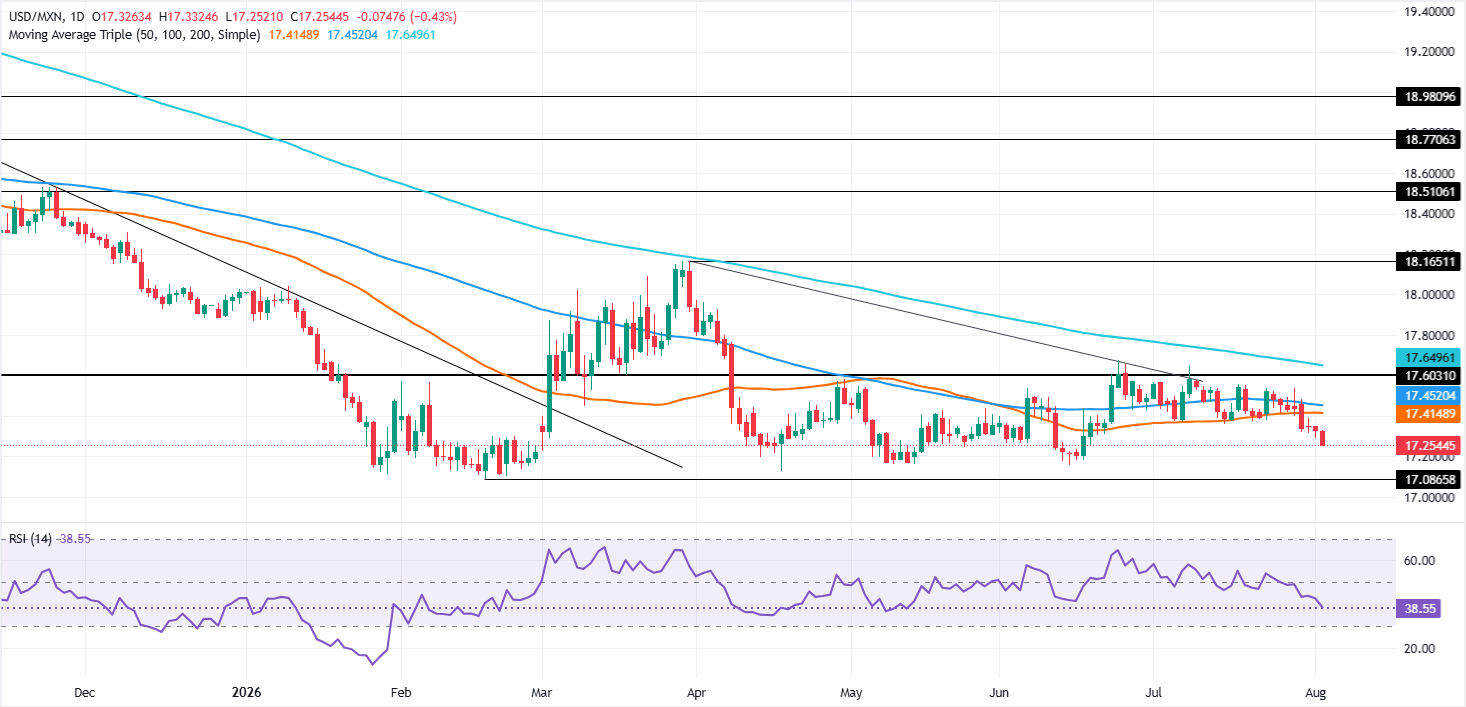
In the daily chart, USD/MXN trades at 17.2545, retaining a bearish near-term bias as spot holds below the cluster of simple moving averages around 17.4149 and the shorter-term downward trend-line break at 17.4188. The Relative Strength Index (14) at 38.6 sits just above oversold territory, suggesting that while selling pressure is easing slightly, the pair remains under structural topside supply.
On the downside, the next notable structural floor emerges near the long-term downward trend-line break at 15.7289, which acts as a distant support zone should the current slide extend. On the topside, initial resistance is seen at the grouped 50/100/200-period simple moving averages around 17.4149, followed closely by the short-term descending trend-line break at 17.4188; a daily close above this band would be needed to alleviate the current bearish tone.
(The technical analysis of this story was written with the help of an AI tool. Know more.)
Mexican Peso FAQs
The Mexican Peso (MXN) is the most traded currency among its Latin American peers. Its value is broadly determined by the performance of the Mexican economy, the country’s central bank’s policy, the amount of foreign investment in the country and even the levels of remittances sent by Mexicans who live abroad, particularly in the United States. Geopolitical trends can also move MXN: for example, the process of nearshoring – or the decision by some firms to relocate manufacturing capacity and supply chains closer to their home countries – is also seen as a catalyst for the Mexican currency as the country is considered a key manufacturing hub in the American continent. Another catalyst for MXN is Oil prices as Mexico is a key exporter of the commodity.
The main objective of Mexico’s central bank, also known as Banxico, is to maintain inflation at low and stable levels (at or close to its target of 3%, the midpoint in a tolerance band of between 2% and 4%). To this end, the bank sets an appropriate level of interest rates. When inflation is too high, Banxico will attempt to tame it by raising interest rates, making it more expensive for households and businesses to borrow money, thus cooling demand and the overall economy. Higher interest rates are generally positive for the Mexican Peso (MXN) as they lead to higher yields, making the country a more attractive place for investors. On the contrary, lower interest rates tend to weaken MXN.
Macroeconomic data releases are key to assess the state of the economy and can have an impact on the Mexican Peso (MXN) valuation. A strong Mexican economy, based on high economic growth, low unemployment and high confidence is good for MXN. Not only does it attract more foreign investment but it may encourage the Bank of Mexico (Banxico) to increase interest rates, particularly if this strength comes together with elevated inflation. However, if economic data is weak, MXN is likely to depreciate.
As an emerging-market currency, the Mexican Peso (MXN) tends to strive during risk-on periods, or when investors perceive that broader market risks are low and thus are eager to engage with investments that carry a higher risk. Conversely, MXN tends to weaken at times of market turbulence or economic uncertainty as investors tend to sell higher-risk assets and flee to the more-stable safe havens.
Read the full article here