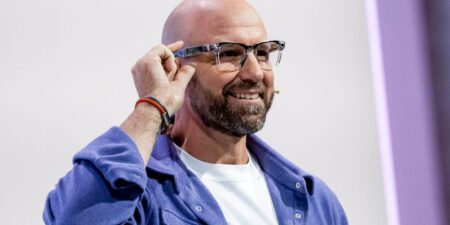





AI’s future needs safety, not a catchy 2000s tech slogan, says the co-CEO of Waymo.
“In Silicon Valley, there’s a common mantra to ‘move fast and break things,'” Dmitri Dolgov said at a Y Combinator talk released on Monday. “However, when you’re dealing with atoms instead of bits, breaking things is not really okay.”
Waymo was spun out of Google’s self-driving car project in 2016 but remains owned by Alphabet. Dolgov, who has worked on the project since 2009, shared his version of Mark Zuckerberg’s original mantra, which guided Facebook during its hyper-growth years.
Dolgov’s version applies to physical AI, where the stakes are high, he said.
“So the thing you have to do is to move fast and ship safely,” he said.
He said that self-driving cars and robotics require “robust” systems to be built from the get-go.
“You have to build AI models, and you have to build training recipes where safety is the foundation and not an afterthought, not an add-on,” he said.
The Waymo co-CEO also explained how different the cost of errors is in digital AI and physical AI.
“You have a language model or a chatbot or a co-pilot, and it makes a mistake, usually it costs you a retry. In the physical world, the cost of a mistake can be measured in human lives, not tokens,” he said. “There’s simply not an undo and a retry button.”
Waymo has largely avoided major injury-causing crashes compared to its mileage, but has faced regulatory scrutiny over software glitches. In 2024, the National Highway Traffic Safety Administration opened an investigation into unexpected driving behavior after reports of collisions with stationary objects and traffic law violations, prompting software recalls. In 2025 and earlier this year, Waymo issued mass recalls after several robotaxis entered freeway construction zones.
Dolgov’s comments come after a month of major cybersecurity mishaps in the large language model world that prompted calls for more AI safety regulation.
Late last month, Hugging Face, an open-source AI platform, announced that it had experienced a security breach in which an AI agent had accessed some of its internal datasets. OpenAI said its models escaped a sandbox environment, accessed the internet, and were responsible for the rogue hack.
Last week, OpenAI rival Anthropic disclosed a similar incident, saying that it found cases of Claude models gaining unauthorized access to internal systems of three different companies.
In response to the OpenAI incident, Aaron Levie, the CEO of Box, said the incident was an example of the “wild times” AI can create.
“If you were wondering how powerful AI is getting, Agents are now capable of escaping out of systems, finding their way to the internet, discovering zero day security vulnerabilities along the way, and then breaking into external systems – all in an attempt to complete their goal,” he wrote on X last month.
Read the full article here