





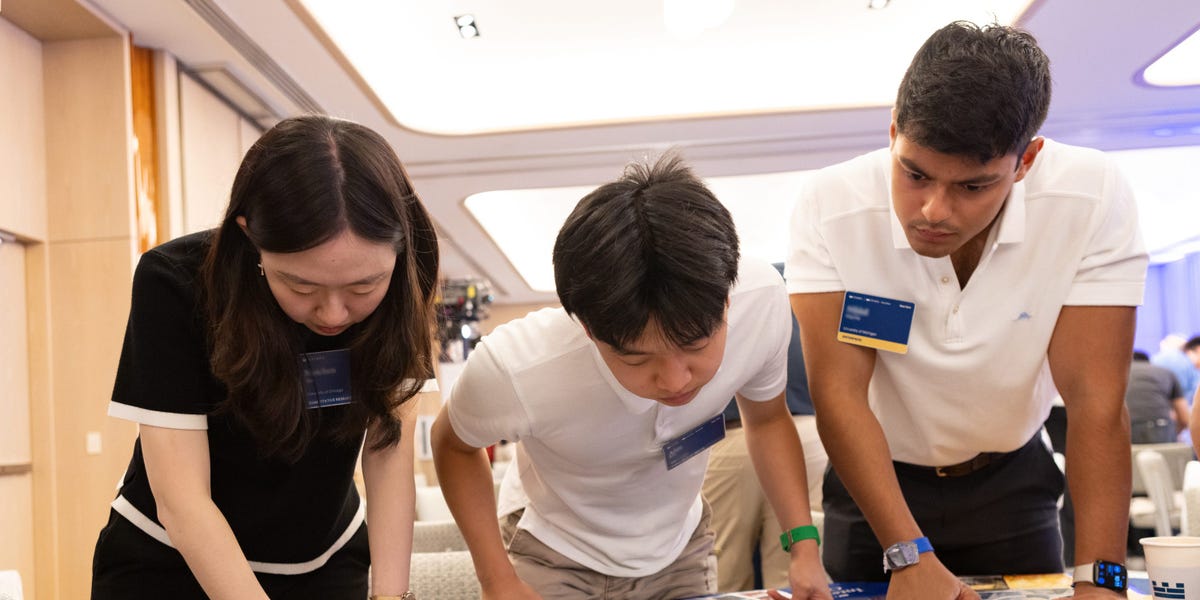
Ken Griffin’s companies are making their biggest bet yet on entry-level talent, as Citadel interns kick off their program with an offsite in Palm Beach on Monday.
They’re among the more than 350 interns at the company and its sister firm, market maker Citadel Securities, and comprise the biggest global class to date. The companies, known for recruiting the sharpest quants and traders, accepted a miniscule 0.36% of applicants out of more than 115,900 applications, up 6.4% from last year’s record.
“The reason our class is larger than ever is precisely because the business has seen how valuable campus talent can be,” Iris Wang, who oversees campus recruitment at Citadel, said, adding that the firms aren’t “headcount-restrained.”
Despite widespread anxiety about what AI will do to entry-level hiring, Citadel’s commitment to young talent isn’t entirely surprising, as the top hedge funds have been scrambling to hire enough people to invest their massive sums. Some of the biggest hedge funds are beefing up their talent pipelines to rival that of the big banks, whose intern programs are something of Wall Street folklore.
Other hedge funds are also investing in their talent pipelines: in 2027, Millennium is starting an investing internship, and Balyasny is launching a nine-month Catalyst training program for recent graduates.
Wang and Fabian Figi, who leads recruiting at Citadel Securities, said roles in quantitative finance are especially attractive to young people because they incorporate cutting-edge technology and AI, and might seem like a wise long-term bet in a rapidly evolving workforce. Some AI labs have been trying to poach the most impressive quants from hedge funds and trading firms, at times offering multimillion-dollar pay packages.
Citadel and Citadel Securities interns, some of whom have PhDs, won’t be starved for summer cash: their base salary is $4,300 to $5,800 per week, depending on their role and experience. Interns also get a signing bonus and can choose to live in corporate housing or receive a $15,000 housing stipend.
How to select top candidates
Interns across Wall Street are entering an industry transformed by AI, as new tools automate much of the work once synonymous with junior roles and firms incorporate the technology into training. Griffin, once a prominent AI skeptic, said last month that the technology has become “profoundly more powerful,” and can now complete work in hours that would have taken people with PhDs in finance weeks, even months.
Citadel assessed applicants on their AI fluency during the recruitment process, along with their good judgment. Many of the strongest applicants knew how to leverage new tools and help AI code effectively, but the “A-plus” candidates were differentiated by their judgment and adaptability, Wang said. Figi said that though soft skills are especially important, a traditional STEM degree still holds weight, even if the traditional STEM skills aren’t as crucial.
“We like people who pursue STEM degrees not just because of their technical expertise, but because it’s hard,” he said. “These are people who want to challenge themselves, and it requires a certain level of raw intellectual horsepower that will push them forward no matter how tools evolve.”
This year’s interns, he said, will have more time to think about higher-order, complex problems, which will likely make the role “more interesting.”
Return offers and evaluation
While the intern role itself is changing, Citadel and Citadel Securities are still evaluating interns in much the same way: impact.
Interns work on team projects with real business implications and have access to the same suite of AI tools as full-time employees, Wang and Figi said. They have one-on-one conversations with their managers each week and ongoing communication with team members.
At the end of the summer, interns present their projects to business leaders, and Griffin and Citadel Securities CEO Peng Zhao review return offers. Figi said that while it’s hard to predict how the summer will shake out, he expects most interns to get a return offer, as they have in past years. The companies don’t have specific quotas for returns, and instead evaluate whether each intern could be “wildly successful” individually, he said.
And the track record is pretty good: campus hires are around twice as likely to one day be considered high performers, based on annual performance reviews.
“We’re going to continue to have an almost insatiable appetite for exceptional talent, and we’ll continue trying to identify as much of it as we can because we believe it’s a critical competitive advantage,” Figi said. “Once we identify that talent, we’ll move incredibly fast to secure it.”
Interning on Wall Street this summer or have a tip? Contact this reporter via email at [email protected] or Signal at alicetecotzky.05. Use a personal email address, a nonwork WiFi network, and a nonwork device; here’s our guide to sharing information securely.
Read the full article here