




Join Us Friday, April 24

When people see the White House for the first time in person, they often remark that it looks small from the outside.

Matt Costello, chief education officer and director of the David M. Rubenstein National Center for White House History, told Business Insider that appearances can be deceiving.

“There’s a lot more to the White House than meets the eye,” he said. “It has six floors, about 55,000 square feet. There are two sub-basements underneath the house that were part of the Truman renovation. And then, of course, you’ve got the Presidential Emergency Operations Center. So there’s a bigger apparatus, so to speak, for the president and their safety and security than you might expect when you first see it.”

The existence of a secure facility beneath the White House, known as the Presidential Emergency Operations Center, the PEOC, or simply the “White House bunker,” is something of an open secret, inspiring portrayals in film and TV such as “White House Down” and “24.” However, details about its protective and operational capabilities remain classified.

The PEOC has undergone various expansions and transformations through different White House renovations, including the ongoing construction of President Donald Trump’s new ballroom where the East Wing once stood.

“I would imagine, like many White House spaces, it’s evolved and changed, and it’s been updated to have the most advanced telecommunication systems, secure lines, everything that a president or vice president or first family or Cabinet members might need in the event of some kind of national catastrophe or emergency,” Costello said. “It is considered the safest place to go on the White House grounds.”

Here’s what we do know about the PEOC.

The first iteration of the Presidential Emergency Operations Center was built in 1942 to protect President Franklin D. Roosevelt during World War II.

After the attack on Pearl Harbor in 1941, a temporary bomb shelter was built in the Treasury Department in 1941.

When Roosevelt expanded the East Wing and added a second story in 1942, a new presidential bomb shelter was built beneath it. It featured a bedroom and bathroom, as well as ventilation masks, food, and communications equipment, all fortified behind concrete walls.

“The best time to construct something underground is when you’re building something above ground, especially when it comes to the White House,” Costello said.

During these White House renovations, Roosevelt also converted a cloakroom in the East Wing into a movie theater.

The bunker was expanded as part of President Harry Truman’s extensive White House renovations from 1948 to 1952.

The four-year, $5.7 million renovation was required to reinforce the entire White House structure, which had begun to sag into the ground. The Trumans temporarily moved to Blair House as workers hollowed out the White House.

“When they do the Truman renovation, where they essentially gut the inside of the house and then rebuild it from the inside out with concrete and steel, they really are fortifying the White House to serve as a bomb shelter,” Costello said.

As the world entered the age of nuclear weapons, the PEOC was also expanded and updated during this renovation.

“As there are these wider changes around the world, they impact how presidential security is revisited, reassessed, and then adapted as needed,” Costello said.

The PEOC largely remained a theoretical precaution until the terrorist attacks of September 11, 2001.

When the first plane hit, Cheney turned on the news in his office at the White House. After the second plane hit, his lead Secret Service agent burst in to escort him to the PEOC, Cheney said in an interview with the American Enterprise Institute in 2011.

Cheney said the Secret Service agent “put one hand on the back of my belt, one hand on my shoulder,” and “literally propelled me out of my office.”

Cheney was joined in the PEOC by staff members, including National Security Advisor Condoleezza Rice, Transportation Secretary Norman Mineta, and Presidential Counselor Karen Hughes. He advised President George W. Bush, who was in Florida at the time, not to return to Washington, DC, marking the first time in US history that the continuity of government operations plan was implemented.

The PEOC served as a command center in the aftermath of the attacks.

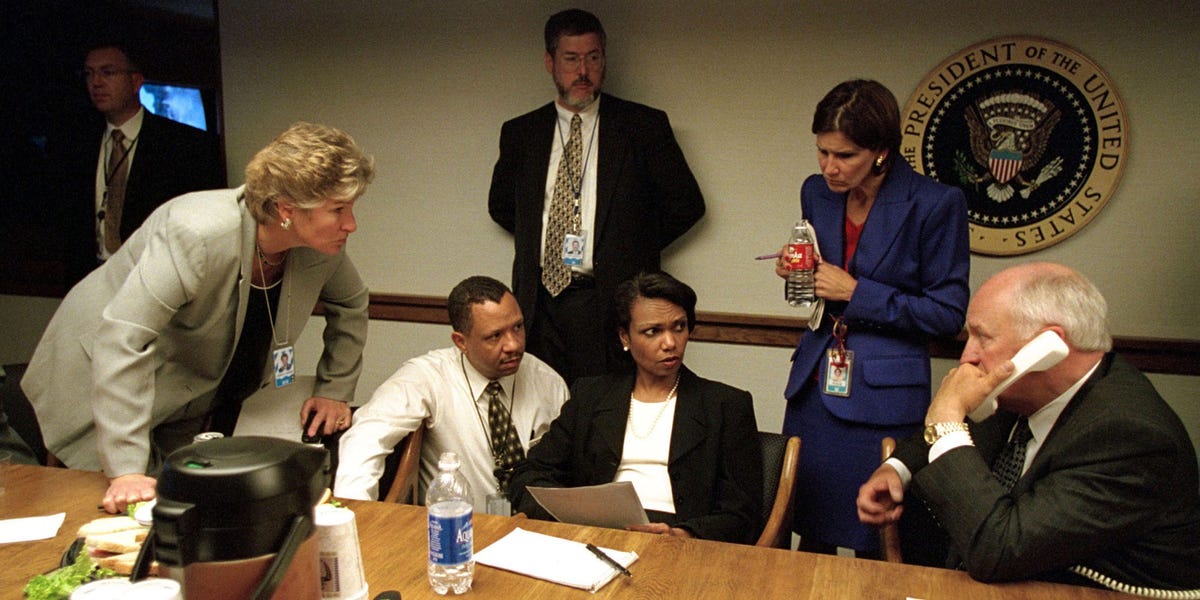
Rare photos of the PEOC on September 11 were released by the National Archives in 2014 as part of a Freedom of Information Act request, offering a glimpse inside the top-secret space.

“As far as I’m aware of, I think those are the only publicly released ones, and they were publicly released because they were forced to be released,” Costello said of the images.

The photos showed a conference room with phones, video call capabilities, television screens playing news reports, world clocks, and a map of the United States.

Former first lady Laura Bush wrote about her time in the PEOC on September 11 in her White House memoir, “Spoken from the Heart.”

“I was hustled inside and downstairs through a pair of big steel doors that closed behind me with a loud hiss, forming an airtight seal,” she wrote in “Spoken from the Heart” of her experience on September 11.

“I was now in one of the unfinished subterranean hallways underneath the White House, heading for the PEOC, the Presidential Emergency Operations Center, built for President Franklin Roosevelt during World War II. We walked along old tile floors with pipes hanging from the ceiling and all kinds of mechanical equipment.”

Upon returning to Washington, DC, on September 11, President George W. Bush was brought to the PEOC.

Laura Bush wrote in her memoir that George W. Bush arrived at the PEOC at 7:10 p.m. on September 11.

When the Secret Service suggested that she and her husband spend the night in the secure bunker, Laura Bush wrote that they declined because the foldout bed “looked like it had been installed when FDR was president.”

In 2020, President Donald Trump was reportedly rushed to the bunker as demonstrators protested the killing of George Floyd outside the White House.

It was widely reported that Trump was taken to the PEOC as a precaution when protesters breached temporary fences outside the White House. Trump told Fox News Radio that he had visited the bunker to inspect it, not to take shelter there.

“I was there for a tiny, short little period of time,” Trump said. “They said it would be a good time to go down and take a look because maybe sometime you’re going to need it.”

When Trump returned to the White House in 2025, he demolished the East Wing and began building a new ballroom, leaving the future of the PEOC below uncertain.

The White House announced that the new ballroom would measure 90,000 square feet, seat around 1,000 people, and serve as a “much-needed and exquisite addition.” Trump and other “patriot donors” will fund the $400 million project, the White House said.

Trump confirmed that a “massive” new military complex was under construction beneath the ballroom after the National Trust for Historic Preservation filed a lawsuit to halt the project.

The National Trust for Historic Preservation’s lawsuit alleged that Trump had no legal authority to demolish the East Wing and replace it with a ballroom.

In March, a federal judge’s ruling halted above-ground construction until Congress approves the project, but allowed work related to “the safety and security of the White House” to continue.

Trump then confirmed what the lawsuit had alluded to: a new and improved PEOC was in the works.

“The military is building a big complex under the ballroom, which has come out recently because of a stupid lawsuit that was filed,” he told reporters on board Air Force One on March 29.

He added that the ballroom would essentially function as a “shed” for the secure facility below.

“We have bio defense all over,” he told reporters on March 31. “We have secure telecommunications and communications all over. We have bomb shelters that we’re building. We have a hospital and very major medical facilities that we’re building. We have all of these things, so that’s called: I’m allowed to continue building as necessary.”

A federal appeals court allowed construction to continue temporarily while it reviews the case more closely, with a formal hearing scheduled for June 5.


Read the full article here

Share.
Leave A Reply