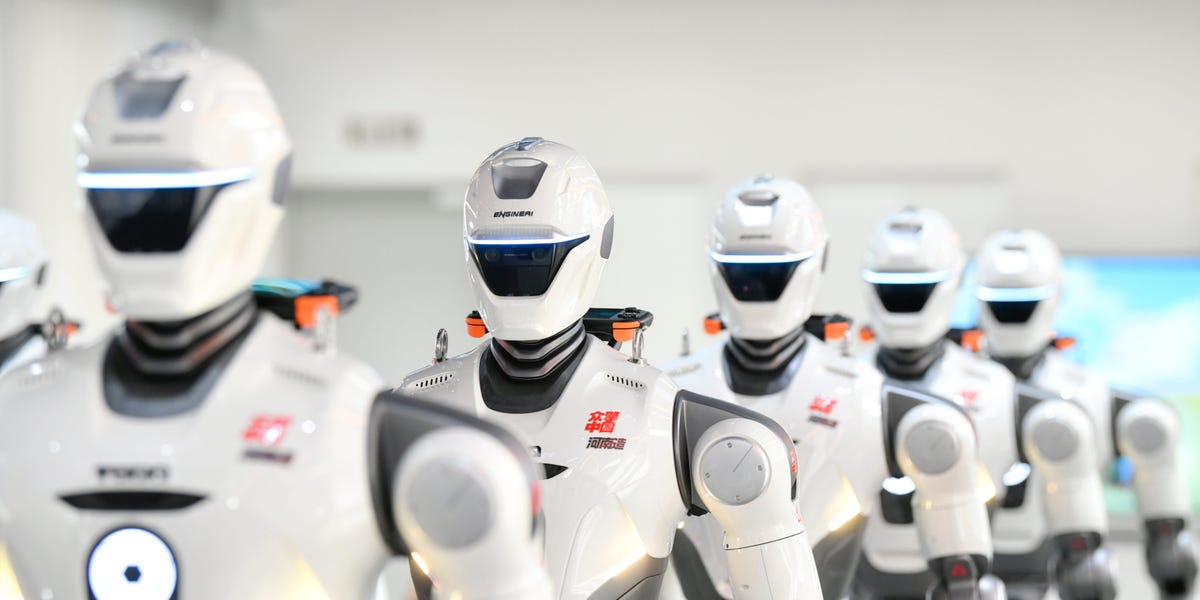
The Trump administration has banned the imports of new advanced robots from China.
VCG/VCG via Getty Images
The Trump administration has announced a ban on new Chinese humanoid robots entering the US.
The authorities say the robots pose “unacceptable safety risks” to national security.
Some policy pundits have voiced full-throated approval for the ban.
The Trump Administration’s crackdown on Chinese robots is getting mixed reactions.
On Tuesday, the Federal Communications Commission announced the administration’s ban on new imports of “advanced robotic devices” from China, including humanoid and quadrupeds. The ban also extends to China-made power inverters used in batteries and data centers.
The FCC’s Tuesday news release wrote that the ban was imposed because these robots “pose unacceptable safety risks to the national security of the United States.”
Robots that have already been brought to the US before the ban was announced will not be affected by it.
Here’s what smart people in policy, tech, and venture capital are saying about the ban.
Chris McGuire, senior fellow at the Council on Foreign Relations
Responding to FCC Chair Brendan Carr’s X post about the ban, Chris McGuire said this was a “very, very big deal.”
McGuire is a senior fellow for China and emerging technology at the Council on Foreign Relations.
He said in his Tuesday X post that the ban will incentivize the US to shore up its robotics supply chains while “preventing China from flooding the US market with cheap robots that also pose national security risks (similar to Chinese connected vehicles).”
McGuire praised the tactic of imposing import bans on specific rapidly growing technologies from China that could pose national security risks to the US.
Rush Doshi, director of the China Strategy Initiative at the Council on Foreign Relations
Rush Doshi, the director of the China Strategy Initiative at the Council on Foreign Relations, called the ban “one of the most significant actions taken so far in support of the U.S. robotics ecosystem.”
Reposting Carr’s X post, Doshi compared the move to the FCC’s announcement last December regarding restrictions on new foreign-made drones.
“The FCC’s drone action was a shot in the arm for the domestic drone industry, and I think this has that same potential in robotics,” Doshi wrote.
Doshi was the deputy senior director for China and Taiwan on the National Security Council under former President Joe Biden.
Peter Harrell, visiting scholar at Georgetown Law School
Peter Harrell, a visiting scholar at Georgetown’s Institute of International Economic Law, called the ban an “important national security move,” adding that advanced robots collect vast amounts of data and are integrated into key industries.
“This should provide a substantial tailwind to U.S. and allied inverter and robot manufacturers,” Harrell wrote on X. He said the move will protect the US market and create space for its companies to expand.
Ramez Naam, founder of Planetary VC
In an X post on Tuesday, climate investor Ramez Naam described the new ban as a “double-edged sword.”
“Short term, the rest of the world will have access to better cheaper hum/quad robots than the US,” he wrote. “Longer term, with luck, US industry will thrive. But China will have advantage of a larger market indefinitely.”
He said that humanoid robots are a “terrible form factor” for warfare and are unlikely to affect defense. But the ban on quadrupeds, animal-like robots that walk on four legs, could have consequences for defense.
Justin Lopas, founder of Base Power
Justin Lopas, the founder of home battery system provider Base Power, gave a nod of support to the ban.
“For those in the know, this is a very big deal,” Lopas wrote on X.
The founder worked in manufacturing and mechanical engineering at SpaceX and Anduril before launching his company in 2023.