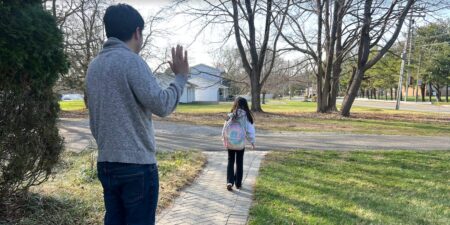




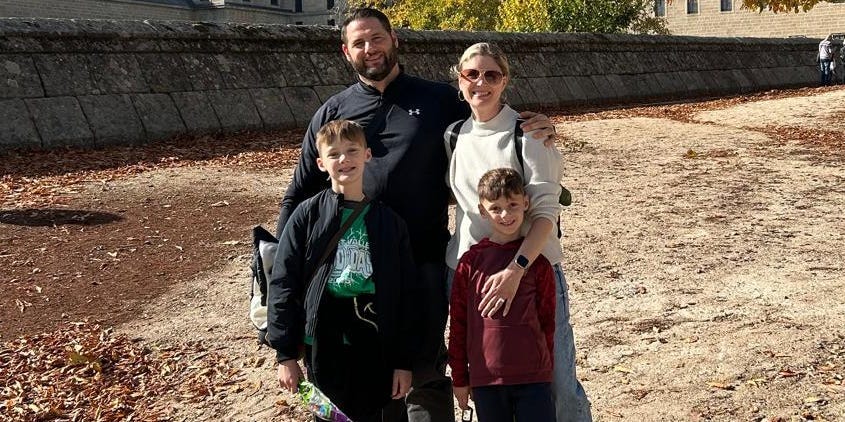
Everyone said the same thing when my husband and I shared our plans to move from Connecticut to a suburb outside of Madrid: “But what about the kids?”
If I’m honest, I was asking myself the same question.
I worried that my two sons, now 10 and 7, would struggle to make friends, feel left out due to the language barrier, and shut down in a new environment.
It’s now been about seven months since our move to Spain, and none of the worst-case scenarios I imagined have come to fruition. The boys did more than adjust; they grew.
Although I find that kids tend to be resilient, I believe much of their success came down to what my husband and I did before boarding our one-way flight.
Our family talked openly about the move for months before we did it
Long before we actually arrived in Spain, my husband and I wanted our children to feel like participants in the move rather than passengers.
We involved them in ways that felt appropriate for their ages, asking them what they hoped life would feel like in Spain and letting them choose what to pack and sell (they kept their earnings as pocket money).
Although they didn’t speak Spanish and had never visited Spain, I wanted to make the unknown feel as familiar as possible. So, we watched Spanish videos, learned basic vocabulary, and read books about Spain.
The move went from being an abstract concept to something they could visualize.
A few weeks before we left the US, they each had a Zoom call with the principal of their new school. She listened as my eldest said he felt excited, nervous, and sad to leave his friends behind.
She gave him space to feel it all, never glossing over his emotions. After the calls, their relief was visible as their new school went from an unknown place to one that felt safe.
Perhaps most importantly, we fostered an environment where our kids could share their fears. My husband and I reminded them that they’re part of a team that would figure things out together, one step at a time. I wanted to make sure they knew they weren’t in it alone.
Of course, there would still be hard moments no matter what we did or said ahead of time. The most we could do was soften the landing.
Read more stories about moving abroad
Once they started school in Spain, they hit the ground running
When we arrived in Spain, my kids were understandably homesick.
My youngest, who was 6 at the time, really missed our old home. It symbolized safety to him, so losing it so suddenly felt disorienting. Our oldest, just shy of 10 when we landed, dreamed about his friends and grandparents at night.
These moments were hard to witness, but they also didn’t last as long as I feared they would.
Starting school made all the difference. Their small international school has traditions that feel familiar to the boys, like trick-or-treating on Halloween and St. Patrick’s Day festivities.
Half of the students are international, so they have plenty of classmates who know what it’s like to start over. The other half are local Spanish children. The combination has been such a gift.
My boys have found peers who have empathized with them and others who have welcomed them, shared their culture, and made them feel like they belong. They love school so much that it’s often hard to convince them to leave at the end of the day.
Outside of school, I rely on a combination of old and new routines to give their days structure. We have Taco Tuesday, a family movie night, a dinner-table game we call “sad, mad, glad,” and special treats on Friday.
These small rituals give them comfort, familiarity, and stability amid so much change.
Seven months into the move, I’m constantly amazed by their bravery
My boys’ boldness has surprised me over and over.
Shortly after we arrived in Spain, my youngest would lean out our apartment window and greet passersby below in Spanish. Seven months in, he joins pickup soccer games at the park with kids of all ages. Because he has the courage to show up, it doesn’t matter that he isn’t yet fluent in Spanish.
As for my eldest, he’s already talking about moving to France one day to learn French, telling me that the best way to learn a language is through immersion.
This winter, he chose to go on a five-day ski trip with his school despite never having skied before. More recently, he stood up in front of a room full of peers, parents, and judges and delivered a 10-minute presentation on inequality as part of an end-of-year project.
He was nervous leading up to it, especially since he hadn’t prepared for it the year before like many of his classmates. But when he stood up, he was composed and articulate. In a new country, he carried himself like he belonged.
My sons have adapted better than I ever hoped
Before we left the US, I worried my sons would struggle to find a community.
Now, my eldest has close friends in various grades, and my youngest views everyone in his class as a companion. Although they arrived in Spain without speaking Spanish fluently, the language barrier hasn’t isolated them.
There have been plenty of bumps along the way — and there are surely more hard moments to come — but my kids are more open to change and adaptable than I ever imagined possible.
I spent so much time worrying about what moving from the US to Spain might do to them that I didn’t let myself consider what it would do for them.
Read the full article here