


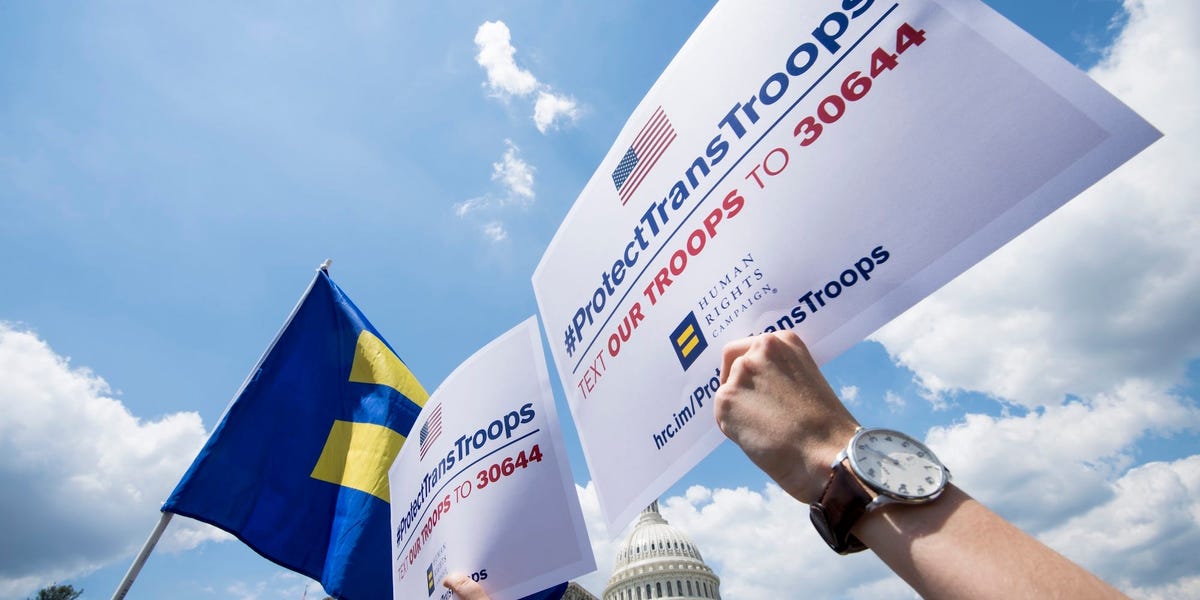
A federal appeals court ruled Monday that the Pentagon’s policy to kick out transgender troops was illegal, halting the administration from removing more than two dozen transgender service members who have sued the Pentagon.
A majority of the three-judge panel of the US Court of Appeals for the District of Columbia Circuit found that the Trump administration’s efforts to bar transgender troops were “arbitrary” and based on animus.
The ruling applies to 28 plaintiffs who filed suit last year. The decision is a major reversal for the Trump administration and allows those transgender troops to continue serving, though the military can continue to prohibit transgender recruits from joining. In a 2-1 decision, the court’s majority found that the Trump administration’s rhetoric and policy vilified transgender people and violated their rights to equal protection under the law, but legal experts cautioned that the Supreme Court may be less sympathetic to these claims.
President Donald Trump moved quickly after taking office to bar transgender troops from service through an executive order that declared transgender identity incompatible “with a soldier’s commitment to an honorable, truthful, and disciplined lifestyle.” Defense Secretary Pete Hegseth has repeatedly highlighted one of his accomplishments as “no more dudes in dresses.”
“In this litigation, the government has not attempted to defend or provide any factual basis for these disparaging characterizations of American citizens,” the majority opinion said. “Indeed, the government has not contested that the Plaintiff-Appellees who are currently serving (and who have collectively earned more than 80 commendations) have served honorably and pose no threat to national security, even though they happen to be transgender.”
The policy violated equal protection because it was an “unadulterated expression of animus” and reflected a “bare … desire to harm a politically unpopular group,” Judge Robert Wilkins wrote.
Judge Justin Walker noted in his dissenting opinion that the Supreme Court has allowed the military to “deprive its members of rights that the Constitution may well guarantee to civilians,” adding that he dissented in part because “the plaintiffs are service members not civilians, and because we are judges not generals.”
“We have neither the expertise nor the authority to decide whether the military can exclude the plaintiffs from its ranks,” he continued. “The Constitution assigns that authority to Congress and the Commander in Chief.”
The Pentagon referred Business Insider to the Department of Justice when asked for comment on the ruling.
‘The damage is already done’
The government is likely to appeal the decision, said Franklin Rosenblatt, a retired Army JAG officer and president of the National Institute of Military Justice.
“There’s no evidentiary record they have developed to show that by allowing trans people to serve in the military, that that’s going to erode our national security somehow,” Rosenblatt said. “It’s really based on national security as window dressing,” he continued, “when otherwise all this is really based on is discrimination against a politically unpopular class of people.”
Despite the ruling, for many transgender troops “the damage is already done,” said Rachel VanLandingham, a professor at Southwestern Law School and a retired Air Force JAG officer. Many transgender service members have already left the military, opting to take what was characterized as a “voluntary” separation rather than face discharge boards, she said.
Military officials estimated in May 2025 that around 1,000 troops had identified themselves as transgender to begin their separation process. The Pentagon has estimated that there are about 4,200 transgender troops, though one 2014 estimate from the University of California Los Angeles School of Law put that figure close to 15,000.
“There’s no rational relation to good order and discipline,” VanLandingham said of the administration’s justification for removing transgender troops.
The case still has several steps before it could reach the Supreme Court, VanLandingham said, including further proceedings in the lower courts and potential appeals. She expressed doubt that the Supreme Court would ultimately uphold the ruling in favor of transgender troops, calling such an outcome “wishful thinking.”
Read the full article here