




What if the company you worked for just ghosted you?
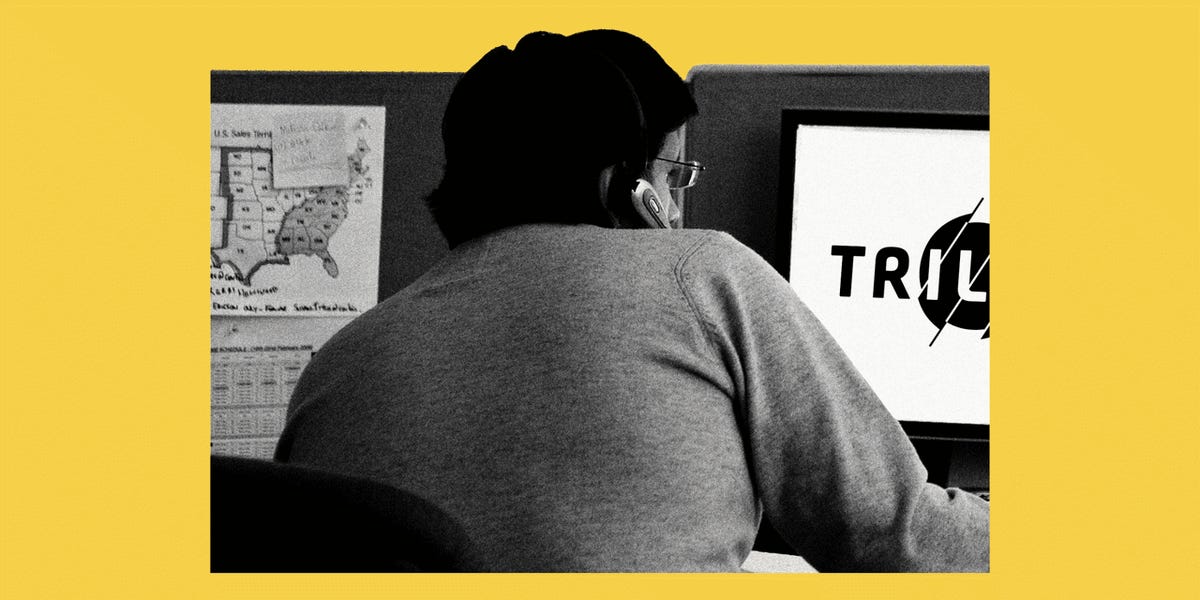
A group of staffers at Triller, a startup that raised over $400 million to challenge TikTok, say they haven’t received a paycheck in the past year, nor heard from their bosses in months. The company shut down their work emails and suspended their health insurance.
As far as the employees know, they were never fired or laid off. There were no termination emails or ominous HR meetings added to their calendars. The company simply cut them off, said eight impacted staffers across the firm’s various divisions, including marketing, events, and sales. It’s unclear how many employees, if any, are being paid today.
“My involvement at Triller is the most bizarre, mind-boggling experience I’ve had,” one staffer who worked on its events business said. “No communication. No, ‘You’re fired.'”
The employees, left in workplace limbo, are puzzled about what to do next and fuming about missed pay. One employee asked the company’s payroll processor, ADP, if they would receive W-2 forms for the 2025 tax year. An ADP representative told them that Triller had cut off services with the company, according to an email viewed by Business Insider.
“I have not left the company, the company has left me,” said another Triller staffer, who worked on its communications.
What makes the situation stranger is that Triller hasn’t gone out of business — it’s still a publicly traded company listed on the Nasdaq. In fact, the company announced in late June that it plans to acquire a “significant position” in SpaceX, priced at over $400 million, to be held as a “strategic treasury asset” on its balance sheet. Triller’s stock jumped on the news. Its market capitalization was about $60 million at Thursday’s market close, up from $5 million at the start of 2026.
Triller shows the chaos that can emerge when a startup repeatedly pivots in search of a workable business model. The company, like other short-video upstarts, hoped that a potential TikTok US ban would help its app take off. It snagged celebrity investors like Snoop Dogg, Kendrick Lamar, and The Weeknd, and at one point scored an endorsement from Donald Trump Jr. When the TikTok ban failed to materialize, Triller made a series of bets increasingly far from its original business — including its most recent SpaceX gambit.
Kyle Jensen, director of the entrepreneurship program at the Yale School of Management, said that while startups can stop paying employees when they run out of money, it’s quite unusual for one to simply go quiet.
“A typical startup would communicate about that,” he said.
Without a paycheck, some of Triller’s workers said they’ve had to dip into their retirement funds or other savings as they look for jobs.
A handful have filed wage claims with the California Labor Board or sued the company, alleging they’re owed hundreds of thousands of dollars in unpaid wages. In one lawsuit, filed in the Superior Court of California in Santa Barbara in October, six staffers say they’re collectively owed around $280,000. Triller has not responded to the suit in court. The company did not respond to requests for comment.
Dreams of a TikTok ban
Triller launched in 2015 as a music-focused video app popular in the hip-hop community. PitchBook called it a “treasure trove of dance and lip sync videos, many of which highlight the hottest new hip-hop.”
In late 2019, it announced investments totaling more than $10 million from a mix of popular artists and music executives, including Lil Wayne, Pitbull, and Marshmello.
The app surged in popularity after TikTok was banned in India in 2020, topping the app store charts in some countries. The company hoped it could pull off similar growth in the US that year when it looked like TikTok might face an ousting by the Trump administration.
It went on an all-out marketing blitz to position itself as the best TikTok alternative, attempting an offer to buy TikTok for $20 billion via a financing arrangement with the asset-management firm Centricus. TikTok’s spokespeople at the time called the bid “preposterous” and asked, “What’s Triller?” when Bloomberg covered it.
Donald Trump Jr. endorsed the app in 2020 as an “option that you can go to that’s an American company that’s not saving your data, that’s not going to eventually weaponize it against your children.”
Triller also made a big push to win over new creators. It recruited some of TikTok’s biggest stars, like Charli D’Amelio and Josh Richards, as spokespeople and offered them equity, fancy titles, rent-free mansions, and, in D’Amelio’s case, a free leased Rolls-Royce.
“Triller captured the moment,” said one staffer who worked on its marketing efforts at the time. “There were branded parties, a Jake Paul watch party, a movie premiere for ‘Space Jam 2’ — there was always something happening.”
The company’s efforts to puff up its chest and position itself as the predestined TikTok successor sometimes surprised its own workers.
In 2020, six former employees told Business Insider that the company had announced monthly active user numbers that were more than five times those shown on some internal dashboards. Triller’s CEO at the time said the workers were “disseminating inaccurate information” and it could “validate each and every one of our 239M plus” users.
TikTok survived, so what’s next?
When a US TikTok ban failed to materialize in 2020, Triller sought other growth opportunities.
It expanded into sports by hosting boxing matches between Mike Tyson, Roy Jones Jr., Jake Paul, and Ben Askren and featuring performances from artists like Justin Bieber and Doja Cat.
In 2021, it went on a company-buying spree, offering $10 million in cash and about $16 million in equity to acquire the Verzuz rap-battle video series from Timbaland and Swizz Beatz. It bought a handful of other businesses, like a combat-sports streaming app, a fight club called BKFC, and an AI marketing company.
The company’s M&A push contributed to a big loss on its balance sheet. Triller reported a net loss of over $700 million in 2021 on revenue of around $63 million. Its financial troubles deepened when it failed to turn its new media empire into a profit-making venture. Its accumulated deficit reached about $1.38 billion at the end of 2025, according to company filings.
“You had really good deal makers with a lot of cash to make deals, but there just was not the forward planning that would enable them to safely execute,” said Tuhin Roy, Triller’s former president of business operations, who joined in late 2020 to assist with its operations and investment strategy. “It was as if they thought the spigot of money would continue indefinitely and they would be able to raise whatever they needed whenever they needed it. And at some point, the music stops. Any company that pursues that growth strategy gets into trouble at some point.”
As Triller sought to go public to raise more money, it crafted a narrative for investors that connected its different businesses into a single enterprise.
“They wanted to seem like everything was meant to work together in some ways, for investors,” the staffer who worked on Triller’s communications said. “There was this idea of Triller One, how everything came together internally with shared resources.”
Money problems begin to spread
Before Triller cut off pay for some of its workers last year, it was having issues paying them on time, the eight employees said.
And delayed payments weren’t just affecting staff.
In 2022, the company’s namesake app lost access to popular songs after failing to pay its music licensing partners. That year, Timbaland and Swizz Beatz sued Triller, alleging they were owed $28 million in missed payments tied to their acquisition. The company settled by increasing the performers’ ownership stakes in Triller.
In company filings, Triller has said it owes millions of dollars in settlements or arbitration awards to partners like the record label Sony Music Entertainment, Samsung Electronics, and the events company Epic Sports & Entertainment. It could owe millions more if it loses lawsuits from other companies, including its former Los Angeles landlord.
A last big push to take on TikTok
When Triller went public in late 2024 via a reverse merger with a Hong Kong firm called AGBA, it said it was beginning a “transformation journey.”
“I thought we were going to get a big influx of money. We were going to pay our bills. We were going to have some working capital,” said Cole McMannus, who served as Triller’s senior director of technology. “None of those things ended up happening for us.”
The company made a big push to try to improve its fortunes in January 2025 when it again looked like TikTok might be banned. It launched a website to encourage TikTok users to download videos and reupload them to Triller. When TikTok was restored, and the Trump administration signaled plans to rescue the app, it felt like the fight was over, four staffers said.
“In my head, this was our last chance,” one staffer said. “Then the ban fell apart.”
A few months later, Triller’s app stopped working. Triller later said it had shut down the app because it had not “evolved enough to justify continued cash burn.”
Triller’s revenue from social media and sports streaming fell from around $5 million in 2024 to $0 in 2025. The company separately makes money from AGBA’s financial services business, which existed before the merger, but it has not been enough to offset the company’s losses. Triller said it halved its head count from 288 workers in December 2024 to 144 in December 2025.
Triller’s auditor wrote in an April filing that they had “substantial doubt about the Company’s ability to continue as a going concern,” listing working capital deficits, recurring losses, and limited cash resources as the reasons. The company was delisted from the Nasdaq in December for delinquent filings, but was reinstated in April after being given a chance to trade and meet the exchange’s $1 minimum share price.
Triller was sued by one of its own companies in April. In the complaint, the team behind its combat-sports streaming platform said Triller leadership abandoned it in late 2025 when it was in financial distress and becoming “insolvent and on the brink of no longer being a going concern.”
It is highly abnormal for a subsidiary company to sue its parent, said Benjamin Means, a law professor at the University of South Carolina.
“That’s not a normal corporate governance feature,” he said. “If the board of the subsidiary feels compelled to take that step, it sounds like there’s something badly amiss.”
Triller is now in the midst of a strategic reset as it retreats from some of its legacy businesses, the company wrote in prepared materials for its annual general meeting in June. It’s looking to salvage parts of its business that it says are working, like its boxing business, BKFC. It also wants to break into new media business lines, like micro dramas and casino-style digital games. And it plans to own SpaceX shares as a “strategic treasury asset.”
“This is the beginning of the next chapter,” Triller’s CEO Wing-Fai Ng said of the SpaceX deal. “Several additional recapitalization initiatives are underway.”
The US workers who have waited a year for an update on their missed paychecks, though, are still wondering whether they’ll ever get any resolution.
“It just all seems insane to me that there’s no repercussions for this,” the communications staffer said. “At any point, I could have been like, ‘What is the worst thing that could happen? The company could disappear, and they could ghost us forever?’ That actually happened.”
Read the full article here