

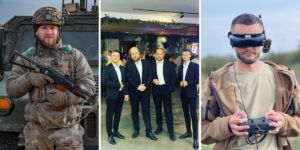



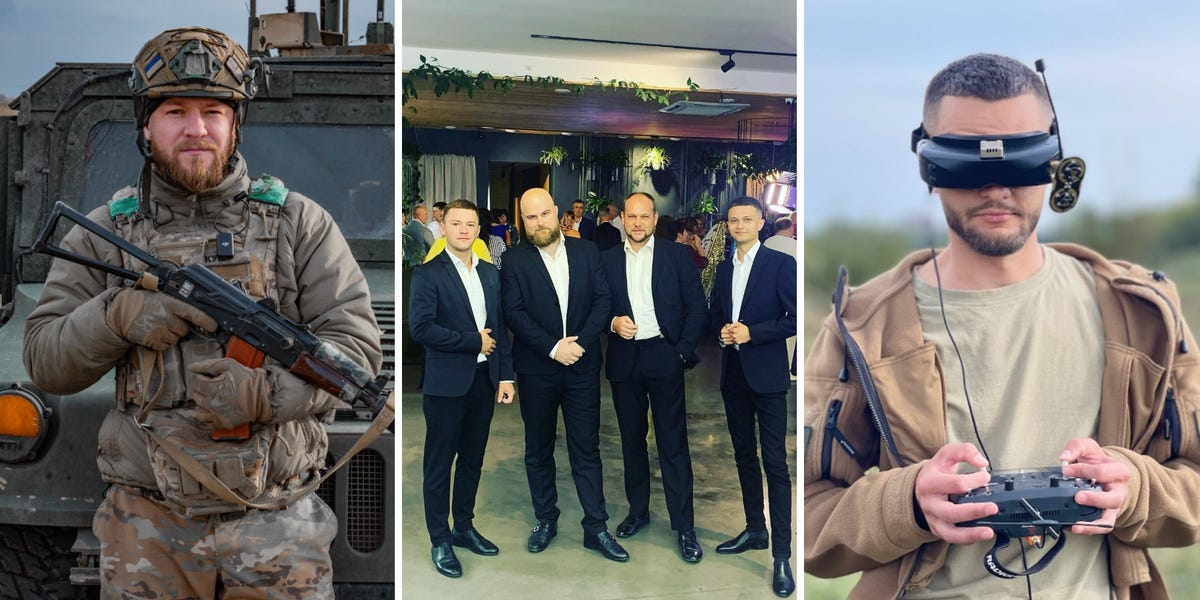
Before Russia, Vlad and Andriy’s battle was with COVID.
The pandemic had blown a gaping hole in the incomes of the two singers, who’d performed for a decade in an a cappella quartet. The group was named Luciano — after their hometown, Lutsk, and the Italian tenor Luciano Pavarotti — and they played folk and classical music at weddings, birthdays, and corporate events.
During lockdowns, the side jobs they relied on to stay afloat, like Vlad’s restaurant work and Andriy’s bartending, had disappeared as well.
But just as the coronavirus’s grip on Ukraine faded, Russia stormed in.
“At the beginning of the full-scale invasion, we were given some performances, but it was mostly to raise money for charity,” Vlad, now the deputy commander of the VORON drone battalion of Ukraine’s 100th Mechanized Brigade, told Business Insider.
As the war dragged on, he and Andriy swapped their tuxedos for the fatigues and olive sweaters of Ukraine’s military, serving in the VORON combat drone unit in Donetsk. Business Insider is identifying them only by their first names for security purposes.
Vlad enlisted first, joining the 100th in July 2022, when attack drones were a novelty and the war was still being measured in weeks. It’s been four years since — time that Vlad spent coordinating drone strikes and leading troops in the trenches.
Andriy, who’s pursued music since first grade, joined VORON in 2024 and runs its social media pages, editing and uploading video clips of battle drones striking Russian soldiers and vehicles.
“The opportunity to pursue our music was no longer an option, but I still wanted to do something creative,” said Andriy. “Vlad and a mutual friend reached out to me and asked if I could create content for the unit. And I thought: ‘Yes, why not?'”
The new world of war
Andriy and Vlad met in 2012 while studying at the Eastern European National University, where they’d sung together in the choir.
After starting Luciano there with two friends, they began building momentum in the regional scene, growing a niche audience and gig income with their operatic singing style, Vlad said.
In the early months of the war, his first assignment was to Volyn, a rear region, to guard the Ukrainian border with Belarus. At the time, the 100th was one of Ukraine’s territorial defense brigades, which consisted mostly of light infantry.
“Most of the missions were still run in traditional ways. Reconnaissance was still done sort of manually,” he said.
As the war progressed, Vlad learned to fly Chinese-made Mavic drones for scouting missions, then first-person-view attack drones as they grew more popular on the front line.
These cheap quadcopters, his squadmates realized at the time, provided a far more consistent hit rate against Russian soldiers than artillery.
“Little by little, we got better and better. We organized a team, and what started as a drone platoon has become quite a large unit,” Vlad said.
VORON, which means Raven, is now a multi-role unit that operates small quadcopters, heavy bomber drones, fixed-wing drones, and reconnaissance uncrewed systems.
For Andriy, his new job means he’s well-versed in running community engagement for war, creating and posting content on the unit’s Instagram, Telegram, and YouTube accounts.
Social media plays a major role in Ukraine, where individual units frequently upload battle footage to show donors how their money is spent. Many battalions and brigades also leverage large followings to increase their chances of securing volunteer funding or resources.
“There’s not always time to keep everything updated, but we try our best,” Andriy said. He also runs fundraising campaigns for VORON and works with allied volunteers who supply the unit with much-needed drones at no charge.
Civilian life, a world away
Should the war end, Vlad is unsure whether he will remain with the Ukrainian military. He said he believes the country’s defense industry will continue to expand and will need people with his experience and practical knowledge of drones.
The country said in February that its military-industrial base had grown more than 50-fold since the full-scale invasion began, producing $50 billion worth of weaponry a year. Kyiv, meanwhile, has been signing deals throughout the Middle East and Europe to provide drones or jointly manufacture key weapons.
“If the war hadn’t happened, it’s hard to say what my life would have looked like. Maybe I would have changed careers, but it’s difficult to imagine this pre-war time, pre-war life,” Vlad said.
Andriy hasn’t had time to think about returning to music. He and VORON are “still in a constant fighting state,” he said.
“I don’t like to speculate on what could have happened or not. We are here now, and that is what matters,” he said.
There are days when the pair still sing together. But they said performing at concerts or parties again is hard to even fathom.
“I’ve simply forgotten what civilian life is. What is life without war? Over the years, everything has changed so much,” Vlad said.
Read the full article here