




When I ripped open my first snail-mail art print from Trinity Shiroma, I couldn’t help smile.
Out of the envelope fell a beautifully intricate watercolor painting of Casa Battló in Barcelona that doubled as a postcard. It was wrapped in a handwritten letter explaining its architectural significance, and by a black-and-white print of Spanish tiles, meant to be colored in by the receiver.
I’ve never been big on postcards or snail mail, but holding this piece of art in my hands, I understood the hype.
Shiroma, a 25-year-old architect-turned full time artist in Florida, started her snail mail club in August, sending 5-by-7-inch prints of her artworks to subscribers around the US for $8.88 a month. She now has about 2,400 subscribers and earns about $16,000 a month from the gig.
“When I was working as an architect, this was more a documentation thing of my travels, something just for myself,” Shiroma said. “Then people told me that I should start selling them.”
She said that she started with commission work, priced above $200 per piece. However, her mail club became a way for her to make her art accessible and “get a steady income instead of going from commission to commission.”
Shiroma is one of many Gen Z artists around the world who have figured out a way to guarantee a stable monthly paycheck: subscription-based snail-mail clubs.
The concept is simple: an art print wrapped in a letter from the artist arrives at your doorstep every month you’re subscribed. The print often doubles as a postcard, and the artists also include additional interactive elements, such as coloring pages or stickers.
Most are priced under $10 a month, perfect for cost-conscious, analog-loving Gen Zers who like to spend on small luxuries and collectibles. As with all letters, you don’t know exactly when it’ll land, so recipients get a pleasant surprise from what feels like a pen pal.
Niloofar Abolfathi, a professor of entrepreneurship at the Singapore Management University, said the rise in popularity of snail mail fits a familiar pattern: the reemergence of products once thought obsolete, like film photography.
The hustle of packing hundreds of envelopes
Josephine Simon, like Shiroma, quit her architecture job to pursue art full time in August 2024. The NYC-based artist started her art business with detailed pen sketches of buildings, which took about three to four hours each with fine-tip pens.
She said she quickly felt burnout setting in and tried to find a way to get her art out to more people without painstakingly drawing every piece.
“I was taking 30 commissions a month, which was crazy,” Simon said. “I realized if there were a way to get freedom and be able to work for myself, that would be the ultimate goal.”
In August, she launched her print club, sending prints of her travel sketches from trips to Greece, Patagonia, Guatemala, and other places.
Simon, 26, now dedicates a week every month to her print club and the other three to working on commissions and other projects.
The most demanding part comes at the very end: packaging by hand for her 400 subscribers.
“It’s crazy to be doing this all yourself, but I see it as a nice break from other things I’m doing,” she said, adding that her family members sometimes help her out with the packing.
Shiroma said her process takes about a week from start to finish. She dedicates the first four days to making the art and writing the letter.
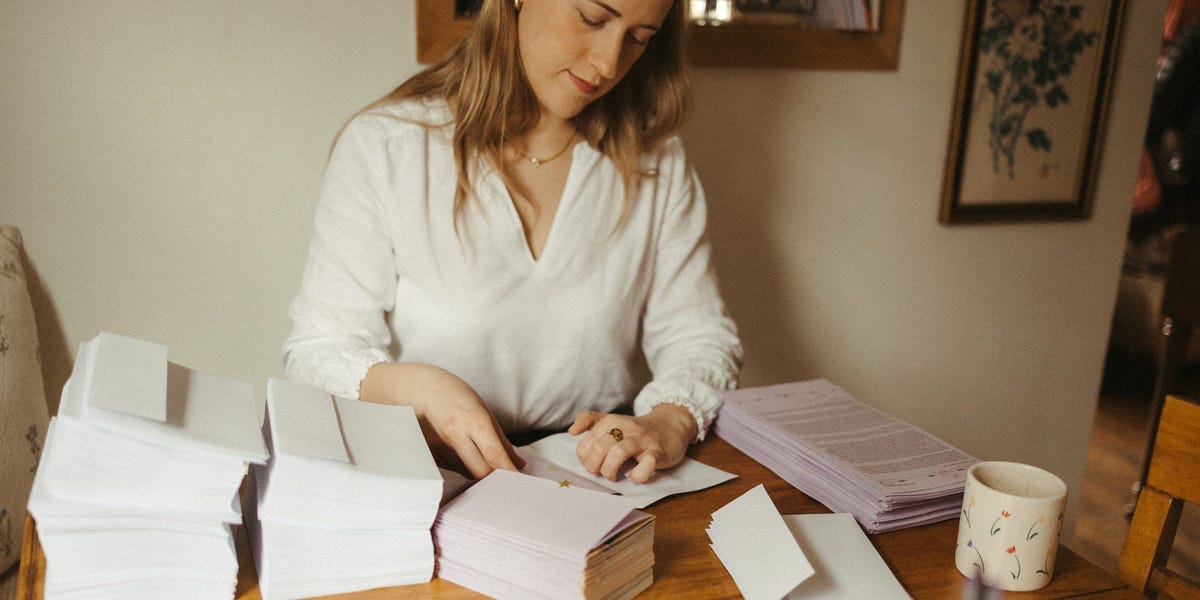
And the last three days are all about packaging. Her parents help her package 2,000 envelopes, and she handles the other 400.
A smart second stream of income
For Kiki Klassen, a Toronto-based artist, the snail-mail club began as a side hustle in October 2024. Her art prints feature whimsical and colorful illustrations, and her letters center on gratitude and everyday observations.
“I started this side hustle mail club art project as a means of escape because I was working as a barista,” Klassen, 28, said. “I didn’t like what I was doing, making coffee all day. It was a little bit grueling.”
Then she got a job as a social media manager at a Michelin-starred restaurant in Toronto, where she now works four days a week. Klassen said her “Lucky Ducky Mail Club” art side hustle now earns about 10,000 Canadian dollars, or about $7,200, monthly, close to double what she earns at her full-time job.
She said she’s too scared to quit her job and go into art full time.
“It’s still so new, I’m worried it’s all going to go away on a moment’s notice,” Klassen said. “At this rate, it’s only been growing.”
Abolfathi, the entrepreneurship professor from SMU, said that creative work often comes with highly variable income, making monthly subscriptions more reliable.
She said subscription models are attractive because they shift the business from a one-off transaction to an ongoing relationship with fans. They also help give customers a “taster,” which might convert them into higher spenders.
“It is a low-commitment model that benefits both sides: Artists gain better visibility into demand and more predictable monthly income, while customers make small, manageable commitments in exchange for regular physical mail,” Abolfathi said.
The clock is running out
The allure of analog letters is bringing in good money. But the artists Business Insider spoke to say they know they’re working on borrowed time before the trend dies down.
Abolfathi said the trend will stay with analog-loving Gen Zers, rather than move to a wider market.
One artist in Australia is already counting her days with her snail mail club.
Alessia Emanuele, a 26-year-old artist in Brisbane, quit her job as a law secretary in 2021 and has been dabbling with creative side gigs since. She now sells ceramics, stationery, stickers, and other merchandise. Her “Cloudy Club” snail-mail club, which she started last year, now has about 1,000 subscribers.
“I think that realistically, the snail mail club might have another year,” Emanuele said. She said the space was already oversaturated and would die soon, and she would return to ceramics — her core business — after.
“So I think I’ll ride that out till that’s sort of done,” Emanuele said.
Gwen Lee, a 32-year-old game animator based in Singapore who started a snail mail club in December, said that, in addition to being a source of income, it’s “something like self-healing.”
Lee’s game design work used to contain gruesome illustrations of killings and violence, and she felt heavy after work.
When working on her own art, she chose subject matter that made her feel calm. Her main character, Layla, is always surrounded by lush greenery and pretty pink flowers.
The idea for the club started like that — Layla delivering bouquets of peonies to her friends.
“The idea is that, no matter where you are in the world, just remember that someone in a little nook is looking out for you,” Lee said.
Read the full article here