



Highway 321 runs like a lifeline through Pigeon Forge, a tourist town in the US state of Tennessee. On either side of the road, at the foot of Great Smoky Mountains National Park, amusement parks sit alongside two-story motels and toothless fast-food joints with drive-through windows — it doesn’t get much more American than this.
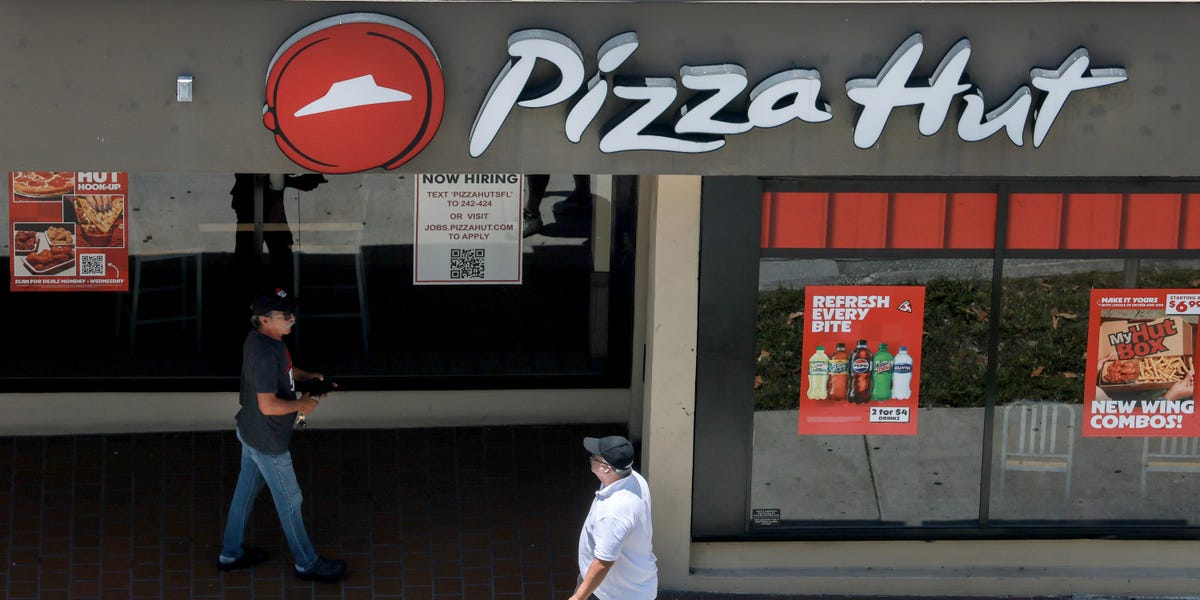
Inside a Pizza Hut branch here, televisions flicker against beige tiled walls, the windows have taken on a yellowish film, and garlands reading “We love USA” dangle from the ceiling, swaying wearily in the breeze of the air conditioning. After nearly half an hour’s wait, a young employee in an apron, who looks as though he’s simply killing time on his summer job, calls out a number: one large pepperoni pizza, $22, the crust thick and glistening with oil.
The whole scene feels bleak, almost like a swan song — as if the branch’s days were already numbered. And that is no coincidence. Across the country, one Pizza Hut location after another is shutting its doors.
For decades, the brand was so deeply embedded in the American collective memory that its decline once seemed unthinkable. When brothers Dan and Frank Carney founded their first restaurant in Kansas in 1958, they had to borrow the startup capital from their mother.
Just a few years later, the company’s then-revolutionary franchise business turned the pizza market upside down. The red roof became a cult symbol of fast food “Made in America” — not just in the US, but in dozens of other countries around the world, much like the McDonald’s golden arches.
Now the chain, owned by parent company Yum!, has been sold, split into two parts. Yum! Brands announced the deal in June; both transactions are expected to close in the third quarter, pending regulatory approval. Because Yum China has operated Pizza Hut’s mainland China business independently since splitting off from its US parent in 2016, the sale had to be structured as two separate deals: one for China, one for everywhere else.
A new owner of an aging brand
The US business and the rest of the world (except China) is going to Connecticut-based private equity firm LongRange Capital for roughly $1.5 billion. The firm, founded only in 2019, currently holds stakes in businesses as varied as the American fitness chain 24 Hour Fitness and ski lifts in the Austrian resort of Kitzbühel — a leap into global chain restaurants with nearly 20,000 locations is something of new territory for founder and managing partner Bob Berlin and his team.
Mainland China’s operations, meanwhile, are being taken over by Yum China Holdings which already operates KFC, Taco Bell, and, indeed, Pizza Hut as a licensee in China. For Yum China, the acquisition essentially means expanding a business it already runs on the ground — for roughly $1.2 billion, the company secures full brand rights to Pizza Hut’s by far most important international market. In China, the chain counts nearly 4,500 locations across 1,200 cities.
What the deal means for Pizza Hut’s future, and whether a rebranding is more likely than an even higher number of closed restaurants, seems unclear. Yum left a press inquiry unanswered as did the US buyer.
“Pizza Hut is still one of the most recognized names in the market,” Ishann Dhawan tells Business Insider. “If the economics improve, the brand will benefit. If they don’t, a rebrand won’t change very much,” says the restaurant-management consultant, based in France.
But whether the new owners can push through the long-overdue modernization faster than the old corporate machine remains to be seen in the coming years. Wall Street doesn’t seem entirely convinced yet: Yum’s stock, currently trading around $151, moved only slightly following the sale. After the share price tumbled roughly a year ago, it has barely recovered since.
“People haven’t stopped liking pizza,” says Dhawan. “The market is still enormous.” Rather, he argues, the way pizza is sold in the US has changed — and Pizza Hut slept through that shift. Customer behavior, he says, has changed fundamentally. Pizza Hut restaurants once stood for an experience — places you took the kids, celebrated birthdays, or held company parties: planned but relatively rare visits.
Today, it’s more about the simplicity of ordering and speed of availability — and, not least, price. The restaurants suddenly seemed out of step with the times. The comparatively large dine-in locations, with their high rent, staffing, and maintenance costs, no longer fit a market where customers above all expect fast delivery and easy ordering, Dhawan says. Competitors like Domino’s invested earlier in digital ordering systems and delivery infrastructure, lowering their operating costs in the process — however, their stock isn’t exactly skyrocketing either, losing about 13 percent over the last 12 months.
What LongRange plans to do differently is still largely an open question. In its own announcement, Berlin said the firm looks forward to “working with Pizza Hut’s talented team and franchise partners to drive its next phase of growth through investments that deliver consistently great food and experiences for customers.”
Restaurant Business editor Jonathan Maze noted that LongRange “focuses on operational and strategic improvements to generate a return, rather than financial engineering” — a longer-term approach than the debt-and-cost-cutting playbook typical of private equity, and, in his view, “exactly what the brand needs.”
But LongRange is a comparatively small player for the job: the firm manages around $1.7 billion in assets, a modest base for overhauling a nearly 20,000-store global system. It also has not said whether further closures beyond the 250 already announced under “Hut Forward” are on the table.
For Yum as a whole, the split looks almost like a relief. Pizza Hut had been dragging down the balance sheet for years while its sister brands delivered results. CEO Chris Turner handled the sale with sober, unsentimental language. He now appears to be focusing primarily on KFC as the group’s growth story: the chicken chain alone opened more than 600 new locations across 55 countries in the first half of 2026. Taco Bell, also part of the Yum group, has meanwhile been dealing with the fallout from a food-safety incident that dominated headlines in the US.
Chasing a bigger slice of the US market
Just how far Pizza Hut has fallen becomes clear on closer inspection of the numbers.
US sales recently shrank by roughly five percent, while archrival Domino’s grew. With $12.8 billion in global system sales and nearly 20,000 locations in 108 countries, Pizza Hut remains the second-largest pizza chain in the US — but with just over $5.5 billion in US sales, it trails far behind Domino’s $9.5 billion. In the first half of 2026 alone, around 250 unprofitable locations disappeared under the so-called “Hut Forward” program — a name that reads almost cynically for what has been a painful downsizing effort accompanied by numerous layoffs.
None of this is truly surprising. The entire American pizza industry has been in decline for years. According to National Restaurant News, pizzerias have slipped from the number-one spot to sixth place among the most popular restaurant categories, overtaken by coffee shops and Mexican restaurants. The number of pizza restaurants has been declining year after year since 2019. Oliver Ostertag, a restaurant-management expert at software provider PAR Technology, sees two forces pulling at the industry simultaneously: inflation is leading customers to order less often, while third-party delivery platforms have absorbed margin, customer data, and loyalty that once belonged to the chains themselves.
On top of that, rising labor costs are being compounded by tariffs imposed by President Trump, which are pushing up the cost of ingredients, Ostertag writes in a piece for National Restaurant News — squeezing Pizza Hut’s profit margins ever further.
And finally, the trend toward healthier eating has likely taken a toll on the chain as well — a large pizza there contains between 2,000 and 4,000 calories. The characteristically thick crust and oil-glistening surface mean franchise pizzas can pack in twice the calories of a wood-fired restaurant pie.
The trend is unmistakable, particularly in the country’s urban centers: instead of pizza piled high with extra cheese, diners are increasingly reaching for “clean protein” dishes, tofu, and other healthier alternatives. That may also help explain why competitors are feeling the squeeze too. Papa Murphy’s, with more than 1,000 locations across 34 states, recently announced the closure of 68 unprofitable outlets. Papa John’s, meanwhile, is set to shutter around 300 locations after a sharp drop in sales.
Just how deeply Pizza Hut was once woven into American everyday life is captured by a 1995 commercial: Donald Trump appeared alongside his ex-wife, Ivana, to promote the newly launched Stuffed Crust pizza. The couple, who had split just three years earlier amid a very public divorce, poked fun at their own multimillion-dollar settlement in the spot — the punchline being who had earned the right to the last slice of pizza.
A brand once woven into the fabric of American pop culture: that status is long gone for Pizza Hut. On Instagram, the company recently posted videos and photos from a “Throwback Dinner,” to which influencers were invited — apparently in an effort to make the brand feel modern again. Toasts were raised to the good old days in a restaurant done up in retro style. The upcoming years will show whether the company can go back to the glory of its long-past heydays.
This story originally appeared in Germany’s Welt, and is courtesy of the Axel Springer Global Reporters Network, which harnesses the resources of the company’s newsrooms to publish ambitious scoops, investigations, interviews, opinion pieces, and analysis. It allows journalists — including those from POLITICO, Business Insider, WELT, BILD, Onet, and Fakt — to collaborate on major stories for an international audience of hundreds of millions across platforms.
Read the full article here