




With inflation heating up, Americans’ spending power is under stress. But in a few sectors, wages are still growing faster than inflation.
New data published on Wednesday showed inflation in May exceeding 4% for the first time since 2023 and outpacing private-sector wage growth for the second-straight month, at 4.2% and 3.4%, respectively.
The chart below shows the range in wage growth based on the 12-month change in average hourly earnings:
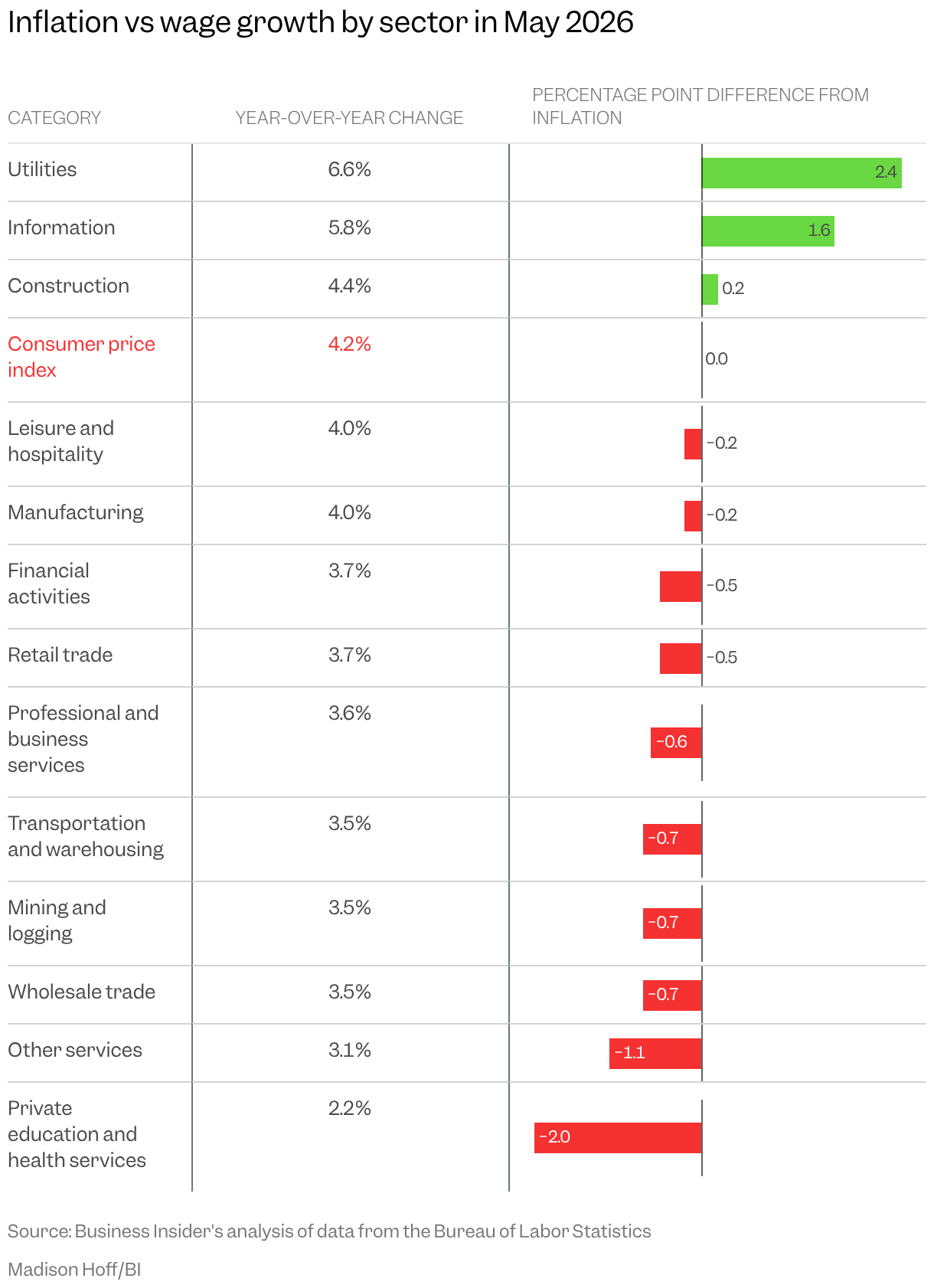
It’s important to look at wage growth and employment changes in tandem. Wage growth in the information sector, which tends to be higher than in other sectors, was more than a percentage point above inflation. However, employment in the sector is down 11% from its most recent peak, in late 2022, and down 1% since January.
“One possibility here is that workforce reduction in the information sector is impacting lower wage workers more dramatically, pushing the average hourly earnings of the remaining workforce upwards,” Elizabeth Renter, senior economist at NerdWallet, said in an email.
Private education and health services had the lowest wage growth among the major sectors, but had the highest 12-month net job growth last month. Healthcare made up most of the net 610,000 gain in private education and health services, at 458,100.
“Wage growth with a shrinking employment picture means a walled garden with little opportunity to enter, while jobs growth with sluggish wage growth means difficulty keeping up with inflation,” Daniel Zhao, the chief economist at Glassdoor, said.
Utilities and construction were the other two major sectors outpacing inflation.
“Employers are hiring in these sectors and likely coming up against issues with labor supply,” Renter said. “Increased labor demand (from employers) and a shortfall of supply (in the form of not enough workers) can push wages up as companies try to entice new candidates.”
Zhao said data center construction and higher electricity demand could be contributing factors. “Utilities employment has grown steadily since 2021 after remaining largely unchanged from 2005—2020, coinciding with a period of growing electricity demand,” he said. “Construction is a large industry and data center construction is just one slice of the pie.”
Kory Kantenga, LinkedIn’s head of economics for the Americas, said that even when wage growth was outpacing inflation, that didn’t mean all workers were benefiting from those gains. Not everyone has been getting an annual raise, for instance. Others may have gotten raises that didn’t keep up with inflation.
Read the full article here