



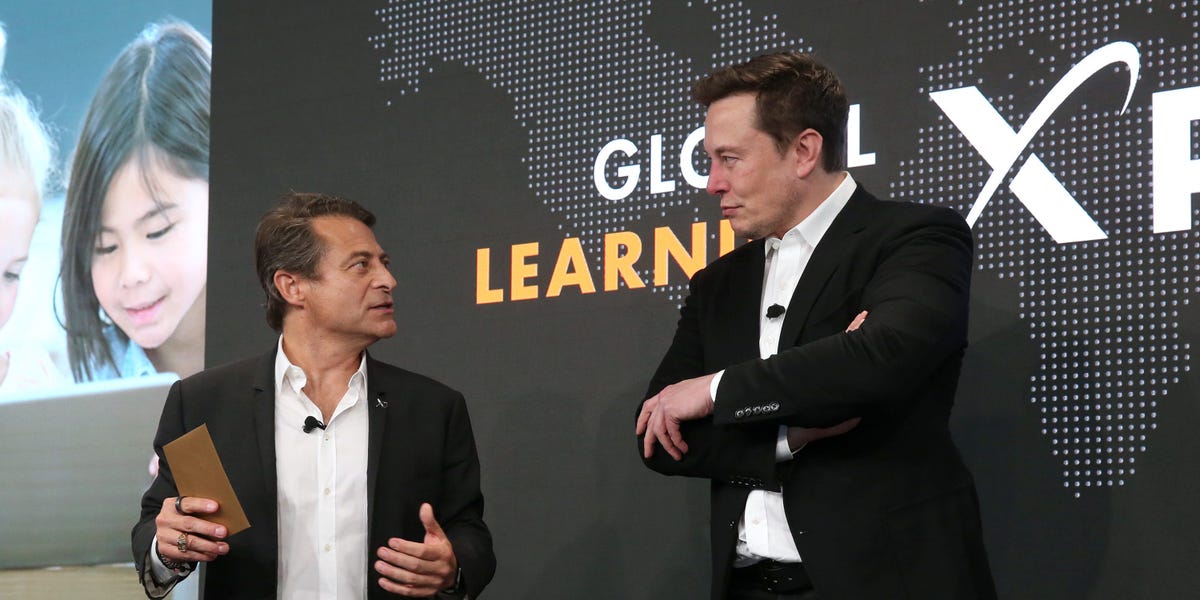
Elon Musk says an AI-driven future will mean government handouts and citizens not needing to save for retirement, so we asked his longtime friend and fellow techno-optimist, Peter Diamandis, to break down the argument behind those claims.
“Don’t worry about squirreling money away for retirement in 10 or 20 years,” Musk said on a January episode of the “Moonshots with Peter Diamandis” podcast. “If any of the things that we’ve said are true, saving for retirement will be irrelevant.”
“So I’m not sure I’m going to be passing that advice along,” Diamandis told Business Insider by video call, before launching into an explanation of Musk’s prediction.
The serial entrepreneur, founder of the XPRIZE Foundation, and author of “Abundance: The Future is Better Than You Think” said that Musk’s argument centers on his view that technological progress will generate so much wealth, and make things so cheap, that the government will be able to provide a “universal high income” (UHI) to every American, meaning they won’t need a nest egg in old age.
“It’s a world in which every man, woman, and child on the planet can have access to all the food, water, energy, healthcare, and education that they need and desire,” Diamandis said.
Musk echoed that view in an X post last week. He endorsed the federal government issuing checks to all as the “best way” to deal with job losses from AI.
Diamandis said he also expects AI to cause unemployment, “and the only thing I can imagine the government’s going to do is write COVID-style checks to help stabilize people.”
He added that Musk expects advances in AI, robotics, and energy to boost corporate profits and GDP, helping to cover the cost of the checks, and “drive the price of everything down through the floor,” making the money go further.
Diamandis envisioned the government paying $3,000 a month in universal basic income (UBI) to help people meet their basic needs, then once goods and services become massively cheaper, “that money goes much, much further.”
He pointed out that many technologies have plummeted in cost over time, including bandwidth, digital communication, and access to intelligence.
Nodding to Musk’s comment on his podcast that people could have “whatever stuff they want” in an abundant future, Diamandis said there’s a “point at which AI and robotics and advanced manufacturing are making so much that you could not desire enough to saturate this manufacturing ability.”
The space enthusiast, who recently launched the Vision XPRIZE to incentivize filmmakers to paint more uplifting pictures of the future in their work, acknowledged that vision clashes hard with reality.
He said that “people today are facing a lot of real challenges, whether it’s electricity costs, or costs of food, or not getting a job,” so a comment like Musk’s “rings hollow if that’s the situation you’re in.”
Even so, Diamandis said he subscribed to Musk’s vision.
“I like to say, Elon’s actually never been wrong,” he said. “He’s just not always correct on timeframes.”
Diamandis wrestled with Musk’s prediction that work will become optional in an abundant future. He said there could be a “split” between consumers, who “live a great Netflix lifestyle” where a “robot brings you your beer and your popcorn and you’re living off UBI checks,” and creators who harness new technologies to make their “dreams come true.”
He pointed out that many people work jobs not out of passion but to provide for their families or have health insurance, and would be finally free to quit them.
“There was never any way of getting off that roller coaster ride of working and surviving,” he said. Now someone can use AI to start a business for “tens of pennies on the dollar” compared to 20 or 30 years ago, he said.
Governments should think carefully before paying everyone so much that they can opt out of work, Ekaterina Abramova, a London Business School professor and expert in machine learning, told Business Insider.
She warned that “prolonged detachment from meaningful economic activity risks skill atrophy and reduced long-term productivity,” so a universal income must be “paired with strong incentives for participation in learning, entrepreneurship, or socially valuable work, rather than passive consumption.”
Read the full article here