



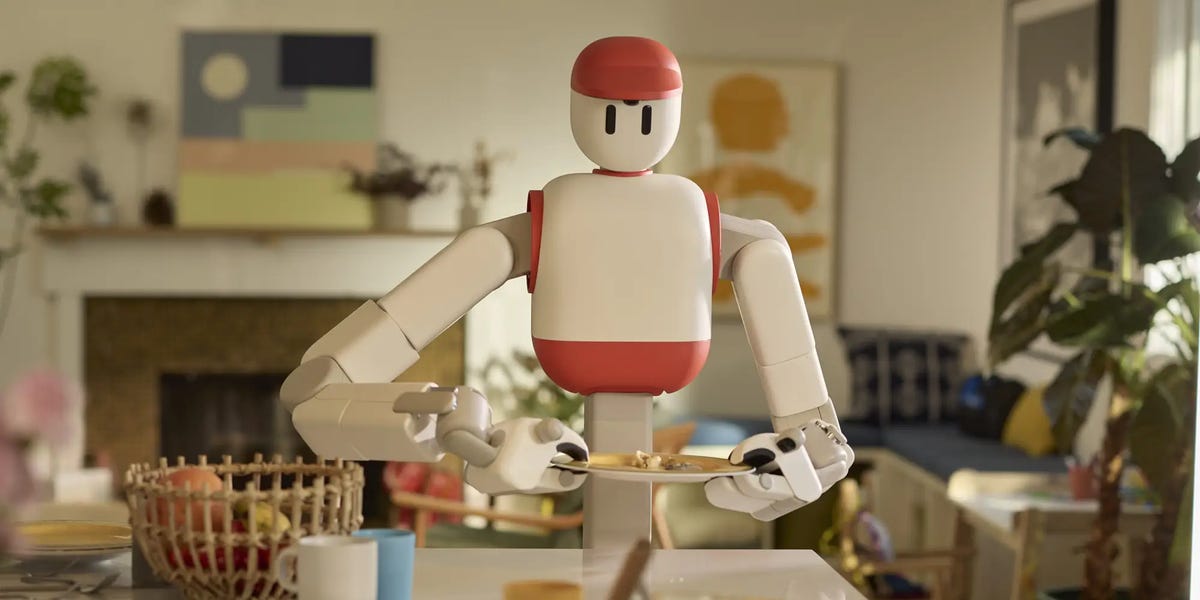
In the race to bring autonomous robots into the home, Sunday Robotics says it has solved one of the field’s hardest problems: getting a robot to work in homes and handle objects it has never seen before.
On Thursday, the Bay Area-based startup unveiled ACT-2, a new AI model that powers Memo, its wheeled home robot. Sunday said that Memo folded laundry successfully more than 99% of the time when tested in unfamiliar homes, and on garments it had not been specifically trained to handle.
“I think 2026 will be when the timeline for autonomous home robots shrinks in a very drastic way because of this breakthrough,” Sunday Robotics CEO and cofounder Tony Zhao told Business Insider.
For decades, home robot companies have struggled to build machines that are both reliable and adaptable. A robot may master a task in a controlled setting and falter in a new room or when handed an unfamiliar object, like folding a scarf when it’s been trained to fold jeans. Sunday says ACT-2 can carry what it learns in one environment into the next, potentially avoiding the costly process of retraining Memo for every home.
Sunday raised $165 million earlier this year at a $1.15 billion valuation.
Sunday proposed a new robotics standard
Sunday also proposed a new industry standard for measuring progress in robotics. Called a “Solve,” it is meant to distinguish reliable capabilities from flashy demos that often omit how many attempts a robot needed or the conditions under which it was tested.
“Each demo is a different robot, setting, and object, and it’s really hard to figure out if we’re progressing,” Zhao said. “It’s like apples-to-oranges comparisons.”
Under Sunday’s framework, companies would clearly state what a robot can do, where it was tested, and how much extra training or human assistance it requires in each new setting.
Sunday considers laundry folding Memo’s first Solve capability.
To reach that level of reliability, Sunday trains ACT-2 in two stages. First, it learns basic physical skills from people performing everyday tasks while wearing sensor-equipped gloves that Sunday developed in-house. The gloves cost about $200 to make and mirror the shape and sensor layout of Memo’s hands, allowing human movements to be translated more directly into the robot’s movements.
Then, Sunday’s in-house fleet of robots enables the model to learn from its mistakes. With its initial knowledge, the robot can learn new skills and improve its performance within minutes.
“Memo’s performance in our office almost perfectly transfers to its performance in the wild,” Zhao said.
He added that the company has spent the last few months testing the model in employees’ homes and Airbnbs to see how well it performed in unfamiliar environments.
Sunday competes with other home robots
Zhao, who left Stanford’s computer science Ph.D. program to build Sunday, and cofounder Cheng Chi started the company with a small team in a Silicon Valley hacker house in 2024. They chose to focus on the home because, unlike a factory, it is messy and unpredictable. Building a robot that can handle that, Zhao said, is the clearest path to physical artificial general intelligence, a term for AI capable of performing a broad range of real-world tasks as well as or better than humans.
Sunday has since grown to more than 100 employees. Conviction’s Sarah Guo, who wrote the company’s first check, previously told Business Insider that she backed the founders because they were “completely cracked researchers” with “a real commitment to building products that got deployed and an Elon-style religion on delivering a mass-consumer product.”
Sunday’s advance comes as several companies prepare to put robots in homes. Y Combinator-backed Weave Robotics plans to begin shipping Isaac 1, a $7,999 wheeled robot that folds laundry, in California this fall. 1X aims to start delivering its $20,000 NEO humanoid around the same time, while Tesla is working toward bringing Optimus into homes.
Sunday plans to place Memo in homes through a beta program this fall. Zhao declined to say how many homes would participate.
Memo will operate autonomously in homes, Zhao said, with a remote operator stepping in only when customers need help, similar to the remote assistance used by Waymo’s self-driving cars. Unlike many robotics companies, Sunday does not plan to use those interventions to collect training data from customers’ homes.
“Being fully autonomous is the best way to build trust,” Zhao said. “We are not trying to creep in a teleoperator into your home to collect your data so that we can get our model to be better.”
Sunday previously demonstrated an earlier model, ACT-1, clearing a dinner table, loading a dishwasher, and pulling a shot of espresso. The company wants ACT-2 to eventually make those capabilities more reliable, starting with laundry. It is learning to vacuum, organize toys, fasten zippers, and make coffee.
Those tasks, Sunday said, are not yet reliable enough.
Have a tip? Contact Rya Jetha via email at [email protected] or Signal at rjetha.07. Use a personal email address and a nonwork device; here’s our guide to sharing information securely.
Read the full article here