


SpaceX’s IPO filing is written for Wall Street — but parts of its 277 pages read like a sci-fi novel.
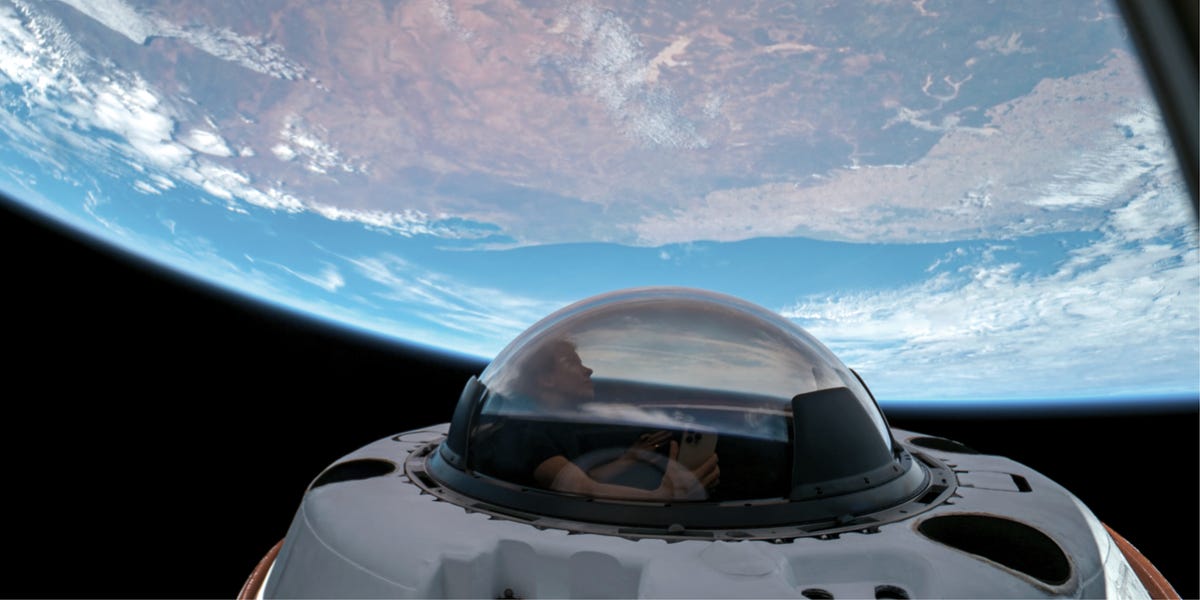
Sprinkled among the necessary financial disclosures for Elon Musk’s rocket company are a bevy of glossy images of his futuristic vision, planets, and products floating in space — tied together with a whole lot of nerdy nomenclature.
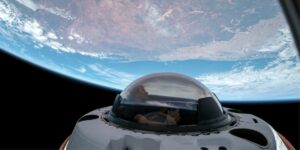
The tone is set right out of the gate with the first image.
No, that’s not a still from “Interstellar,” it’s an image of one of SpaceX’s rocket ships.
And here’s a photo that drives home the intensity of some of SpaceX’s listed risk factors…
This isn’t new to Musk, who is an avid science fiction fan. He has a long history of sneaking geeky references into names, internal memos, and product roadmaps.
The filing shows that Musk continues to lean into nerd-dom, and in many ways, that makes sense. After all, he’s selling investors quite literally on rocket science.
Some of that science has yet to materialize, as this disclosure makes clear:
The company acknowledges that its vision involves bets in “future markets” that literally don’t exist at the moment, though it believes “these industries will develop over time.”
So how nerdy does it get?
Grab your helmet, buckle up, and let’s launch into it.
‘Cryogenic propellant transfer in microgravity’
Really rolls off the tongue, doesn’t it? “Cryogenic propellant transfer in microgravity.” Basically, SpaceX doesn’t want to send its rockets back to Earth every time they need to refuel.
So, the company has to solve two problems with space’s harsh environment that make refueling unlike filling a car’s gas tank: It’s cold, and there’s far less gravity than on our home planet.
“Cryogenic propellants” is another way of saying super-cold rocket fuel. SpaceX flags the transfer of that fuel on Mars and the moon’s “microgravity” as a challenge in its filing, because the fuel doesn’t always settle at the bottom of the tank the way it would on the ground.
Put simply, the company still needs to figure out how to build rocket gas stations in space.
‘Kardashev Type II’
“We believe the next paradigm shift for humanity is the creation of a resilient, perpetually expanding spacefaring civilization that drives continuous innovation across new frontiers, ultimately propelling us to Kardashev Type II status,” SpaceX writes.
Here, SpaceX is referencing the Kardashev scale, a theoretical framework developed in the 1960s by Soviet astronomer Nikolai Kardashev. It ranks civilizations by the amount of energy they can harness.
A “Type I” civilization can use energy at the scale of its home planet. A “Type II” civilization can capture the full power output of its star.
Humanity is generally thought to sit somewhere below Type I, which makes SpaceX’s mention of “Kardashev Type II” a very big swing for an IPO filing.
In the filing, SpaceX defines the term as “a civilization that harnesses the full energy output of our Sun.”
‘The light of consciousness’
In the filing, the company says its mission is to “extend the light of consciousness to the stars,” which is a lofty way of saying “human intelligence,” with extra cosmic drama, and ensure mankind doesn’t put all its eggs in one planetary basket.
The phrase fits SpaceX’s long-running argument that becoming multi-planetary is a backup plan for human civilization. It appears 10 times in the S-1.
‘Orbital AI compute’
This is SpaceX’s way of saying it wants to put data centers — the protest-inducing buildings helping fuel the AI boom — in orbit.
The pitch: Space could help solve some of AI’s earthly problems, such as power constraints, water use, and cooling costs.
The catch: SpaceX needs to figure out how to build, launch, operate, and eventually refresh a fleet of AI satellites.
There is growing interest in the concept of data centers in space, though OpenAI CEO Sam Altman, Nvidia CEO Jensen Huang, and Amazon cofounder Jeff Bezos have all said it could take a while.
‘Asteroid mining’
You’d be forgiven if your mind immediately jumped to the 1998 film “Armageddon” starring Bruce Willis. Thankfully, SpaceX’s vision for asteroid mining doesn’t involve a nuclear bomb.
The company lists “asteroid mining” as one of its future markets (one that doesn’t exist yet). It envisions a world where materials such as nickel, cobalt, iron, and even water could be extracted from asteroids rather than dug up on Earth.
Drill, baby, drill!
‘Lunar mass driver’
So this one is likely directly inspired by an actual sci-fi novel. Also referred to in the past by SpaceX as an “electromagnetic mass driver,” it’s basically a slingshot on the Moon.
The concept is reminiscent of an instrument in the 1937 science fiction novel “Zero to Eighty.”
Instead of burning fuel, the system would use electromagnetic force to fling cargo off the lunar surface and into space.
It’s the kind of idea that sounds absurd on Earth; however, it makes a little more sense on the Moon, where gravity is much weaker.
‘Starman’
This one is already a reality, floating far out in space.
“Starman” comes up in the filing where SpaceX mentions the Falcon Heavy rocket’s maiden test flight. The rocket carried Musk’s own Tesla Roadster into orbit in 2018 — complete with a mannequin dressed as an astronaut.
SpaceX called the dummy “Starman,” a nod to the David Bowie song about an alien messenger. Yes, there is a literal Starman sitting in a Tesla, deep in space. In the words of Bowie, let all the children boogie.
It’s a quintessentially Muskian stunt, and a good reminder that the SpaceX CEO has pulled off the truly absurd before.
Musk’s rocket company certainly kept things interesting with its Wednesday filing, as others were quick to point out online.
Venture capitalist Kevin Kwok called it the “most enjoyable S1 read in a long time.”
“Reads so easy like sci-fi or fiction,” he added.
Read the full article here