




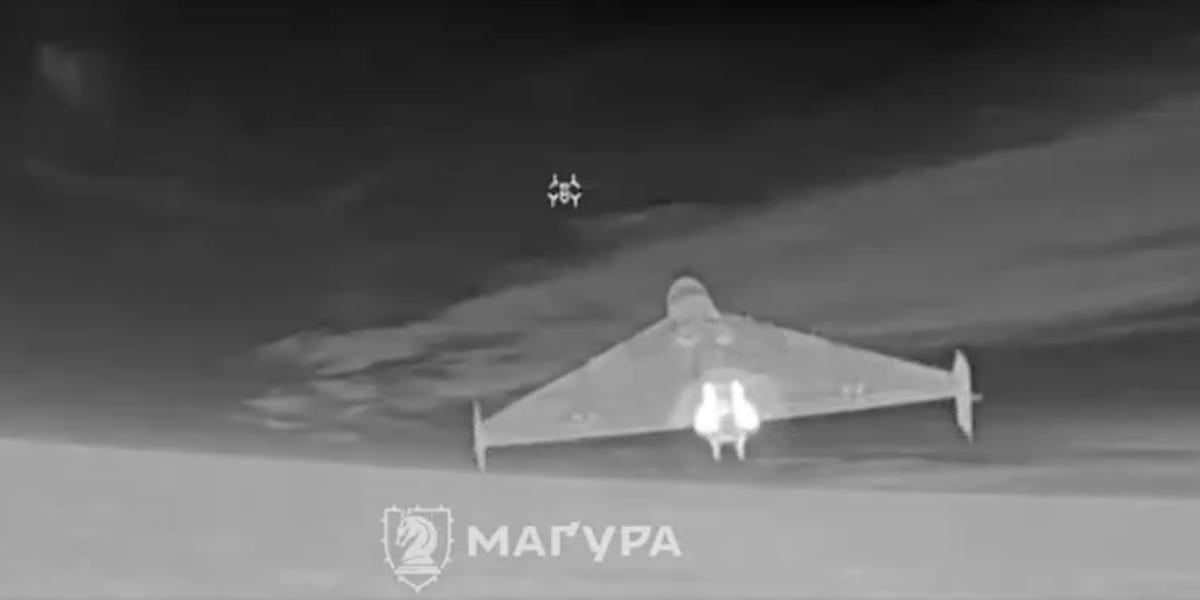
KYIV, Ukraine — Russia is launching a growing number of one-way attack drones that are controlled remotely by operators, allowing them to hunt moving targets in Ukraine and also evade interception.
Russia’s deadly one-way Shahed-style attack drones are typically launched with pre-programmed coordinates; they fly in waves along fixed routes and strike planned targets in Ukraine. Many are shot down by air defense crews during nightly bombardments.
However, Russia is increasingly deploying operator-controlled Shaheds in its attacks, Oleksiy Vyskub, Ukraine’s first deputy defense minister, told Business Insider in a recent interview.
Vyskub, speaking through a translator, said that Russian operators can maneuver the Shahed-type drones, flying them at low altitudes and evading interception, since they have more situational awareness than the autonomous ones flying toward pre-determined targets. These drones are also a greater threat to Ukraine.
“The most critical component is that these controlled Shaheds may attack dynamic targets, which include our aircrews — our teams,” he said.
Ukrainian officials and drone experts have previously observed the emergence of Shaheds controlled by Russian operators, who can pilot them from hundreds of miles away in real time, as if they were traditional strike or reconnaissance drones or first-person-view (FPV) drones.
Russia is equipping its Shaheds with mesh modems to relay signals from drone to drone across the sky, or via antennas in occupied regions of Ukraine, Russia, or Belarus, Ukrainian officials have said.
Samuel Bendett, an expert on Russian drones with the Center for Naval Analyses, a US research organization, told Business Insider that the operator-controlled Shaheds represent “a growing danger for Ukrainian civilian and military targets,” given they are effectively precision-strike weapons like FPV drones.
“Most Shahed targets included stationary civilian ones,” he explained; however, “the new ability for the pilot to maneuver this drone enables the [Shahed] to target many moving military targets such as large vehicles, military systems,” and people.
Bendett said that because the Shaheds carry large warheads, “the damage from such a strike can be significant.” One example of this is Russian drone attacks on Ukraine’s rail network, which have proven deadly and destructive.
Beyond being able to strike moving targets, Russia’s operator-controlled Shaheds are a major challenge for Ukrainian air defenders because Russian pilots can use the built-in cameras to take evasive maneuvers against interceptors.
The Shaheds can evade Ukrainian interceptor drones or engage Ukrainian helicopters used for air defense. Some Shaheds have been spotted carrying air-to-air missiles, making them a significant threat to aircraft.
Neither Russia’s defense ministry nor its US embassy responded to a request for comment on the tactic.
More broadly, Russia is attacking Ukraine with a growing number of Shaheds as Moscow invests heavily in its drone production and expands launch infrastructure at various bases.
Mykhailo Fedorov, Ukraine’s defense minister, recently told reporters that the number of Shahed launches has increased by 35% month over month since the start of the year.
Russia launched over 6,500 Shahed-type drones in April, with an average daily launch rate of 219 drones — surpassing previous records of 208 in March and 203 in July 2025, according to data collected by the Institute for Science and International Security, a US-based think tank.
Russia has also introduced new tactics during its drone attacks. Most bombardments typically occur overnight, but Moscow has started to launch prolonged strikes that begin during the day and last for hours into the night, eventually combining drones with missiles.
Earlier this month, for instance, Russia launched some 1,500 drones and missiles at Ukraine in continuous waves over a period of nearly 24 hours, killing and injuring dozens of people.
Read the full article here