




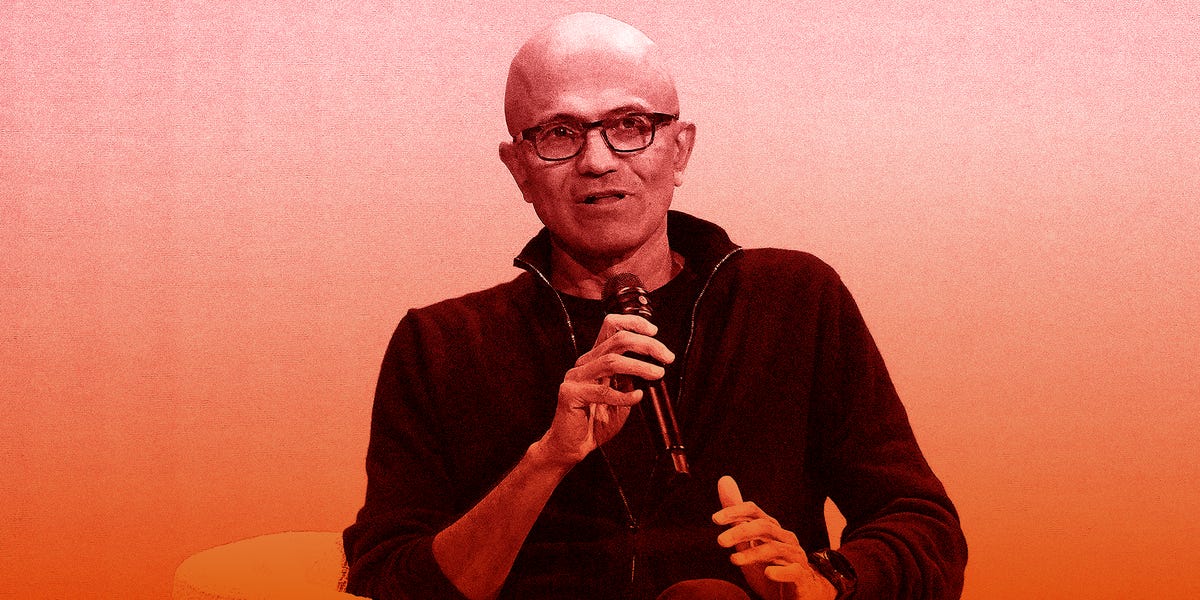
Three years ago, Satya Nadella catapulted Microsoft to the front of the AI race and became “like a superhero,” one recent former Microsoft executive said.
In February 2023, after betting early on OpenAI, the CEO unveiled Microsoft’s AI-powered Bing search engine before a packed audience outside Seattle, and declared a war on Google’s search dominance. “A race starts today,” he said. Waves of adulation followed. When Nadella helped navigate OpenAI’s board crisis later that year, Bill Gurley called it an “amazing shift in corporate reputation.” CNN Business chose Nadella as the CEO of the Year.
Inside Microsoft and across the tech industry, Nadella was hailed for seizing the future. Now, his legacy is at stake.
Microsoft’s stock is down more than 24% from 12 months ago, significantly worse than the rest of the Magnificent 7. Investors have grown increasingly skeptical that the company’s multibillion-dollar AI bet will deliver. Copilot, Microsoft’s flagship AI product, lags behind other AI tools like ChatGPT and Claude. LinkedIn has drawn criticism for becoming flooded with AI-generated hustleporn. Xbox’s business is “not healthy,” its CEO recently said, and undergoing layoffs and restructuring as it tries to justify the company’s record-breaking $69 billion Activision Blizzard acquisition.
And inside the company, employees are questioning Microsoft’s plans to spend a record $190 billion this year to build AI infrastructure. As generative AI changes how people work, write software, and consume information, three of the company’s core businesses hang in the balance: Microsoft 365, GitHub, and Azure. Investors will get a report card on these challenges on Wednesday, when the company releases its fourth-quarter earnings results.
As AI adoption spreads through corporate America, every software company is fighting to fend off the so-called SaaSpocalypse. But the battle is particularly fraught for Nadella’s Microsoft, which made an early and loud bet on AI to propel the company’s future. Now the company’s north star has also become a potential noose.
For decades, Microsoft’s productivity software has been the default homeroom where knowledge workers start their day. They opened Word to write, Excel to analyze data, and PowerPoint to build presentations. Now, millions of those workers are beginning to do all these things directly inside AI tools. Gartner analysts earlier this year predicted AI would threaten to dethrone traditional productivity suites like Microsoft 365 and Google Workspace in a $58 billion market shakeup.
Microsoft executives point to continued growth in Microsoft 365 and increasing Copilot adoption as evidence customers still want Microsoft’s products at the center of their workdays. “The M365 business is seeing tons of new adoption and M365 Copilot usage,” one executive said, who said the company is specifically chasing computing capacity to meet the demand.
GitHub faces a similar challenge. Since acquiring the software development platform in 2018, the company has held a dominant position with developers and had an early advantage in AI coding through GitHub Copilot. And it continues to grow: The platform recently had its “best month ever,” an executive told employees in internal meeting comments viewed by Business Insider, though he didn’t say by what measure.
But upstarts have swarmed in, as millions of engineers have adopted Cursor — which SpaceX recently announced plans to acquire for $60 billion — and Anthropic’s Claude Code. As Business Insider previously reported, executives have discussed internally the need to overhaul GitHub to better compete with those AI-native coding tools. AI demand has also strained Github. As AI usage surged GitHub has experienced dozens of major outages this year.
The company is also struggling broadly to keep up with the demand for compute capacity. Despite this crunch, Microsoft is raising salespeople quotas for selling its cloud computing platform, Azure, some by 30% this year, according to people familiar with the change.
Azure remains Microsoft’s fastest-growing strategic business, but internally executives say it has become a constant balancing act. Demand for computing infrastructure has outpaced the company’s ability to build new capacity, forcing Microsoft to make difficult decisions about where its resources go. Even with this year’s $190 billion capital expenditures — largely to expand data-center capacity for AI workloads — executives say the company is still constrained.
Earlier this year, Chief Financial Officer Amy Hood suggested Microsoft was prioritizing scarce computing resources for its own AI products before allocating the remaining capacity to Azure customers.
“The first thing we’re doing is solving for the increased usage in sales and the accelerating pace of M365 Copilot, as well as GitHub Copilot, our first-party apps,” Hood said during Microsoft’s January earnings call. “Then we make sure we’re investing in the long-term nature of R&D and product innovation… Then what you end up with is the remainder going towards serving the Azure capacity that continues to grow in terms of demand.”
Why would Satya prioritize growing Adobe over growing M365?Microsoft executive
If Microsoft had allocated the GPUs that came online during the first half of its fiscal year to Azure instead of its own AI products, Azure growth would have exceeded 40% instead of 39%, Hood said. Microsoft previously reported $75 billion in Azure revenue for its 2025 fiscal year.
That earnings report triggered one of Microsoft’s biggest post-earnings stock declined by more than 10% as investors questioned the company’s slower Azure outlook despite record AI spending and growing concerns that Microsoft was diverting capacity away from cloud customers.
Executives who spoke to Business Insider say those tradeoffs have intensified.
Microsoft is so desperate for capacity that it’s turning to competitors to help relieve some of those constraints. Following a series of GitHub outages, Amazon bailed Microsoft out. The company also explored leasing Oracle cloud infrastructure but Microsoft walked away due to security and compliance concerns.
Microsoft is now seeking additional cloud capacity from other providers, including evaluating Amazon and Google, according to people familiar with the discussions. “We are shopping for capacity everywhere,” one of those people said.
While prioritizing internal services has a mixed reception on Wall Street, the strategy is clear within Microsoft.
“All of the supply is gone once you solve for frontier labs and our internal businesses like M365 and Microsoft AI,” one executive said.
Those decisions have created difficult conversations internally.
“Why would Satya prioritize growing Adobe over growing M365?” the person said. “I have no idea how we’re going to land that message with customers.”
As the pressure on Microsoft’s core businesses mounts, Nadella has been bearing that pressure down on his workforce, and reshaping the structure of the company and its leaders.
As Business Insider previously reported, Nadella promoted Judson Althoff to CEO of Microsoft’s commercial business to free himself and the company’s engineering leaders to focus more directly on AI. Althoff was previously Microsoft’s longtime sales boss but the role gave him a bigger profile. In an internal memo viewed by Business Insider at the time, Nadella described the moment as “a tectonic AI platform shift.”
The mounting pressure on Nadella has trickled down through Microsoft’s ranks from the executive suite to the rank-and-file employee.
At the same time, Nadella has remade his inner circle. Business Insider previously reported that Microsoft effectively retired its traditional senior leadership team structure in favor of smaller, flatter leadership groups. AI CEO Mustafa Suleyman has narrowed his focus to Microsoft’s superintelligence efforts, top Nadella lieutenant Rajesh Jha retired, longtime product and marketing leader Yusuf Mehdi is preparing to leave the company, and more executive changes are expected.
According to people familiar with the succession planning, Hayete Gallot, who recently returned to Microsoft from Google to lead the company’s security business, is viewed internally as the long-term successor to Althoff as sales chief. Gallot previously worked for Althoff and left in what one executive told Business Insider was “not an amicable departure.” Nadella recruited Gallot back to replace Charlie Bell, who moved into an individual contributor role focused on engineering quality. Rodrigo Kede Lima, who Microsoft just put in charge of a $2.5 billion AI sales unit, is also a rising star, one of the people said.
The changes extend beyond the executive suite. Business Insider has learned that Microsoft overhauled its performance review system this year, simplifying ratings into five categories while making performance distinctions significantly sharper.
Executives say the new process feels like a return to “stack ranking,” the controversial system that evaluated employees relative to one another during the Steve Ballmer era. At the same time, managers have been instructed to reduce the number of employees in higher-level engineering roles as Microsoft continues flattening parts of the organization, emblematic of a broader hardcore work culture that’s spread across Big Tech in the last few years.
“It’s almost like the old era of Microsoft is back,” one former executive said. “The old Windows era where you lead with a lot of fear and a billy club in your hand.”
For years, Microsoft’s greatest strength was that it owned where people worked and where developers built software. AI is beginning to challenge both assumptions at once. Now Nadella’s legacy won’t be defined by whether Microsoft can build the best AI, but by whether it can keep AI from eroding the businesses that made it one of the world’s most valuable companies.
Ashley Stewart is a chief technology correspondent at Business Insider.
Business Insider’s Discourse stories provide perspectives on the day’s most pressing issues, informed by analysis, reporting, and expertise.
Read the full article here