



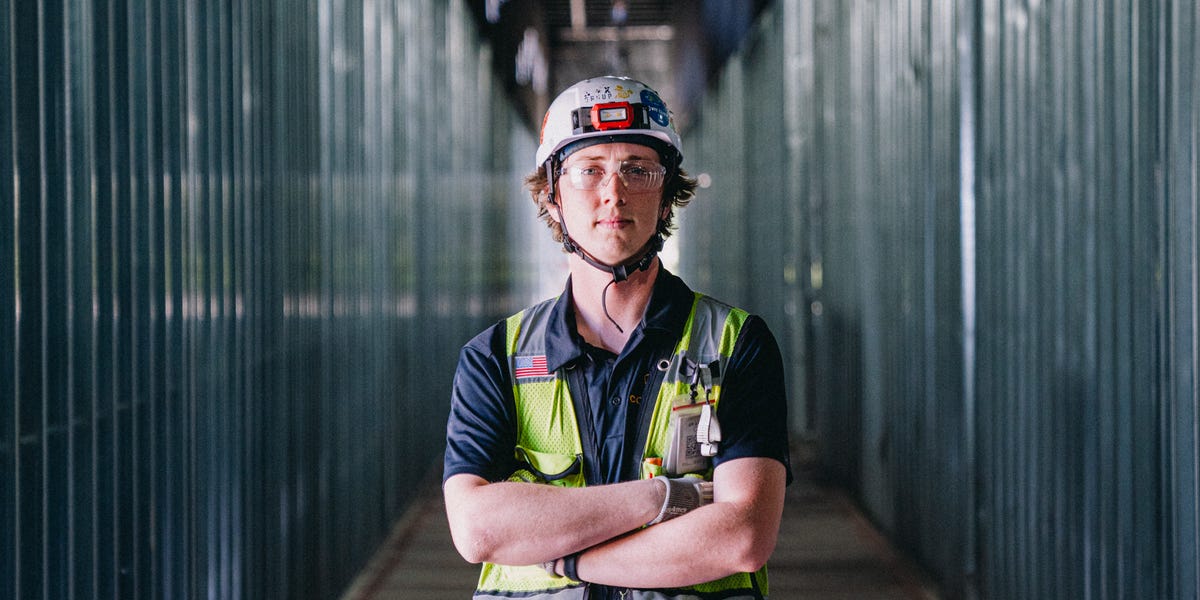
This as-told-to essay is based on a conversation with Cody Cole, 25, an Arizona-based electrical field superintendent with Corbins, an industrial electrical contractor. The following has been edited for length and clarity.
I started in the electrical field in 2019 at 18 years old, shortly after getting out of high school. At first, I wasn’t particularly thrilled about doing electrical work. But my brother, dad, uncle, and grandpa all worked with their hands, and I’m very similar to them, so I thought I’d give it a try.
As I immersed myself more and saw all the positive career opportunities that arose, I found that I began to like my role.
Now, seven years later, I’m a superintendent making over $40 an hour with 45 people who report to me. It’s helped relieve the financial stress my wife and I have from everyday life, as we raise three kids and give them the best upbringing we can.
I didn’t want to pay for a traditional education
I’ve never been amazing at school; it wasn’t something I looked forward to. My parents taught me to pay my own way and earn my own money — something I greatly appreciate — so paying for a traditional college education wasn’t something I wanted to do.
With a career in industrial electrical work, I knew I was able to start making good money right out of high school.
The AI boom also changed my perspective on my career in electrical. I’ve seen firsthand that there’s going to continue to be a need for skilled tradesmen; at my company, Corbins, we specialize in data centers, which are going to be needed with the expansion of AI.
After entering the industry without any formal training, one of the turning points of my career came a year and a half in, when I had the opportunity to do an electrical apprenticeship program through the Western Electrical Contractors Association (WECA).
Corbins would fund my schooling and pay my salary while I attended classes for two-week blocks every three to six months, across four years. The program consisted of a minimum of 156 hours of classroom instruction a year and 8,000 hours of on-the-job training.
I couldn’t justify not going to school — it was such a great opportunity. I ended up graduating as salutatorian in 2024.
My salary grew from $15 an hour to over $40 an hour
I had started out making $15 an hour — which was awesome for not having any experience — but I’ve progressed quickly from doing hands-on labor to being a foreman to being a superintendent. Now my hourly rate is in the high $40s.
I could’ve even started making more, faster, if I’d jumped into the apprenticeship sooner.
I don’t feel I’d be in the financial position to be the sole provider of my family, had I chosen a different path. We’ve been fortunate that with my income, we’ve been able to achieve our goal of my wife being a full-time stay-at-home mom.
There’s so much opportunity for young people. One of the foremen who works with me is only 21, and he’s phenomenal at his job. Another superintendent I work with is also amazing, and he’s only 23 or 24.
The data center boom means endless job opportunities
There’s a lot of job security in what we do. With the expansion of AI going at an extreme rate, there’s plenty of work all over the country with these jobs. The opportunities are endless — not only on the construction side of things, with physical, hands-on labor, but also with the other positions it takes to build these data centers, such as accounting, financing, and planning.
For the last two years, I’ve been working fully on data center projects. I’ve been fortunate enough to travel to New Mexico a few times and to Texas; the data centers are going up all over the place, so the work is there.
I know there are controversies around data centers. I’m not an expert, but I believe the ones I’m working on are quiet and not intrusive. They’re also very necessary for the way technology is going, in order for AI to progress, and are providing new work opportunities, like the ones I’ve had.
Although I’ve only been doing this for seven years, I enjoy mentoring others
Although I’m now a superintendent, I still feel like I’m new to the trades and there’s still a ton that I want to learn. However, I’m enjoying being able to mentor others and see the bigger picture of the projects we’re working on.
When I was learning, people taught me the “why” behind what I was doing; that’s something I’m now able to share with the people I work with, especially as the AI industry and data centers are fairly new.
In my role, I plan for the whole building, but in the higher positions, they’re looking at an even larger picture of the impact and what’s coming next. Understanding the big picture of projects is an aspect of my career I really enjoy and am looking forward to continuing.
I don’t want to do something just because I’m told to — I want to know why I’m doing it. It makes the work more meaningful, and makes me want to try harder, give the job my full effort, and train those around me so they can learn from me too.
For the people I manage, and for people who are new to the industry, data center construction gives them an opportunity to get into the industry as it’s booming, learn, and progress their careers quickly.
Do you have a story to share about pursuing a blue-collar career rather than a corporate one? Contact this editor, Jane Zhang, at [email protected].
Read the full article here