


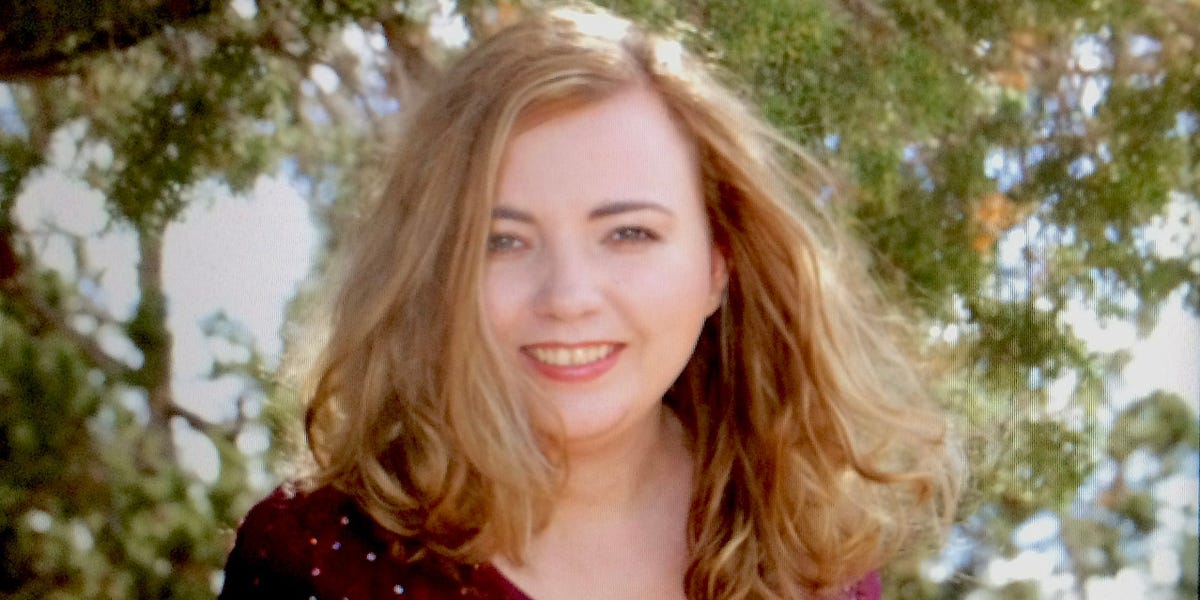
This as-told-to essay is based on a conversation with Briell Decker, 40, a former member of the Fundamentalist Church of Jesus Christ of Latter-Day Saints, and the 65th wife of its former leader, Warren Jeffs. She married Jeffs in 2004 at 18 in an arranged marriage. It has been edited for length and clarity.
I was born and raised in the FLDS faith. From the time I was a child, my days were structured around religious instruction.
I spent at least four hours a day in sermons — in the morning with my family, at school, after lunch, and again before bed.
I believed everything I was told by my parents and Warren Jeffs, who became the prophet for the FLDS in 2002 and was presented as the closest person to God on Earth.
Growing up, no one asked me what I wanted to be, it was expected that I would become “a mother in Zion.” The Yearning for Zion Ranch was the main FLDS compound in Texas.
At 18, my father wrote a letter and recommended me for marriage to Warren Jeffs. I said yes, even though I was afraid and did not love him.
Women could technically refuse marriage, but the consequences could be severe. Losing your family, your community, and your place in the church was always a possibility.
Looking back at that moment when I agreed to marry Jeffs, it felt like standing on the edge of a cliff without a way to turn around.
Jeffs had a way of making everything he did seem right, even when it was wrong. He used The Book of Mormon to justify his actions. That’s what makes me believe the FLDS was a cult. (Multiple organizations, documentaries, and other former FLDS members have also described the FLDS as a cult.)
Once, I was brought into one of Jeffs’ group sessions (aka orgies). He was bringing underage brides into the room with adult wives, and it was a very bad situation. I did not want to be part of it, and afterward, I asked for more time to adjust so I wouldn’t have to go back. I never had to.
I was married to Jeffs for two years before he went to prison, and I remained in the FLDS as part of his group for many years until I escaped in 2012. I never consummated the marriage.
Control shaped everything — where I lived, what I ate, and how I thought
Jeffs controlled nearly every part of my life and the lives of everyone in the church.
For example, he had the titles of everyone’s houses in a legal trust and used that to control housing. He decided where people lived, and could move families at any time.
The women in his family, including me, weren’t allowed to leave our homes freely. We couldn’t go outside. Food, which Jeffs selected for us, was brought to the house. And in some places, there were cameras and caretakers watching us. There was really no exit route.
Over time, restrictions tightened, especially in the mid-2000s when Jeffs was under police investigation. We got rid of televisions and internet access. I think that was to help hide the truth from the people.
I tried to escape again and again, but each attempt made it harder
I tried to escape about 10 times before I succeeded. The more I tried, the tighter the control around me became.
In one early attempt, I made contact with the police and thought I might be able to leave for good. But they told me they wanted to place me in a shelter that was near the FLDS compound, and that didn’t feel safe to me.
It was my first time trying to explain what was happening, and I didn’t know how to communicate why being that close to the compound still felt dangerous. I ended up going back to my family in the FLDS in Short Creek, an area along the Arizona-Utah border, because I couldn’t see how the police’s plan was going to work.
After that, I started trying to plan more quietly. I would look through phone books or try to figure out where I could go, but I was often seen before I could get far. People were expected to report anything suspicious, so it didn’t take much for someone to notice.
At one point, after I tried to leave, the room I was in was physically altered. They put screws into the window so it wouldn’t open fully, and they turned the doorknob around so I couldn’t unlock it from the inside.
Even calling for help was risky. In some areas, calling 911 could connect you to people affiliated with the FLDS, so it didn’t feel like a safe option. There wasn’t a clear path to outside support, and I didn’t have access to information that could help me navigate it.
The day I escaped
On May 23, 2012, I escaped.
That morning, I tried to leave and was caught on the main roads and brought back. Later that day, I was in a room and I noticed that one of the screws on the window was loose.
I found some scissors and worked at it until it came completely loose. Eventually, the screw broke.
Someone in the house noticed and tried to stop me, but I kept going. I climbed out the window and ran.
This time, I avoided the main roads. I went through back paths and a creek until I reached a house of former FLDS members who had turned against the church.
By the end of the day, they had driven me out of town to safety.
Leaving was only the beginning
After I left the FLDS, I stayed in shelters and worked to rebuild basic parts of my life. I changed my name and my Social Security number. I opened my first bank account. I eventually got married again — this time by choice — and began building a life that was mine.
I saw the ocean for the first time on my honeymoon in Santa Monica, something I never thought I would experience. Later, I saw the Statue of Liberty, which felt especially meaningful because it represents freedom, and I was finally free.
I eventually learned that I had rights to Jeffs’ 45-room property in Short Creek. I applied for ownership in February 2016 and was awarded the house later that year.
I started giving free tours in it to raise awareness and connect with people who might help turn it into something bigger. Through those connections, I partnered with a nonprofit called the Dream Center, which agreed to take over operations and turn the property into a recovery center.
Today, it serves as a place where people — especially those from the FLDS and other polygamous groups — can find housing, support, and resources as they rebuild their lives.
Warren Jeffs was sentenced in 2011 to life in prison plus 20 years for sexually assaulting two underage girls, unrelated to Briell Decker. His defense — led by several attorneys — argued that his religious freedom had been violated.
Read the full article here