



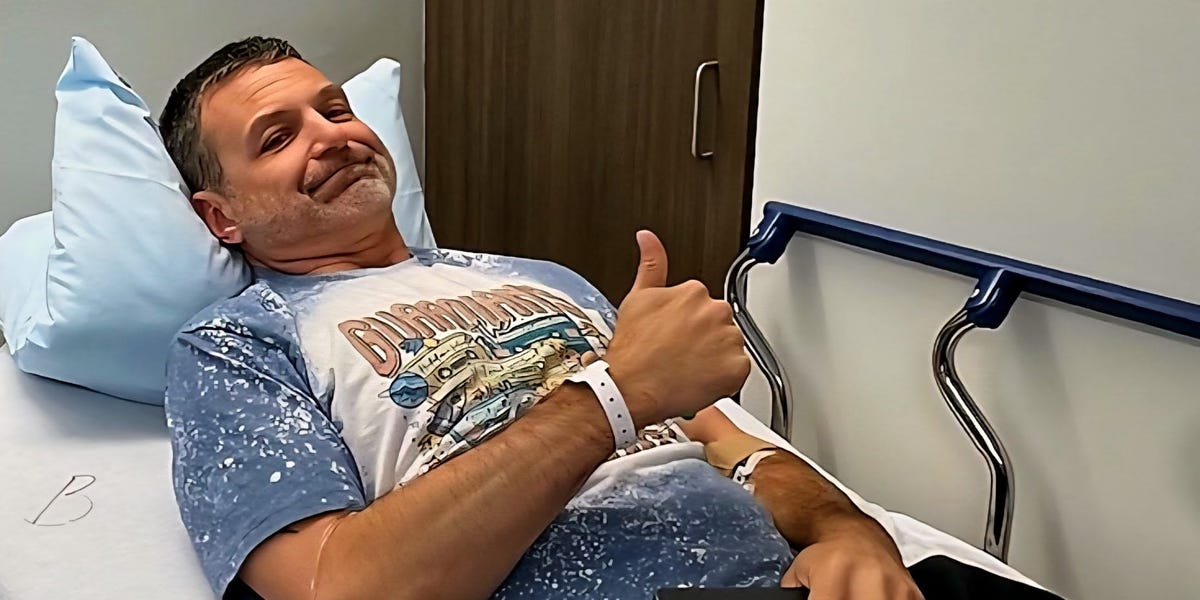
From a young age, Randy League loved being on his feet — one of the best habits for reducing cancer risk.
He played football and basketball in high school, which he continued to do throughout his adulthood. “I enjoy playing golf, I enjoy any sports and just being outdoors, walking the dogs,” League, 46, told Business Insider. The production manager at a commercial printing company in Columbus, Ohio, League was also kept busy by being in charge of maintenance for the whole building and three separate departments.
Then, in January 2025, he woke up in the middle of the night with a sharp pain that felt like extreme constipation. He spent the night straining to use the bathroom, so much so that some blood vessels burst in his eyes.
The pain kept getting worse, with League avoiding sitting as much as he could. “There were points where I couldn’t even be in my office very long,” he said, opting to walk on the floor of the building. When driving to and from work, he dreaded getting stuck in front of a train or anything that would delay the trip.
Months later, at age 45, he learned he had stage 3 colon cancer, of which he’d felt no symptoms prior to that first night.
“It’s hard to imagine that there was a golf ball-sized tumor that just didn’t show itself until that day,” he said. “It was really weird.”
It took him 3 months to get diagnosed
Because League almost never got sick, he didn’t have a primary care physician. It was also why he didn’t think to get screened once he turned 45, the standard screening age for colon cancer.
While he was proactive about booking an appointment early, the wait time was 6 weeks.
In the meantime, he tried to treat his symptoms as best he could. His wife looked online, and they both thought the issue might be dietary or related to hemorrhoids. League ended up trying suppositories, which only made the pain worse.
When he finally went to the appointment and had a very painful digital exam, the doctor ordered a diagnostic colonoscopy.
From then, it was another 3 to 4 weeks of waiting, even though League was technically “fast-tracked” for an appointment. On the day of the colonoscopy, League went with his mother, since his wife was convinced the issue would be hemorrhoids.
By April 2025, League was diagnosed with invasive poorly differentiated carcinoma with hepatoid differentiation — considered a rarer variant of colon cancer, since his tumor was located in his lower colon and some of the cancer cells resembled liver cancer cells.
“I was shocked and scared and speechless all at the same time,” he said. “It took a good couple of days for me to really calm down.”
He learned he had a genetic predisposition for colon cancer
The plan was for League to start with radiation and chemotherapy, with the hope of shrinking the tumor before any surgery.
At his first radiation appointment, League was offered genetic testing to see if he had any hereditary conditions linked to higher cancer risk. He learned he had Lynch syndrome, a symptomless genetic condition affecting 1 in 300 Americans that can greatly increase the chances of developing several types of cancer.
Colon cancer is the most common cancer associated with Lynch syndrome, increasing the lifetime risk of developing it anywhere from 22% to 74%.
League wanted his family to get tested. So far, his brother has tested negative. League, who has a 16-year-old daughter, is hoping she can get tested within the next four years, as Lynch syndrome would increase her risk of developing endometrial, uterine, and ovarian cancers.
He qualified for a milder cancer treatment
In the meantime, League continued with his radiation and oral chemotherapy treatments for six weeks, which successfully shrank the tumor and made it less painful for him to sit. In June 2025, he met with his oncologist to discuss his chemotherapy protocol — the plan was to continue with IV and oral chemotherapy.
Because he was diagnosed with Lynch syndrome and a specific gene mutation, League qualified for immunotherapy, a sometimes milder cancer treatment that trains the body’s immune system to fight cancer cells, rather than destroying both normal and cancerous cells via chemo.
“I was just so thankful,” League said. “I’m sure chemotherapy would’ve done a good job, but it also would’ve taken a lot more of a toll.”
League was able to keep working, only taking time off for appointments. “I have a family that I’m responsible for and a mortgage, and I felt like the best thing I could do as long as I could do it was work,” he said. His main symptom from treatment was extreme fatigue and struggling to sit for long periods of time. “I couldn’t operate the forklifts and stuff like that.”
As of June 2026, League is cancer-free and will continue to get regular MRIs and CT scans, as well as annual colonoscopies. Because of his Lynch syndrome diagnosis, he will also be screened for other cancers he might be predisposed to, such as stomach cancer.
League said one of his biggest takeaways was the importance of having a primary care physician and getting colon cancer screenings. “I don’t even know if anything would’ve been caught for me, but I know that timelines would’ve been different and that would’ve reduced a lot of stress and anxiety that I had to deal with early on,” he said.
Read the full article here