



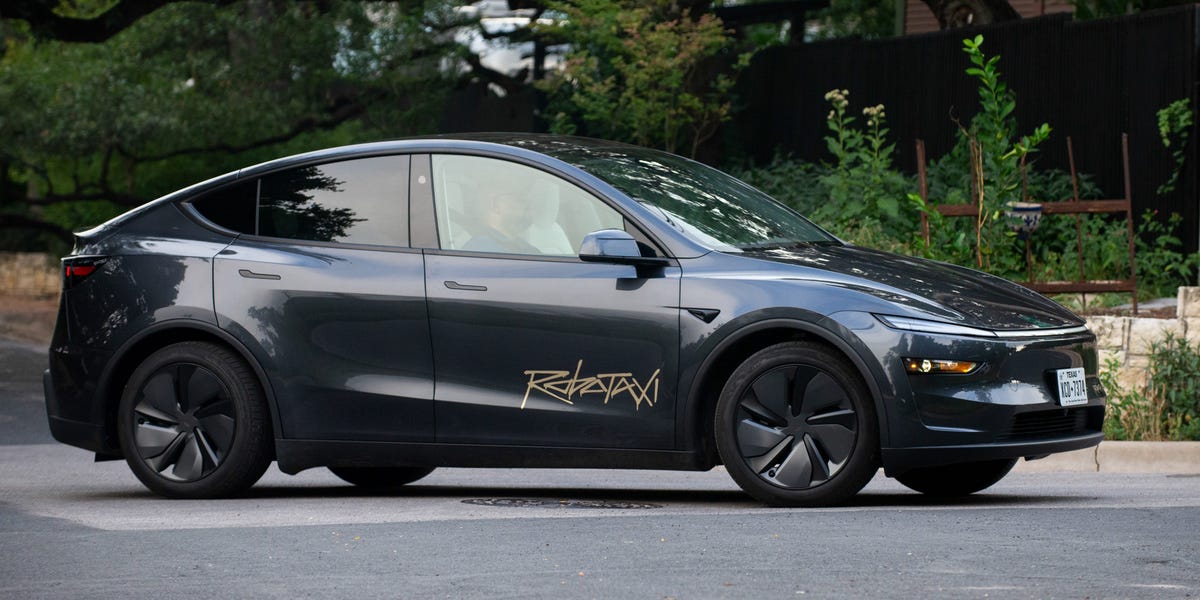
Robotaxis officially hit the streets of Dallas last week. Their arrival gave one enthusiastic passenger a glimpse of both the promise — and the limitations — of autonomous driving.
Chris Ramos, a 34-year-old accounts payable supervisor, told Business Insider that he rushed to try Tesla’s service on Saturday after seeing posts online saying it was live. The launch came after Tesla began a similar driverless service in Austin in January, about 10 months after Waymo launched its service there.
Early reactions to Tesla’s robotaxis have been mixed, with some riders praising the smooth, futuristic experience while others report glitches, confusion in traffic, and the need for human intervention. More broadly, public skepticism remains high, with many people still wary of safety and hesitant to trust fully autonomous vehicles.
“I was just excited to kind of be on that frontier of this tech,” Ramos said.
But frontiers can be unpredictable — and sometimes a bit glitchy.
Tesla’s robotaxis operate within a virtual approved boundary. Ramos went to a designated service area and tried to request a ride through the Tesla Robotaxi app. It repeatedly showed no nearby vehicles for nearly two hours. He called Tesla customer support, and a representative told him that the service hadn’t launched in the area.
“I was like, ‘Oh man, so am I just like wasting my time? Should I just go home?'”
After two hours, Ramos got a robotaxi from a nearby Bank of America parking lot. He said the car handled city driving smoothly, even though it had some difficulty reading signals, like failing to realize that it could turn right at a red light.
He said the trip took a turn when the vehicle missed an exit and entered a highway.
Traffic was going at 80 to 90 miles per hour, he said. At first, the robotaxi began picking up speed to keep up with the other cars, until suddenly, it started to slow down, as if it were preparing to pull over. That’s when Ramos said he started to feel unsafe.
“There are cars flying by us. You don’t pull over on the highway unless it’s like a super emergency or something,” he said.
He said a Tesla representative appeared to take over the car and kept it moving in the “slow lane” until it was guided off the highway.
From there, the ride continued — and so did the plot twists. The car missed its final destination, took him to the wrong location, and then got stuck circling a hotel before support stepped in to redirect it.
“I went around that hotel about five times,” he said. “In the same loop, going over the same speed bumps.”
Ramos said at one point, the car tried to drop him off about 2.6 miles from his final destination before it took him to the right spot.
The trip covered about 11 miles and took 54 minutes. It cost Ramos around $18, compared with his previous $16, three-mile Waymo ride in Dallas.
His final verdict: It’s a fun trip for the risk-loving, despite the hiccups. He would not recommend it to his grandmother.
Tesla did not immediately respond to Business Insider’s request for comment about Ramos’ trip, sent outside normal working hours.
“I’ll see people post on X saying everything is flawless, there are no mistakes,” Ramos said. “I wanted to see if I could find any flaws in the system — any room for improvement.”
The bumpy trip didn’t dent his long-term expectations for the technology.
“I do think the future is autonomous,” he said.
Read the full article here