


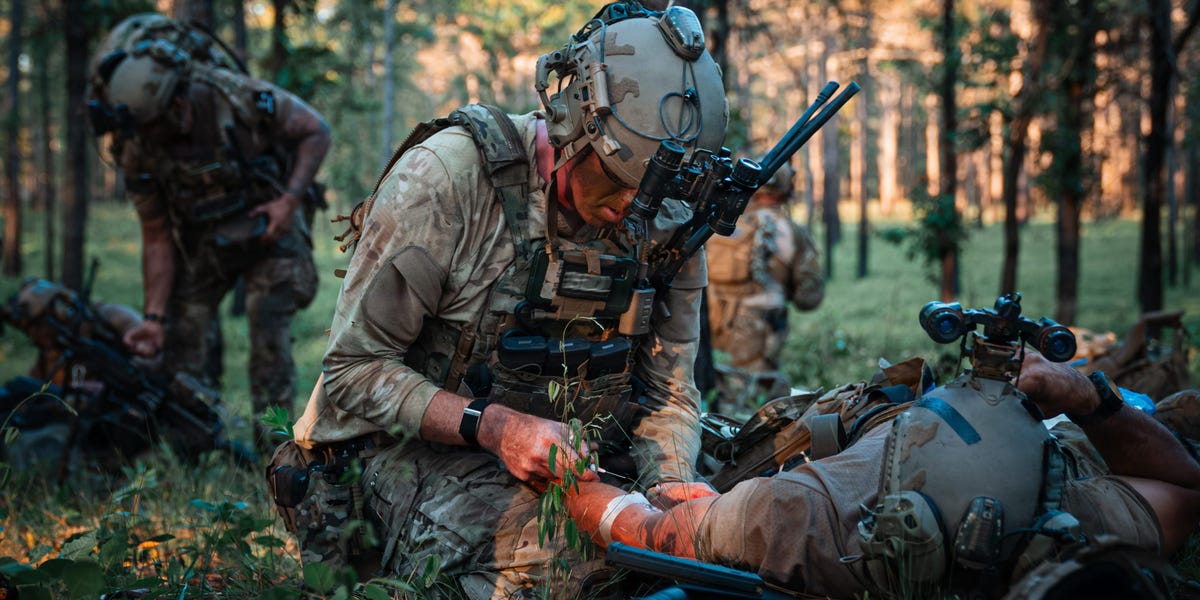
The corpsman strapped his patient onto the litter as the sound of swirling helicopter blades roared from a watchful instructor’s hand-held speaker. Double-checking his IVs were secure, he and a stretcher team hoisted up their casualty and sprinted toward the landing zone amid flying debris from the helo’s rotor wash — in this case, a leafblower.
On this makeshift battlefield in the parking lot of the Army’s Joint Special Operations Medical Training Center, medics had already quelled enemy fire, stopped the bleeding, drawn two bags of blood from teammates for the wounded, and carried him half a football field to a protected position before the “helicopter” arrived to whisk the injured soldier off to a military hospital nearby.
Such a scene — a wounded US service member being swiftly evacuated to advanced lifesaving care — is familiar to veterans of the Global War on Terror and reflects the belief around which the American military has built its modern trauma system: medics triage the wounded, helicopters or Humvees arrive quickly to evacuate them to a higher-level care, and then surgeons take over.
That combat casualty care chain is expected to fracture in a future large-scale war.
During the post-9/11 wars, military medics routinely plugged gunshot wounds, stopped hemorrhage with tourniquets on limbs shredded by roadside improvised explosive devices, and cleared shattered teeth and debris from airways with their fingers.
But the prospect of a large-scale war against a sophisticated foe — an adversary with advanced tech on par with the US military’s, with millions of small attack drones potentially stocked and ready — means that they could face the daunting task of keeping casualties alive for longer, without reliable medical evacuation for days or weeks on end.
The military has quietly started preparing some medics to carry more of the burden when evacuation simply isn’t possible. But while a single medic can buy time, they can’t replace an entire medical logistics system disrupted by drones and electronic warfare, major problems in modern war.
In Ukraine, casualty evacuation within the “golden hour” for life-saving trauma care is effectively nonexistent. Surveillance drones and the threat of attack by explosive-laden drones make traversing the battlefield harder than ever, meaning evacuations are often impossible along the front lines.
Ukrainian troops say evacuating the wounded often means waiting for nightfall or for foggy or stormy weather conditions that disrupt drone operations. Soldiers are increasingly turning to robotic systems to evacuate wounded troops because of the danger to medical teams, though with varying degrees of success.
Facing the possibility that the US could one day find itself in a similar war in which medics are tasked with caring for the wounded for longer, some trauma specialists are preparing for that future now.
“Our emphasis on prolonged field care, and how we’ve changed the direction of the course, is sort of baked into what we’re doing now,” the special operations medical course chief said. “The amount of work that goes on after the point of injury for our medics is where we’re shifting the emphasis, so that they can confidently take care of somebody.”
For the instructors, that means exposing students early to skills like battlefield amputations and infection management, which previous generations usually only learned years into their careers and at higher ranks. The jam-packed training prioritizes the basics of trauma care, the chief noted, but instructors are introducing advanced skills earlier.
Tomorrow’s medics, such as the young soldiers and sailors now in the course at Fort Bragg, could face a deluge of responsibilities after stabilizing casualties: feeding them, tracking intravenous fluids, and dealing with infections, a significant problem in Ukraine. Even the prospect of supporting battlefield dialysis in the event of kidney failure, a potential consequence of tourniquets being left on too long, is possible, medical experts say.
During the Global War on Terror, “missions were very often planned within the range of where you could get an aircraft within an hour,” said Col. Ken Dwyer, the school’s commander, which contributed to improved survival rates.
The idea that some evacuations in a future war could occur within an hour hasn’t entirely vanished, Dwyer said. “But it is on life support with respect to what we think the future might hold, and what we’ve been told to prepare for.”
With immediate casualty evacuation unlikely, medics suddenly become responsible for all of a patient’s bodily functions, the course chief explained. One person might take on multiple roles normally seen in an ICU — cleaning patients’ teeth, administering eye ointment for eyes dried out by sedatives, monitoring fluid intake, and managing bowel functions.
That’s not accounting for a volatile battlefield — or multiple patients, said Michael Davis, a retired Air Force colonel who previously directed the US Combat Casualty Care Research Program and served as deputy commander of the US Army Institute of Surgical Research.
Multiple casualties would create a “massive cognitive burden” as medics triage patients with different levels of injury severity, said Davis, still a practicing surgeon.
Prolonged casualty care is not new for the US military. Special operations troops in Africa have long deployed with limited medical support, often without advanced hospitals nearby or quick airlift throughout the enormous continent. Their senior medics have been trained to treat casualties in austere settings, work traditionally known as prolonged “field” care.
But the vast majority of the US military’s medical services fall outside of nimble special operations formations. Despite increasing interest in prolonged casualty care, medical providers set to deploy with most troops lack the same opportunities to develop such advanced skills, military trauma experts said, even amid widespread concern about a large-scale war and lessons emerging from Ukraine. Multiple government watchdog reports have found similarly worrisome concerns with military trauma skills development.
Military trauma experts built their careers saving the lives of wounded troops in the Global War on Terror, Davis said, and became haunted by preventable deaths. Many are now retired, taking years of valuable combat casualty care experience with them.
“The upcoming leaders in that middle category have never seen combat, not even counterinsurgency-type combat,” Davis said of providers outside special operations.
Concerns about prolonged casualty care in an overwhelmed trauma system have garnered some congressional attention. House and Senate drafts of the annual defense authorization bill include provisions requiring reports on military casualty care readiness. Part of that, some lawmakers hope, will include increased transparency from the Pentagon on how many casualties the military expects in a large-scale war.
Army Col. Jennifer Gurney, director of the military’s Joint Trauma System, cautioned that the military’s increasing attention to prolonged casualty care risks presenting it as a solution instead of a consequence when rapid evacuation is impossible.
“You want to be in a trauma system that can move rapidly from capability to capability and get the care that you need,” Gurney told Business Insider. “Prolonged casualty care means you’re stuck.”
That’s not to say that the military shouldn’t prepare medics for prolonged casualty care, she said. Pentagon brass and war analysts have repeatedly warned that future prospects of American air superiority are bleak, and vast maritime distances in places like the Pacific make such preparation a critical requirement.
More advanced training and more readily available supplies can only make an already bad environment slightly less deadly for some, Gurney explained. Medics alone can’t turn a bare-bones treatment site into an intensive-care unit, or turn one lone service member into an entire surgical team.
“I think we have to remember that, because we’re so hyper-focused on it, people are going to start thinking it’s its own capability,” Gurney said, referring to prolonged casualty care. “It’s not.”
“You can’t put all this responsibility on medics,” she added. “But we do have to teach them what they can do in those denied environments to sustain life.”
Read the full article here