


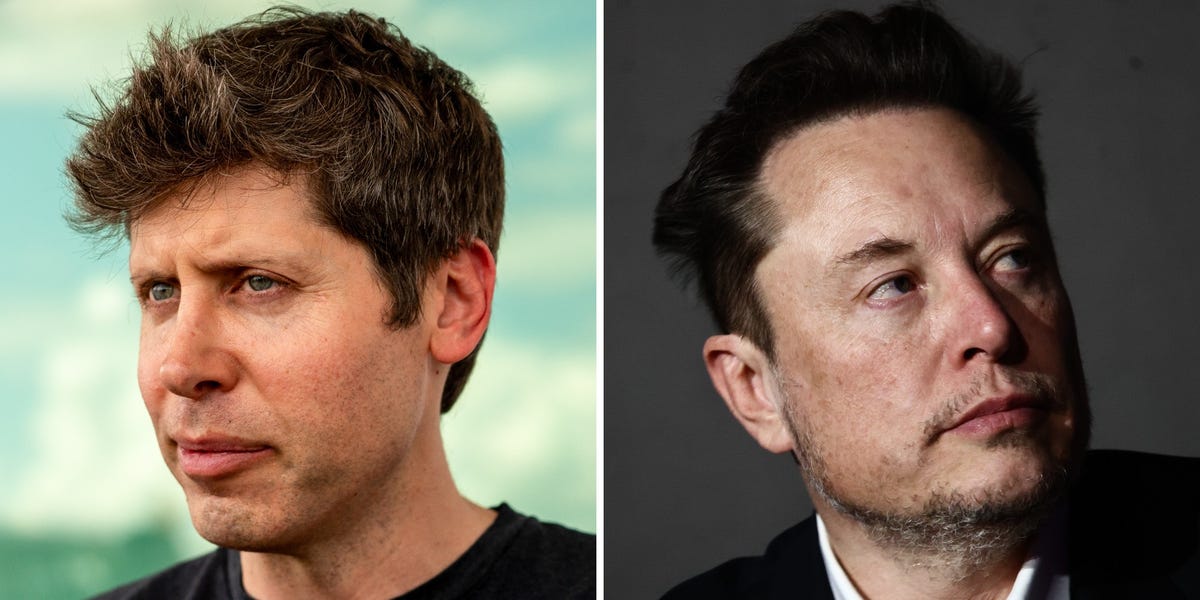
After two weeks of testimony from witnesses who called Sam Altman a liar and a cheat, jurors in Elon Musk’s blockbuster trial against the OpenAI CEO got to hear his side of the story.
Altman took the witness stand in an Oakland, California, federal courthouse on Tuesday for a case that could decide the fate of the groundbreaking artificial intelligence company behind ChatGPT.
Musk’s lawsuit accuses him and OpenAI President Greg Brockman of “looting” OpenAI’s charity through a partnership with Microsoft for his personal gain — allegations that Altman, Brockman, OpenAI, and Microsoft deny.
Under more than three hours of questioning from his lawyer William Savitt and Musk’s lawyer Steven Molo, Altman walked the jury through his childhood fascination with science fiction, his rise through the world of titanic tech companies, and Shakespearean dramas over the control of OpenAI.
Here are the biggest takeaways from his testimony:
Altman confirmed he considered running for California governor
In his under-oath testimony, Altman publicly confirmed for the first time that he was once considered running for California governor.
Asked by Molo about a September 2017 email that referenced his “political goals,” Altman explained it may have been a reference to his interest in California politics.
“I was thinking about running for governor at the time, which I believe is what they meant here,” he said.
Gov. Gavin Newsom ultimately won the 2018 gubernatorial election for the state.
Altman considered going to Microsoft and making ‘a ton of money’
Altman testified in detail about “The Blip” — OpenAI’s nickname for the brief period, in November 2023, when its board ousted him as CEO.
Altman said that he was negotiating with board members to return to the company as CEO when interim CEO Mina Murati was replaced by Emmett Shear.
“I was extremely angry. I felt extremely misled,” Altman said. “I was just like, enough is enough. I’m going to go work on a pure AGI research effort.”
Microsoft CEO Satya Nadella had already offered Altman a job at the tech giant, as well as an open invitation to OpenAI employees who wanted to join. Altman strongly considered giving up on OpenAI and starting fresh, he said.
“There was something appealing about going to work at Microsoft with Greg on a pure AI research effort,” he said. “And I was also very angry, and hurt, and upset. It felt like an incredible betrayal and very painful, very public, crazy few days.”
Altman opted to return to OpenAI with a new board composition, telling the jury he wanted to preserve its nonprofit structure.
“I’m sure I could have made a ton of money and had a much easier life at Microsoft, but I cared about the mission and the people,” he said.
Altman found Musk’s desire to control OpenAI ‘hair-raising’
Musk’s lawsuit alleges that Altman circumvented OpenAI’s corporate structure — which is supposed to develop safe artificial intelligence for everyone — to benefit himself.
In Altman’s telling, it was Musk who wanted to keep a firm grip on OpenAI. He said Musk sought to “fold in” the artificial intelligence lab into Tesla and gave little consideration to questions of good governance. According to Altman, Musk wanted to pass OpenAI on to his children upon his death.
“I haven’t thought about it a ton, but, you know, maybe it should just, the control should pass to my children,” Musk said when members of OpenAI’s board asked him about it, according to Altman. The OpenAI CEO described it as a “particularly hair-raising moment.”
Musk’s lawyer pounced on the subject of Altman’s honesty from the start
Altman’s cross-examination got to an excruciatingly cringey start as Musk’s lawyer Steven Molo grilled him about longstanding questions about his honesty.
“Are you completely trustworthy?” Molo asked Altman at the beginning of the questioning.
“I believe so,” Altman said.
“You don’t know whether you’re completely trustworthy?” Molo followed up.
“I’ll just amend my answer to yes,” Altman responded.
The questioning went back and forth like that for several minutes before Molo moved on to Altman’s leadership of OpenAI.
Altman threw shade on Musk’s contributions
Altman told the jury that he contributed millions to the company, just like Musk. Musk, the world’s richest man, contributed around $38 million to OpenAI’s charity before stopping the donations.
Altman — himself a billionaire through other investments — said he donated $3.75 million to OpenAI “in cash when it started,” as well as $17.5 million in cash to an associated study on universal income.
“And I contributed a lot of my time and effort,” he said.
Altman said Musk’s involvement was more limited.
“He would come by the office every week, or other week, and was available for texts and emails as needed,” he said.
Cofounders Greg Brockman and Ilya Sutskever, by contrast, were working “almost every waking hour,” according to Altman.
Altman was frustrated as Tesla tried to poach OpenAI employees
By the second half of 2017, amid disagreements over how OpenAI should continue to raise money, Musk stopped his quarterly contributions to the artificial intelligence company, Altman said.
Musk was also starting an artificial intelligence initiative at Tesla. He left the board of OpenAI in early 2018, in part, because he was trying to poach its employees for his electric car company, Altman testified.
Asked how he felt about Musk trying to recruit from OpenAI, Altman gave a blunt answer.
“I was annoyed,” he said.
Musk’s ‘chainsaw’ management approach ‘demotivated’ researchers
Altman also said that, while at OpenAI, Musk’s management approach clashed with the culture of its research lab.
Musk made decisions that were “bad for morale,” according to Altman. Altman said he asked other executives to rank OpenAI researchers and then had them “take a chainsaw through a bunch.”
The whole episode “demotivated” researchers, Altman said.
“This idea that you had to show your result or you’re going to be fired — that didn’t work for us,” Altman said.
Read the full article here