



Air travel just got even more chaotic.
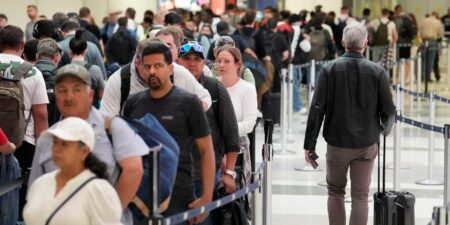
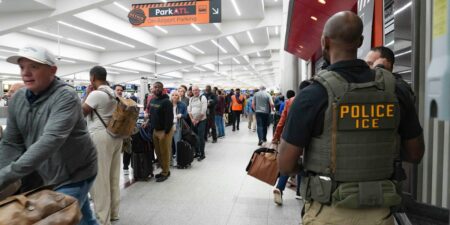
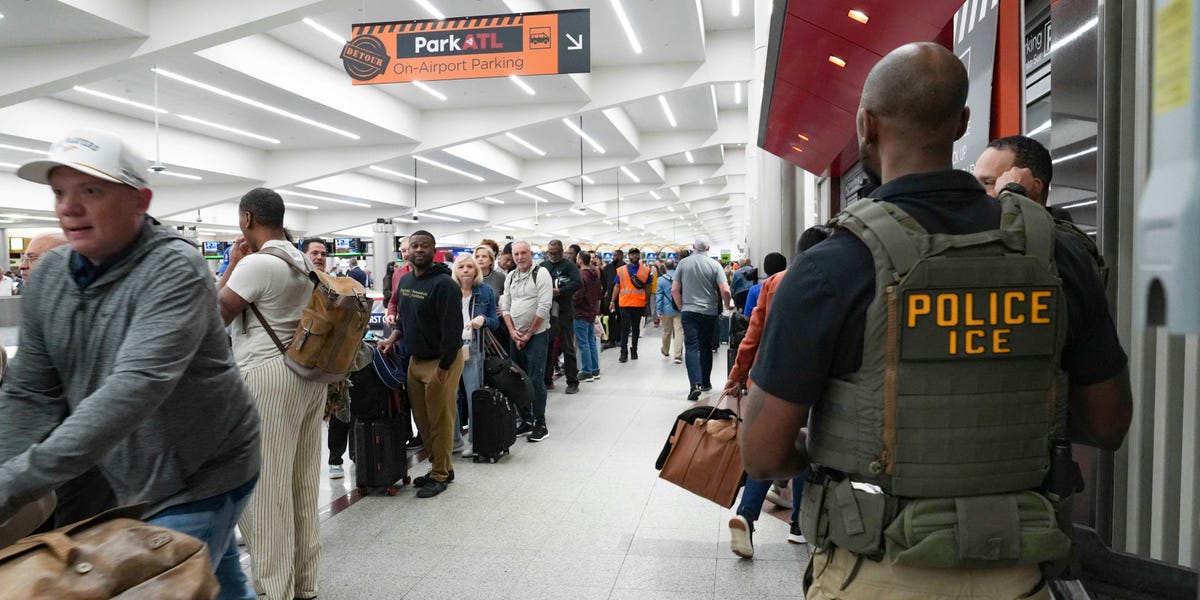
After weeks of airport security lines spilling into sidewalks and parking garages — as unpaid TSA officers call out en masse during the partial government shutdown — Immigration and Customs Enforcement agents have been sent to airports nationwide to help manage the crowds.
President Donald Trump first threatened the action in a Saturday TruthSocial post after Congress, for the fifth time, failed to reach a deal on Friday to fund the Department of Homeland Security.
“I will move our brilliant and patriotic ICE Agents to the Airports where they will do Security like no one has ever seen before,” Trump wrote. He instructed his border czar, Tom Homan, to lead the effort.
In a statement shared with Business Insider, DHS Acting Assistant Secretary Lauren Bis said the agency is not releasing an official list of airports with ICE agents: “For operational security reasons, we are not going to confirm the locations of our officers.”
Some have been revealed.
Reuters and ABC News have reported that ICE agents — who, unlike TSA agents, are still being paid during the shutdown — are stationed at the following US airports as of Monday, citing social media posts and officials.
- Hartsfield-Jackson Atlanta International Airport (ATL)
- Chicago O’Hare International Airport (ORD)
- Cleveland Hopkins International Airport (CLE)
- Houston Hobby Airport (HOU)
- Houston’s George Bush Intercontinental Airport (IAH)
- Fort Myers’ Southwest Florida International Airport (RSW)
- Louis Armstrong New Orleans International Airport (MSY)
- San Juan’s Luis Muñoz Marín International Airport (SJU)
- New York’s John F. Kennedy International Airport (JFK)
- New York’s LaGuardia Airport (LGA)
- New Jersey’s Newark Liberty International Airport (EWR)
- Pittsburgh International Airport (PIT)
- Phoenix Sky Harbor International Airport (PHX)
Several X posts show ICE agents standing at TSA checkpoints and talking to passengers on Monday. They are identifiable by their green and beige uniforms with a “Police ICE” patch. Trump said in a Monday TruthSocial post that he wanted ICE agents to be maskless at airports — they have routinely worn masks and uniforms lacking nametags during immigration raids.
However, few details were given about what these ICE agents — who are trained in law enforcement, not airport security — would actually be doing to help.
TSA agents receive months of specialized training to detect contraband that ICE agents wouldn’t have had time for in the seemingly few days it took Trump’s plan to come together.
Homan said during CNN’s “State of the Union” broadcast on Sunday that ICE duties would be more about crowd control and covering the exits than looking at X-ray machines — but he did not say they would stop conducting their regular immigration enforcement at airports.
On Monday, Trump told reporters that ICE agents at airports are “able to now arrest illegals as they come into the country. That’s very fertile territory.”
Some industry analysts say their presence — especially as people increasingly disapprove of ICE — could make things worse.
ICE is not trained in airport security
ICE and TSA are both part of DHS, but their roles are very different: ICE is armed law enforcement with arrest powers; TSA agents are unarmed screeners who interact with the public but have no police authority.
Everett Kelley, president of the American Federation of Government Employees, warned in a Sunday statement that ICE agents “cannot improvise” airport security.
“TSA officers spend months learning to detect explosives, weapons, and threats specifically designed to evade detection at checkpoints — skills that require specialized instruction, hands-on practice, and ongoing recertification,” he wrote. “Putting untrained personnel at security checkpoints does not fill a gap. It creates one.”
Homan provided some clarifications to CNN. He said ICE agents are “well-trained” in security and identification and are already present at some airports for certain investigations, such as smuggling.
But he said that they would not conduct screenings; instead, they would handle support roles, such as managing passenger flow, covering exits, and assisting with crowd control. TSA lines at airports in Houston and New York have stretched as long as three hours; some airports, like Atlanta, have stopped reporting wait times altogether.
“Stuff like that relieves that TSA officer to go to screening and to reduce those lines,” Homan said. “I don’t see an ICE agent looking at an X-ray machine because they’re not trained in that; there are certain parts of security that TSA’s doing that we can move them off those jobs and put them in the specialized jobs and help them move those lines.”
Transportation Secretary Sean Duffy said on ABC News’ “This Week” on Sunday that ICE agents operate similar screening machines for people and packages at the Mexican border — suggesting they have the proper security training and could help agents in those areas — but said just managing the flow of people is helpful.
Helpful or not, their presence could still be intimidating.
Cathy Creighton, the director of the Cornell University School of Industrial and Labor Relations Buffalo Co-Lab, said in a statement shared with Business Insider that ICE agents have been “acting aggressively in public situations” and may not provide the “softness” and “de-escalation” needed in the confined TSA areas.
“Additionally, the public perception of ICE is poor,” she said. “Multiple public polling has found that public support for ICE has declined markedly.”
Roughly 56% of Americans expressed little to no confidence in ICE in a poll by The Economist/YouGov conducted from February 27 to March 2.
Federal officers on Sunday detained a passenger at San Francisco International Airport (SFO) in an “isolated incident” that the airport was not involved in, an airport spokesperson told Business Insider.
SFO is one of 20 airports across the US that use officers employed by private security companies instead of the TSA —meaning they are paid during the shutdown thanks to pre-funded contracts. SFO said lines have been short.
ICE agents are still being paid
ICE’s presence at airports comes as more than 400 TSA officers have left the agency since DHS funding lapsed and their pay was paused on February 14.
Frontline TSA agents average $60,000 to $75,000 a year, but often live paycheck to paycheck. The ICE agents now stationed alongside them are still being paid, as DHS has funding that continues to cover certain law enforcement roles even during the shutdown.
TSA agents will not get paid again until Congress reaches a deal to fund DHS. Republicans have blamed Democrats for the shutdown, while Democrats say they will not approve a deal without reforms to ICE, including requiring agents to show their faces and wear body cameras.
Read the full article here