




The US military has launched a new mission to clear Iranian mines from the Strait of Hormuz, kicking off a dangerous new phase of the war in one of the world’s most important waterways.
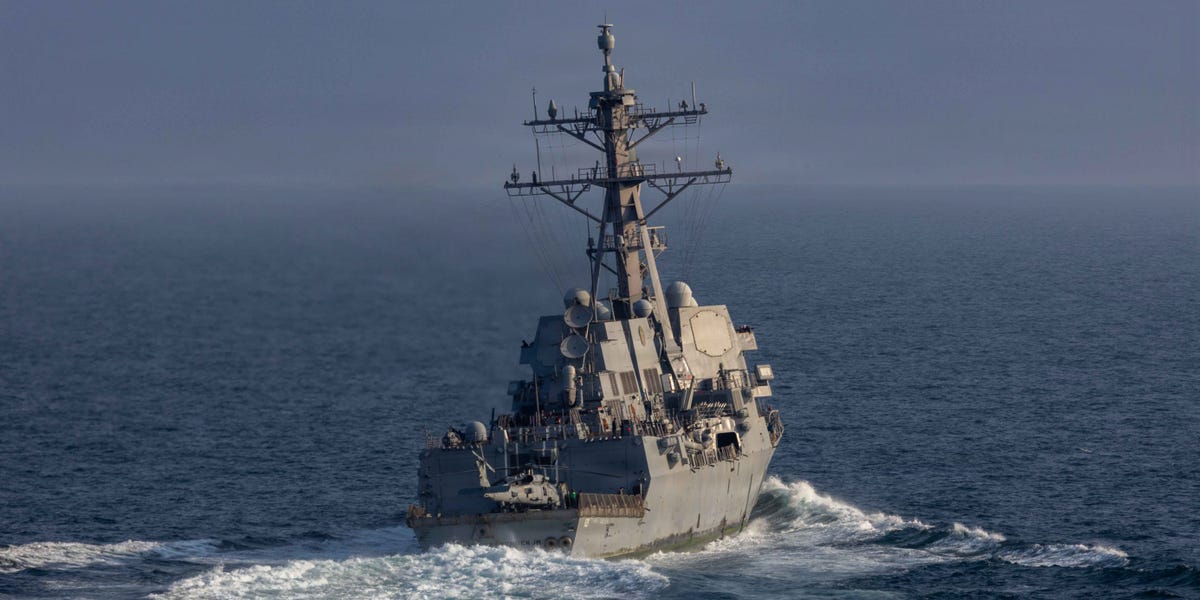
Two US Navy guided-missile destroyers transited the strategic strait over the weekend and operated in the Persian Gulf in what the military said was “part of a broader mission” to clear the key waterway from naval mines that were laid by Iran’s Islamic Revolutionary Guards Corps (IRGC).
US Central Command, which oversees American military operations in the Middle East, said that its forces had only started “setting conditions for clearing mines” in the strait. It’s unclear what role the destroyers played over the weekend, but they were not built to detect or clear mines.
Destroyers are multi-mission ships built for higher-end naval combat. The Navy has a small fleet of dedicated mine-sweeping vessels, such as its Independence-class littoral combat ships and Avenger-class mine hunters, but their specific whereabouts are unknown.
CENTCOM declined to clarify where the littoral combat ships are and what role the destroyers are playing in mine-clearing operations.
Bradley Martin, a retired Navy surface warfare captain, told Business Insider that destroyers could provide support and protection while uncrewed systems conduct detection and clearance. Littoral combat ships could eventually become involved.
The destroyers, which carry a large loadout of surface-to-air missiles, are positioned to provide air defense should Iran fire anti-ship missiles at any US mine-clearing forces. The smaller littoral combat ships lack similar armaments and protection.
However, mine-clearance might not be the immediate priority. Instead, the priority could be a campaign to lock down some shipping in the strait, said Martin, a senior policy researcher at the RAND Corporation think tank.
On Monday, a US military blockade of Iranian ports went into effect several days after Washington and Tehran agreed to a brief but tenuous ceasefire.
CENTCOM said the blockade, which was carried out under President Donald Trump’s directive and followed inconclusive negotiations in Pakistan, applies to “all maritime traffic entering and exiting Iranian ports,” including those on the Persian Gulf and Gulf of Oman.
The new blockade could hamstring critical oil revenue that Iran depends on and further pressure its economy. The US military said its forces “will not impede freedom of navigation for vessels transiting the Strait of Hormuz to and from non-Iranian ports.”
The United Kingdom Maritime Trade Operations, an element of the Royal Navy, said such vessels still “may encounter military presence, directed communications, or right-of-visit procedures during passage.”
The mine-clearing operations and blockade mark a dangerous new phase of the conflict, even as the US and Iran hold fire amid the ceasefire.
US officials have said that more than 150 Iranian vessels are damaged or destroyed. However, Trump said on Monday that Tehran still possesses a number of smaller, fast-attack craft, which have been used in the past to harass Middle East shipping lanes.
Trump threatened to destroy any small Iranian ships that approach the US blockade. But beyond these vessels and the mines, Tehran’s arsenal of anti-ship missiles is another concern for American forces.
Archer Macy, a retired Navy admiral, told Business Insider that the operations are risky for the Navy because Iran could decide to start launching missiles at US warships “to make a point.”
Macy, a non-resident senior associate at the Center for Strategic and International Studies, said that setting “operational redlines” unilaterally creates new risks.
With mines in the water, a blockade underway, and Iran still armed with anti-ship capabilities, US naval forces are entering a particularly challenging phase of the conflict.
Read the full article here