





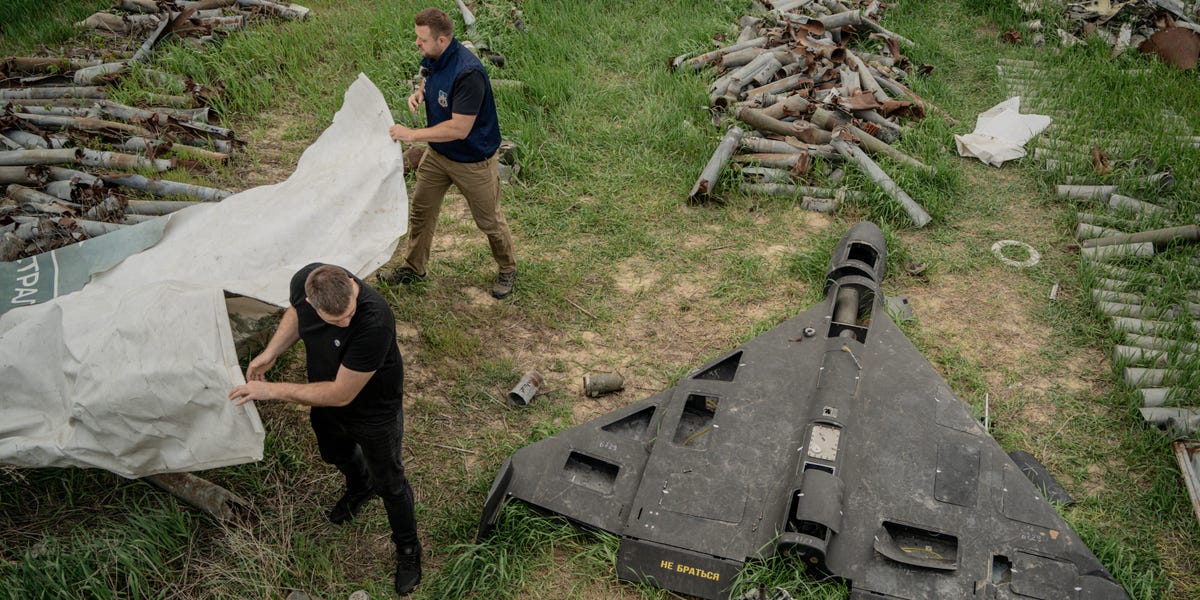
The drones Iran is launching at US forces are the same ones Ukraine has fought for years. Ukrainian soldiers say their battlefield experience offers lessons that matter in this fight.
Alex Eine, the commander of a small Ukrainian drone unit, said it was “surprising” to see reports out of the Middle East of multimillion-dollar interceptors being used to combat cheap Iranian one-way attack drones.
“When long-range drones are flying at you, don’t shoot them down with $3 million PAC-3s from Patriots,” he said, referring to a top interceptor for the most advanced US surface-to-air missile system.
Through trial and error, Ukraine developed low-cost defenses to counter Russia’s Geran drones, copies of Iran’s Shahed drones. Ukrainians involved in defending their country and Western analysts say other countries facing these threats need to be doing the same.
A 122nd Brigade sergeant with Ukraine’s Territorial Defense Forces who asked to be identified only by their call sign Fast, said that Ukrainian soldiers “were sure the US had some secret weapon,” some foolproof shield for stopping Shaheds. They were expecting to see it in action when this new war began, he said.
Instead, what they saw were viral video clips of an Iranian delta-wing drone sailing past defenses and slamming into a US Navy base in Bahrain, causing serious damage.
“Now we see that it is a hard task, even for the US,” Fast said of defending against Shaheds.
On Wednesday, CNN reported, citing an unnamed source who attended a closed-door briefing, that Defense Secretary Pete Hegseth and the top general, Dan Caine, told congressional leaders that Shaheds pose a greater challenge for the US and allies than initially expected.
The Pentagon did not respond to requests for comment.
Speaking at a press conference on Thursday afternoon, Adm. Brad Cooper, the head of US Central Command, said that the US is “very familiar with the Iranian capabilities” and “planned for it right from the outset.”
He added that while he felt good about what the plan was, the military has been making adjustments.
Dimko Zhluktenko, a Ukrainian drone pilot with Ukraine’s Unmanned Systems Forces, said the US and others should lean more into the kind of low-cost systems that Ukraine has proven work against Shaheds.
Hard-won combat lessons
The reality of any major air defense battle is that some threats are likely to break through.
“I’m not surprised that some Iranian drones penetrated their defenses, as they act like a swarm,” said Ukrainian lawmaker Maryan Zablotskyy, who was an early advocate for interceptor drone air defenses. “It’s very difficult to intercept a whole bunch of them flying at the same time.”
Last year, Ukraine saw Russian drones break through and kill over 500 civilians.
“There is no 100% counteraction,” said Oleksandr Skarlat, the director of the Sternenko Foundation, a crowdfunding organization for combat drones. “The question is no longer whether such drones will break through,” he argued, “but what the cost of destroying them will be and how quickly defense systems can adapt.”
Ukraine says it can intercept about 90% of Russia’s Shaheds. That rate isn’t perfect, but Kyiv is able to achieve largely effective coverage and do so with systems that are cheap enough to field at scale, helping it save its missiles like the Patriot and the National Advanced Surface-to-Air Missile Systems, or NASAMS, for Russia’s more dangerous threats.
Ukraine depends on a host of low-cost solutions against Shaheds, including electronic warfare, mobile gun teams, and interceptor drones.
A cofounder of Wild Hornets, the Ukrainian firm behind the popular Sting interceptor drone, said the Shahed threat “forced” their country to develop an entirely new branch of service dedicated to using drones to fight drones.
Ukraine began surging production of cheap interceptor drones, designed to fly at high speeds to intercept Shaheds, in 2025. It says it now produces over 1,000 of them a day.
Math problems
Hegseth said on Wednesday that the US has “the most sophisticated air and missile defense network ever fielded” and that it has vaporized thousands of Iranian threats, both missiles and one-way attack drones.
“We have pushed every counter-UAS system possible forward, sparing no expense or capability,” he said, using an acronym for counter-Unmanned Aerial Systems.
Among the higher-end air defenses on the front lines of this multinational air defense fight are the MIM-104 Patriot and Terminal High Altitude Area Defense (THAAD) systems. Ship-based interceptors, like the SM-series missiles, and planes armed with air-to-air missiles are also in play.
Dara Massicot, a Carnegie Endowment for International Peace defense expert, wrote in an assessment on Monday that drone attacks are being intercepted “at an impressive rate,” but at the cost of “extensive resources of near-constant defensive counter air patrols and the use of ground-based air defense systems that are otherwise needed for intercepting inbound Iranian missiles.”
Zablotskyy, the Ukrainian lawmaker, said that the important thing is to “start thinking low-cost war.” Ukraine’s interceptor drones are priced at around $2,300 to $6,000 each, while Shaheds are generally estimated to cost $20,000 to $50,000 apiece.
That cost ratio is much better than expending a multimillion-dollar interceptor missile on a drone costing only thousands. American military leadership says that they are working to address past imbalances.
“Interceptors, in general, we’ve had a number of new capabilities being fielded,” Cooper said on Thursday. “I think you have seen over a period of time us kind of get on the other side of this cost curve on drones.”
“If I just walk back a couple of years, you remember you used to always hear: ‘We’re shooting down a $50,000 drone with a $2 million missile.’ These days, we’re spending a lot of time shooting down $100,000 drones with $10,000 weapons,” he said.
The admiral declined to go into specifics on the new capabilities being fielded.
The US and Israel are flying over Iran and destroying as much as they can of Iran’s missile arsenal to try to limit its offensive attacks — a state-of-the-art air campaign that Ukraine can’t match, and it has cut both missile and drone attacks down tremendously since the war began.
Offers to help
The US military has taken broader drone lessons from Ukraine; however, observers say it has not adopted Kyiv’s low-cost interception architecture at the scale it needs for this and future wars.
Ukrainians told Business Insider that the US should invest deeply in interceptor drones like the ones they use while also layering in electronic warfare and short-range air defenses.
“The use of interceptor drones might be the key to the Shahed challenge in the Middle East and elsewhere,” said Taras Tymochko, who led the Dronefall project, a program under the charity foundation ComeBackAlive that funded early development of interceptor drones in Ukraine.
“Of course, there is not much time to learn how to use interceptors,” he said. “But it is better to be late than very late.”
On Thursday, Ukrainian President Volodymyr Zelenskyy said that Ukraine “received a request from the United States for specific support in protection against ‘shaheds’ in the Middle East region.” At the same time, reports emerged that the US and other partners were considering purchasing Ukrainian interceptor drones.
Massicot said that while this deeper “learning should have started long ago, now is the time to start — and catch up quickly.”
Several Ukrainians said the urgency for the US to learn from their country extends past the fighting with Iran or the threat from Russia. These countries aren’t its only foes that might rely on Shahed-type drones or swarms.
“Air defense in the Middle East is already unable to withstand the intensity of Shahed attacks,” Skarlat said. “Imagine what will happen if China gets involved” in the drone swarm way of war, he said.
“The world is not ready for massive attacks by Iranian drones,” he said.
Read the full article here