




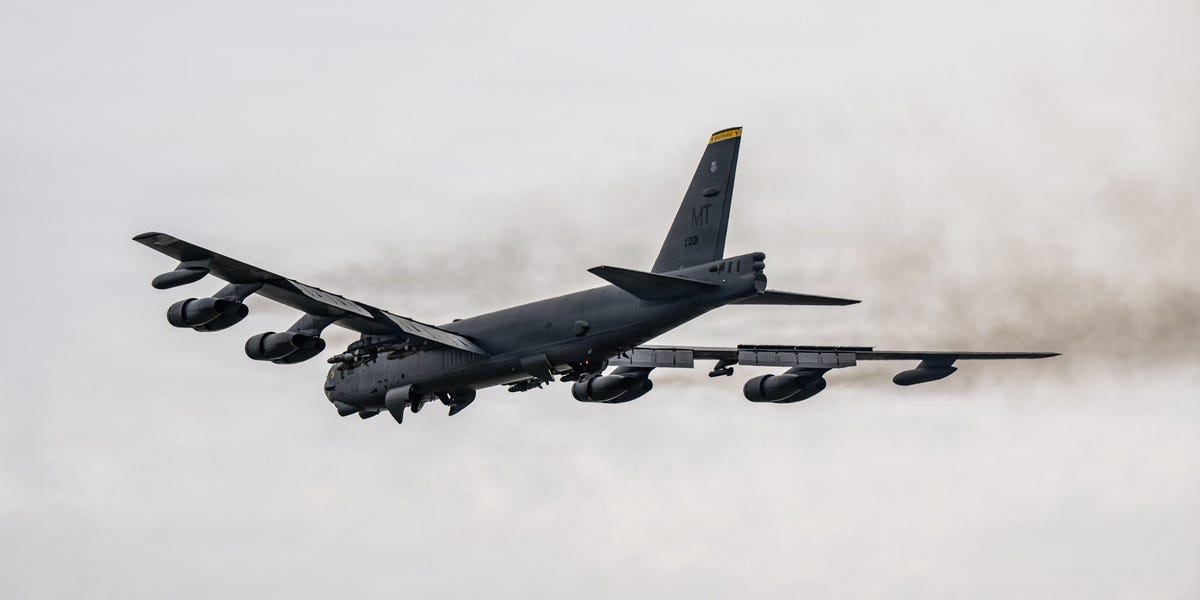
The growing US air superiority over Iran is opening the door for B-52 Stratofortress bombers to fly overland missions, America’s top general said Tuesday.
The US Air Force has been flying its B-52 bomber fleet for over 70 years. Although it lacks the speed and stealth of bomber aircraft like the B-1 Lancers and B-2 Spirits, the B-52s are a workhorse strike platform and will continue to see service into the coming decades with major upgrades.
At a Tuesday press briefing, Air Force Gen. Dan Caine, the chairman of the Joint Chiefs of Staff, discussed operational updates as the US war with Iran stretches past a month of fighting, including the use of B-52 bombers for overland missions.
“Over the past 30 days, we’ve struck more than 11,000 targets. Given the increase in air superiority, we’ve successfully started to conduct the first overland B-52 missions, which allow us to continue to get on top of the enemy,” Caine said.
B-52s — along with B-1 and B-2 bombers — are among the US air assets deployed to the Middle East since the war began. But their use in overland missions signals a shift. US and Israeli aircraft are now operating with far greater freedom over Iranian airspace.
In the early days of the war, Caine and other US officials said Iranian air defenses and missiles were primary targets, and American and Israeli forces used physical munitions to degrade these systems and gain air superiority over Tehran and other areas of Iran.
The Pentagon has also indicated that cyber, space, and electronic warfare assets were used to blind Iranian defenses and disrupt communications. Previous attacks on Iran, including Israeli strikes in recent years and Operation Midnight Hammer last summer, also targeted Iranian air defenses. Now, US officials have pointed to greater air superiority over the country and a new role for the B-52.
The B-52 Stratofortress is a Boeing-made bomber known for its formidable airframe and durable design, both of which have kept the aircraft in reliable combat condition despite continued flights and operations over the decades.
The heavy long-range strategic bomber first entered service in the 1950s. Today, it has 72 active B-52s. It plans to keep its fleet operational until 2050.
While some of the B-52s serve conventional bombing roles, others remain capable of nuclear operations. Retired B-52s are in long-term storage at the Air Force’s “boneyard” in Arizona.
Despite their age, Air Force B-52s are undergoing major upgrades to keep them flying into midcentury. Chief among them is the Commercial Engine Replacement Program, which will swap out the bombers’ aging engines for military-adapted commercial ones. The effort was delayed by funding shortfalls, but Boeing received a more than $2 billion contract last December to begin the work.
The Air Force is also counting on the Radar Modernization Program to keep the B-52 effective. Those upgrades to a new radar that provides greater range and resistance to electronic warfare countermeasures were also delayed and saw a jump in cost. The first ferry flight of a B-52 with a new radar occurred last December.
Read the full article here