




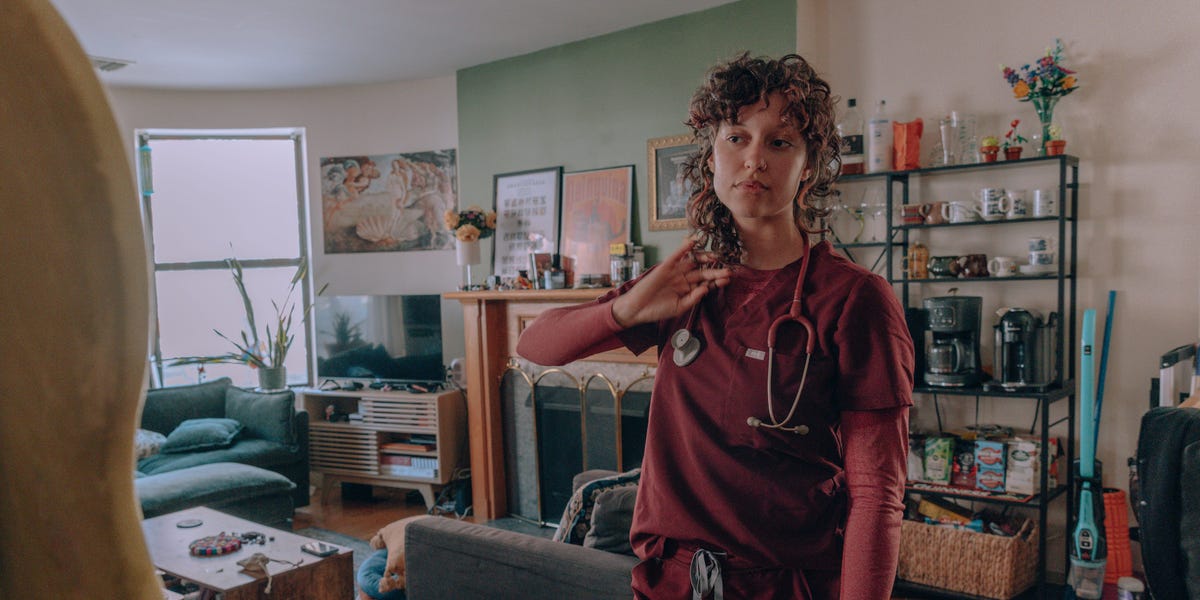
When Alana Aichholz was applying to college, she read her essays aloud to her mom, who edited them orally because cancer was making it difficult to see. It was one of the last big projects the two took on together, before her mom, Laurene, a writer, died in 2022.
“She helped me feel really good about choosing nursing as a possible career,” said Aichholz.
As the 21-year-old prepares to graduate from Northeastern University in December, she wishes she could ask her dad and mom — who died when she was in high school and college, respectively — a number of career-related questions. How should she prep for job interviews? Should she pursue pediatrics or adult care? Where do they think her interest in medicine came from?
“Something that I would crave their advice on is: What did you see in me as a kid?” Aichholz said. “I’m sure they would have things to say.”
Business Insider spoke with seven young people, including Aichholz, about how losing one or both parents at an early age affected their professional lives — from shaping what work they wanted to pursue to how they navigated the job market.
Losing a ‘GPS navigator’
Even with the support of family, it’s hard to be an early-career job seeker these days. Unemployment rates for workers ages 25-34 ticked up to 4.8% in March, compared to 4.0% a year prior, according to the Bureau of Labor Statistics. Between economic uncertainty and the rise of AI, finding a first job can be daunting.
“You are seeing companies cut back at some of their lower-level roles,” said Julia Levy, a career advisor and author of “From Hi to Hired.” “It’s a crazy time right now. I don’t think it’s going to get much better.”
Research suggests that losing a parent early can negatively impact career and wage growth after landing a first job. A 2023 study based on Finnish data found that losing a parent before age 21 is associated with lower income and higher unemployment between the ages of 26 and 30. The early death of a father, for example, was associated with 16.4% lower annual earnings for men and 10.9% lower annual earnings for women.
Levy said parents often function as a “career GPS navigator” for young job seekers. Not having that support can be a challenge. A parent can help craft a professional identity and navigate some of the unspoken rules of the workplace, Levy said.
Colleges don’t teach you “how to handle a difficult boss, or when to ask for a raise, or how to read between the lines of a performance review,” she said. “Some of these things are passed down at the dinner table or over a cup of coffee in the morning.”
Many, like Erum Salam, 30, miss their parents’ personalized career advice.
Salam, a reporter at MSNow in New York City, said her dad, who died in 2024, played an instrumental role in her choice to become a journalist. Every night growing up, he would control the one television in their house and flip between news channels. She’d ask him questions about what was airing while she was doing her homework.
He was the one to tell her she should consider journalism, with all of that question-asking, and later encouraged her to apply for a job at The Guardian, a publication he knew well from his years in London.
“My dad didn’t know anyone in the industry, but he knew a lot about me and what my strengths were,” she said. “He just gave great advice.”
When a stroke in 2022 left him unable to talk, walk, or eat on his own, Salam became one of his caretakers. She said she still relied on him for career input, though he had aphasia, a language disorder that garbles speech.
“One of the hardest things that happened since his stroke and then later death: I did not realize how much I relied on him for guidance in all aspects of my life, especially my career, all financial decisions,” she said.
‘Always on my side’
Kevin Tracy’s mom had dementia for years, but he said he still felt “woefully unprepared” when she died in 2023. After finishing grad school in 2017, he turned down job offers in Traverse City and Lansing, Michigan, to move home and care for his mom outside of Detroit, while working in metropolitan planning.
Tracy, now 34 and working as a policy specialist for Michigan’s transportation department, didn’t ask his mom, a childhood speech pathologist, for practical career advice, but he did confide in her when figuring out his early jobs.
“What my mom did provide is someone who was always on my side,” he said. “Someone I could go to when I applied to 40, 50 jobs and didn’t get any.”
The same is true for Nicole de Ayora, cofounder of a venture-backed product studio, whose mom died when she was working at a digital media startup. Her mom, an AP English teacher, didn’t know much about tech, de Ayora said, but was her “biggest cheerleader.”
“In positive moments, I just want to call her and freak out,” she said. “And then I want to think about her calling everyone at her church and all of our family members.”
Cassie Crooks-Leupke said she was getting closer to her dad in her early twenties, before he died in a motorcycle accident. She misses the random logistical support he would provide, like the time that she’d moved out her dorm and needed a twin bed frame. Her dad pulled up in his pickup truck, her childhood bed frame balanced in the back.
He was also the guy to call about the best way to cook fish, Christmas tree stands, and whether she could get fired for joining the nurses’ strike.
“I went to him for a lot more of the practical things in life,” Crooks-Leupke said.
Finding a mentor
In the wake of their parents’ deaths, some said they’ve turned to mentors with career questions.
While some companies offer formal mentorship programs, Katharine Manning, an advisor on trauma-informed workplaces, said many have scaled back those programs since the height of the pandemic. That’s a great loss, she said.
Levy agreed that professional mentors are important, but said young people can often be more honest with their parents, especially if a mentor works at the same company or in the same industry.
“You’re not going to call your mentor at 11 o’clock at night when you’ve got an early morning interview or meeting you didn’t prepare as well for,” she said.
Though Aichholz has a range of professional mentors, she misses having someone outside the industry who could be a sounding board.
“It is nice to be able to talk to someone who just knows you and your own passions.”
Now, when she needs guidance, she calls her older brothers, both software engineers, or her aunt. Crooks-Leupke doesn’t have one go-to person, but cobbles together wisdom from many people in her life.
“I’m calling like 12 people and meld what they’re saying to try to find the thing I think my dad would say,” she said.
Salam, who still covers breaking news, said her dad’s advice, informed by his vast knowledge of the world and her idiosyncrasies, is hard to replicate.
So, she turns where many young people now turn.
“I ask ChatGPT, and I read articles, and I’m figuring it out all on my own.”
Read the full article here