






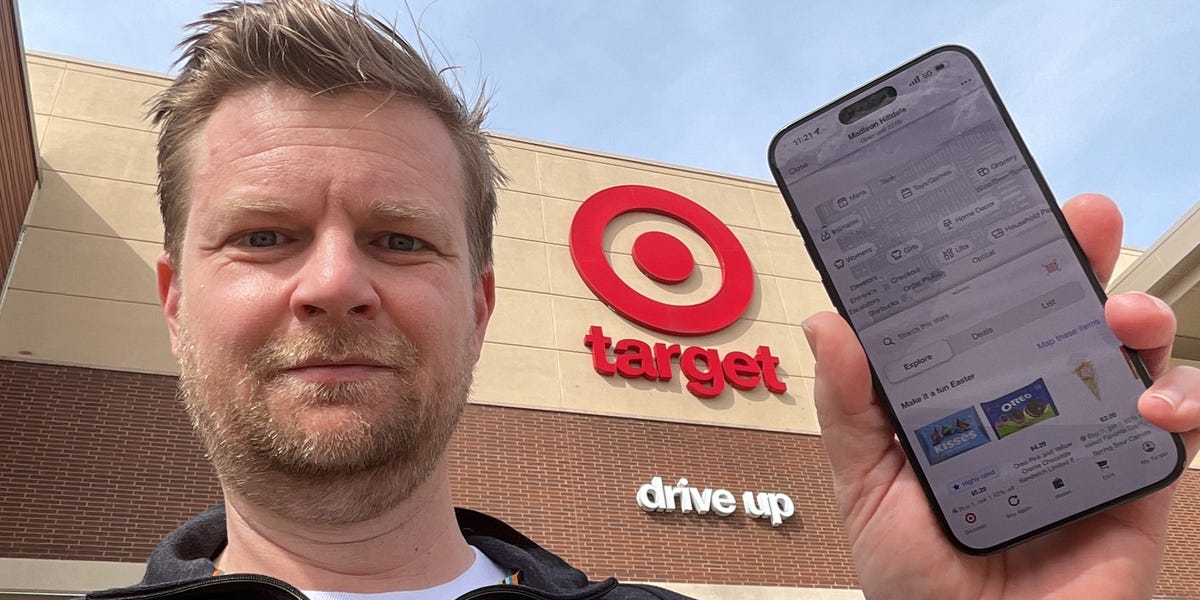
Target’s mobile app has long been one of the company’s not-so-secret weapons.
The retailer was an early mover among its brick-and-mortar peers to seriously invest in its digital business. The app drove Target’s early success in curbside pickup and continues to serve as a hub for its membership programs.
I started shopping at Target much more often when my first daughter was born during the pandemic, and I often wished more retailers had apps as useful as the one with the Bullseye logo. The store map was a particular timesaver for me during a very busy time in my family’s life.
In recent years, the competition has stepped up to narrow Target’s lead, or in some cases, surpass it.
From scan-and-go self-checkout in the Walmart and Sam’s Club apps, to Lowe’s and Home Depot helping shoppers find and learn more about products in their stores, mobile apps have evolved into much more than a pocket-sized version of the company’s website.
Every time Dominick publishes a story, you’ll get an alert straight to your inbox!
Stay connected to Dominick and get more of their work as it publishes.
Not every store’s app needs the same features, but it was starting to look like Target was losing its advantage.
Roughly one-fifth of Target’s merchandise sales last year were made via web or app, or more than $21 billion. Beyond the e-commerce factor, good apps matter because shoppers are still very much going into stores, only now they’re more likely to have a phone in hand while they fill their carts.
“About a third of our guests are using their app in the store,” Target’s chief revenue and digital officer, Sarah Travis, said at a meeting with investors and media at the company’s Minneapolis headquarters earlier this month, which I attended.
Travis showed how Target has responded to this shift with several new, user-friendly features intended to make shopping easier. I was surprised to see these upgrades had been rolled out so quietly.
Unlike Target’s flashy partnerships with Google or OpenAI, these new features involve more subtle integrations of artificial intelligence to supercharge common tasks.
“Target’s unique opportunity is to think holistically about guest experience,” Travis said, referring to this blended digital and physical approach to shopping. “The experience that you get today is vastly different than the experience that you would have gotten six months ago.”
Once I got home, I decided to try them for myself. The features aren’t all exclusive to Target, but three struck me as much-needed additions to the app experience — especially if Target wants to get shoppers to come back.
A handwritten list scanner
Like physical stores, the paper (or whiteboard) grocery list is still very much a reality for many US households.
I can’t speak for everyone, but my family rarely makes grocery lists with detailed branding or package info — we list items in general terms like “milk” rather than “Fairlife 2% Organic Lactose Free Milk — 52 fl oz.”
Now, in the My Target tab in the app, there’s an option to “scan a paper list,” which uses the phone’s camera to capture handwritten text.
Once the app processes the image, it pulls up to 20 relevant product listings per list item to either add to an in-app basket or shopping list, turning your handwritten notes into an order that you or someone else can fulfill with precision.
It worked pretty well when I tried it, except when the app assumed I was looking for a women’s or children’s shirt and didn’t show any men’s options. My paper list just said “T-shirt,” so I could have been more specific.
The buy it again tab
Another more prominent tool enhances a preexisting app feature and gives it prominent placement as a tab on the main screen.
Target’s app has long made it easy to find past orders and add selected items to your cart. That’s still an option, but now the app highlights frequently purchased items, items with active discounts, and stuff you bought a while ago that might be running low.
The tailored experience means that no two shoppers have the same experience, Travis said, adding that the feature “has essentially become a speed run for weekly essentials.”
In a few taps, you can be restocked and ready to go.
A more helpful map
In my experience, one of the Target app’s most useful features — by far — is its mapping tool that shows where to find a product in a sprawling store. This is especially helpful when traveling or when I have to go to a location across town.
When Home Depot rolled out its own version, called Store Mode, I found myself wishing Target had something to match. Now it does, thanks to the same geolocation startup, which says it also provides the service for Dick’s Sporting Goods.
With the recent upgrade (and location sharing turned on), the app now prompts in-store customers to enter “Store mode,” which enables a batch of map-based features, including where to find current deals and promotions.
In the “List” tab, rather than having to hunt for items one-by-one, everything on your in-app list (that you scanned earlier) shows up as a pin on the store map, helping plan a path to get what you came in for without bouncing all over the place.
It’s a win for Target as well. “When guests use store mode, their baskets grow by more than 7%,” Travis said.
These upgrades show that Target’s app is still in the game with one of the most useful shopping apps around, and I can see it saving time and money on my next Target run.
Read the full article here