





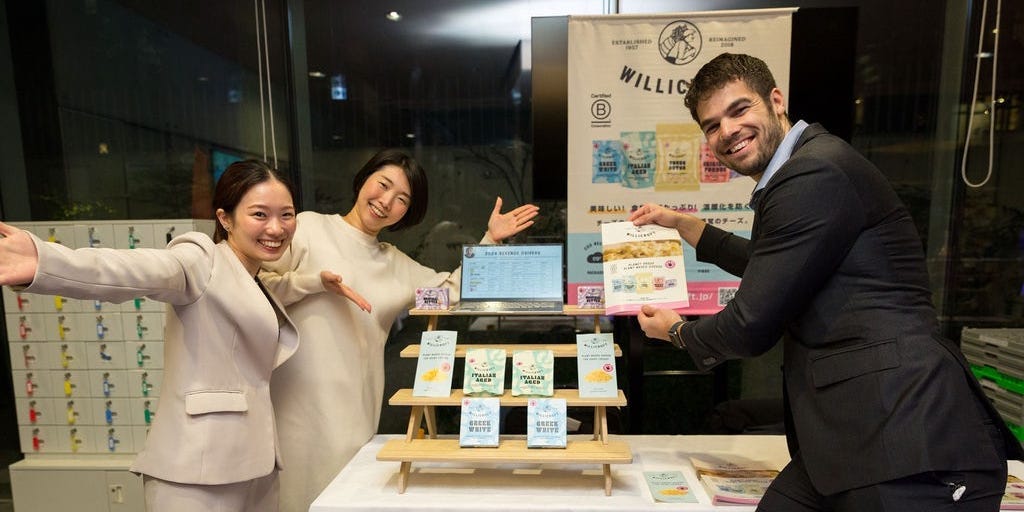
This as-told-to essay is based on a conversation with Fernando Lira, 35, CEO of JML Group in Japan. His words have been edited for length and clarity.
I didn’t move to Japan thinking about fashion — I came to study the language and build a career in logistics. Over time, though, the way I dressed became one of the clearest lessons Japan taught me about work, credibility, and belonging.
To grow professionally, I decided to leave the Netherlands, where I grew up. It felt too familiar, and I wanted something new.
Japan offered both distance and challenge. Ten years ago, when I was 25, I enrolled in a program in Fukuoka, about 550 miles southwest of Tokyo. I intentionally chose a city where English wouldn’t carry me.
Fukuoka itself was a surprise: lower costs, few English speakers, and incredibly friendly locals. It’s also where I met my wife — at a Pocky-themed party organized by friends.
At the time, I barely spoke Japanese, and she spoke no English. Now, we have two children.
First jobs, first lessons
Most Japanese companies have clear dress codes, though the rules vary by role. Some provide a uniform; others expect you to dress a certain way.
At the tech startup where I worked soon after graduation, the culture was relaxed, and no one seemed to care what you wore. That changed when an engineer showed up in flip-flops and received a warning. I quickly learned that even in casual offices, there are unspoken expectations.
Next, I worked as a driver at a transportation company. I was issued a full uniform and instructed not to wear sunglasses while driving. Administrative staff layered the uniform jacket over dress shirts and ties, while warehouse employees wore entirely different outfits — safety vests, helmets, and color-coded gear depending on their tasks. The color of the helmet indicated role and seniority.
At my wife’s company, a family-owned garbage disposal business, female office staff wear dedicated uniforms, while men — who don’t require uniforms — wear suits.
I never held a traditional job in the Netherlands, but from what I’ve seen, unless you work in banking or a uniformed profession, there are very few rules about how you dress there.
Building my own uniform
In 2020, I started an import business that helps food and beverage brands enter the Japanese market.
Having served in the Royal Netherlands Marine Corps before moving to Japan, transitioning to civilian “uniforms” felt natural. But finding my own uniform as a CEO was harder.
In the office, I often wear cargo pants and a worker shirt — practical clothes that let me lift things and get my hands dirty. When I visit clients or vendors, I switch to a suit. The cargo pants give me comfort and flexibility, allowing me to step into the warehouse without hesitation.
I’ve learned that entrepreneurs also have to think about personal branding. In Japan, a foreigner running a business in Japanese is already memorable. Individual touches — a bold haircut or a nonstandard name tag — are subtle.
Personal expression is understated here; loud displays of individuality can read as ego, which is frowned upon in a culture that prizes collective success.
Work culture and identity
As a salaryman in Japan, I was expected to arrive before everyone else and leave after everyone else — even if my work was done.
Later, with my own staff, I saw how deep that collective responsibility runs. I received reports that employees were cleaning toilets or scrubbing floors in my absence, insisting I needed to be more disciplined about tidiness.
At first, I was shocked. But it showed me how strongly Japanese culture emphasizes shared responsibility and group standards.
I roll up my sleeves year-round, even in winter. It’s partly practical, as dress shirts rarely fit my height, and partly psychological. Rolled sleeves signal freedom. In business, I want to project strength and confidence and feel completely unrestricted. I want my focus to be on the best possible outcome and nothing else.
Rolling up my sleeves puts me in that mindset.
What Japan ultimately taught me
There’s no golden rule for navigating Japan.
What matters is working hard, speaking the language, and — most importantly — fitting in. I’m terrible at that last part, so are many other Westerners.
Still, Japan is incredible when you learn to coexist, respecting the boundaries between local culture and your own.
Do you have a story to share about working abroad? Contact the editor at [email protected].
Read the full article here