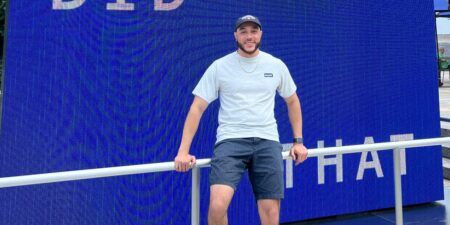




This as-told-to essay is based on a conversation with Jeremy Yoder, founder of Mad Scientist BBQ. It has been edited for length and clarity.
I always assumed I’d become a doctor — the respectable kind of job that made sense to my family and community. Now, I make a living cooking huge cuts of meat on camera and talking about heat transfer, airflow, and collagen breakdown.
It sounds like a wild pivot, but for me, each step — leaving pre-med, starting and then quitting teaching, and building a YouTube channel from scratch — came from the same place: wanting to protect my family’s future while staying true to who I am.
I’ve always believed that the regret of trying and failing is much easier to deal with than the regret of never having tried, and that has shaped everything I’ve done.
I planned to build my career around science and medicine
I grew up Amish until my parents left the community when I was in elementary school. Once we got a television, I found I loved watching the Discovery and Science Channels and learning how the world worked.
In school, I participated in academic science competitions and studied biochemistry, with the goal of pursuing a career in medicine.
Eventually, I joined a program at the University of Louisville to shadow physicians. Instead of showing me the path forward, what it taught was that I didn’t want that life. Many of the doctors I worked with seemed miserable, despite having good salaries and nice homes.
I realized the picture I had of being a doctor — stability, meaning, community — wasn’t the reality I was seeing. So I moved to Los Angeles to study biblical languages because I wanted to understand the Bible better and think more deeply about meaning.
To support myself, I taught at a private school in Woodland Hills. I taught almost everything: English, chemistry, biology, AP biology, and led the science program. I felt like I was making an impact, but I was also struggling to pay my rent while watching kids get picked up in Rolls-Royces. I knew it wasn’t a long-term plan.
That’s when I got obsessed with barbecue. I watched Central Texas pitmasters transform tough briskets into something tender and smoky, and I realized that some online barbecue creators were explaining the science incorrectly.
I figured maybe I had something I could contribute given my interest in the subject, and I knew I’d regret it if I didn’t try.
My first videos took off — and my students noticed
I posted a few videos, and they performed well. When I walked into school, one of my students saw me and said, “Mr. Yoder, you’re famous.” I wasn’t, but it told me people were connecting with the way I explained things.
At the same time, I noticed Los Angeles didn’t have much great barbecue. I thought: “If I can teach all day and still cook all night, maybe I can make this work.” I started catering events on the side — rooftop pop-ups and brewery gigs where they couldn’t serve food themselves.
That year was brutal. I would finish teaching, tutor until 7:30, walk out to my $500 truck, drive to the desert, cook overnight, clean up, go home, sleep a couple of hours, and be back at work on Monday. But it laid the foundation for a viable catering business.
When the pandemic hit, I pivoted hard to YouTube. Gatherings were outlawed, my catering income evaporated, and my wife was five months pregnant. I realized I could film videos without needing anyone else around, so we started posting once a week.
The audience seemed to respond, and the subscriber numbers kept growing. By the time pandemic restrictions eased, YouTube had outpaced catering in revenue — and in how much I enjoyed it.
I’ve diversified revenue, so I’m not trapped on camera forever
People assume I have a big team. Really, my wife films 99% of my videos and edits almost all of them. She handles the creative vision; I handle the science and the cooking process.
A typical day starts with taking our daughter to school, then sitting in my office with a yellow legal pad. I sketch ideas, make calls, and test concepts, like wrapping a brisket in clarified butter.
On cook days, I might spend 24 to 30 hours on a single brisket video. The next day, I take my daughter to the park. I have the tremendous privilege of being around my family every day, and I want to make the most of it.
I realized early that my ability to generate income is directly related to my willingness to stand in front of a camera. Someday I may not want to — or people may stop watching. I don’t want to wake up to learn the whole business has vanished.
So, I intentionally built multiple revenue streams: ad revenue, sponsored content, affiliate links, brand deals, and my own merchandise, like T-shirts, barbecue accessories, and my offset smokers, which I’m proud to say are made in the US.
Diversification protects me if platforms change. If Google said tomorrow they’re not going to monetize any of my videos, I’ll be OK — five years ago that would have wrecked me.
I think about retirement more than college savings
Although I was a teacher, I remain skeptical of the US education system. I’m not even convinced I think it’s necessary for my kids to go to college, unless it’s for a career like medicine. So, my wife and I haven’t started an education fund.
Saving for retirement, though, is front of mind. I recognize that I’m not an expert in personal finance, so I try to lean on people who have the expertise that I need. We work with a financial advisor who helps us decide how much to contribute to retirement accounts, like our Roth IRA and investment stocks.
I never expected barbecue to become my career, let alone the foundation of a business that supports my family. But I also don’t want to look back one day and think, “How foolish I was to waste this opportunity.”
My goal now is simple: build something real and resilient — a business rooted in science, teaching, and cooking — that will carry us long after I’m done being the guy in front of the camera.
Read the full article here