




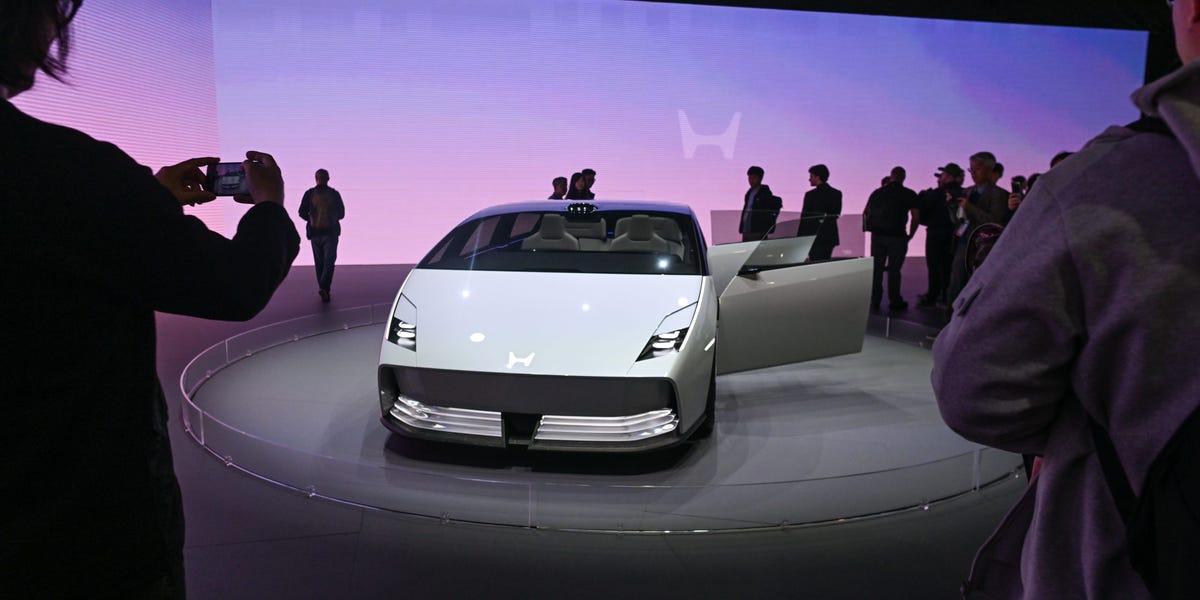
Honda is taking a massive financial hit as it pulls back on its electric-vehicle ambitions.
On Thursday, the Japanese automaker said it expects to write off up to 2.5 trillion yen — roughly $15.7 billion — as it reshapes its North American EV strategy. Honda expects the charge will push profits into the red in 2026, marking its first annual loss in nearly 7 decades.
It’s the latest in a growing list of legacy automakers to announce multibillion-dollar hits as the industry recalibrates its electric plans.
The EV pullback has gained momentum after the federal government ended the $7,500 tax credit for US-built EVs under the Inflation Reduction Act in September. The rebate was intended to spur both EV adoption and US auto manufacturing.
“Many automakers were investing in their EV platforms to align with the subsidies,” Seth Goldstein, an EV analyst at Morningstar, told Business Insider. “When these expired early last September, this led automakers to adjust their investments and EV strategies.”
Jeep maker Stellantis booked a $26 billion charge after discontinuing several EVs and plug-in hybrids. Ford reported a $19.5 billion hit in December and canceled its F-150 Lightning. General Motors took a $6 billion charge as it slowed production across its 11 EV models. Volkswagen also had a $5.7 billion charge.
In total, the five automaking behemoths have announced $72.9 billion in write-downs tied to EV portfolio adjustments.
Honda said its EV reset stems from two main pressures: What it described as an “unfavorable impact” from changes in US tariff policies affecting its gasoline and hybrid business, and a decline in competitiveness in Asia.
As part of the shift, Honda is canceling three planned EVs for the US market: the Honda 0 Saloon, the Honda 0 SUV, and the Acura RSX crossover.
All three models were supposed to roll off the assembly line at the Marysville Auto Plant in Ohio.
The move leaves Honda with just one fully electric vehicle in its US lineup — the Prologue, which it developed in partnership with General Motors.
Acura, Honda’s luxury brand, also discontinued its ZDX electric SUV at the end of 2025, shortly after the federal tax credit was scrapped.
Still, analysts say the industry’s recent pullback doesn’t amount to a full retreat.
“No automaker is abandoning plans to sell EVs as a part of their product lineup,” Goldstein added. “While I see EV sales declining in 2026 from the tax credit expiration, I forecast a return to growth in 2027.”
Electric-only automakers are continuing to push forward with new models, including Rivian’s coming R2 and Tesla’s Cybercab, which could help lift overall EV sales.
Legacy brands are also betting that smaller, more affordable EVs could reignite demand.
Toyota, Nissan, Ford, Chevrolet, and Subaru have all outlined plans to introduce cheaper electric models to US dealerships.
Honda, for its part, still has one EV in the US pipeline: the Afeela, a screen-heavy sedan developed in partnership with Sony, expected to start around $89,900.
Work at Honda? We want to hear from you. Contact Ben Shimkus at [email protected] or Signal at bshimkus.41. Use a personal email address and a nonwork device; here’s our guide to sharing information securely.
Read the full article here