



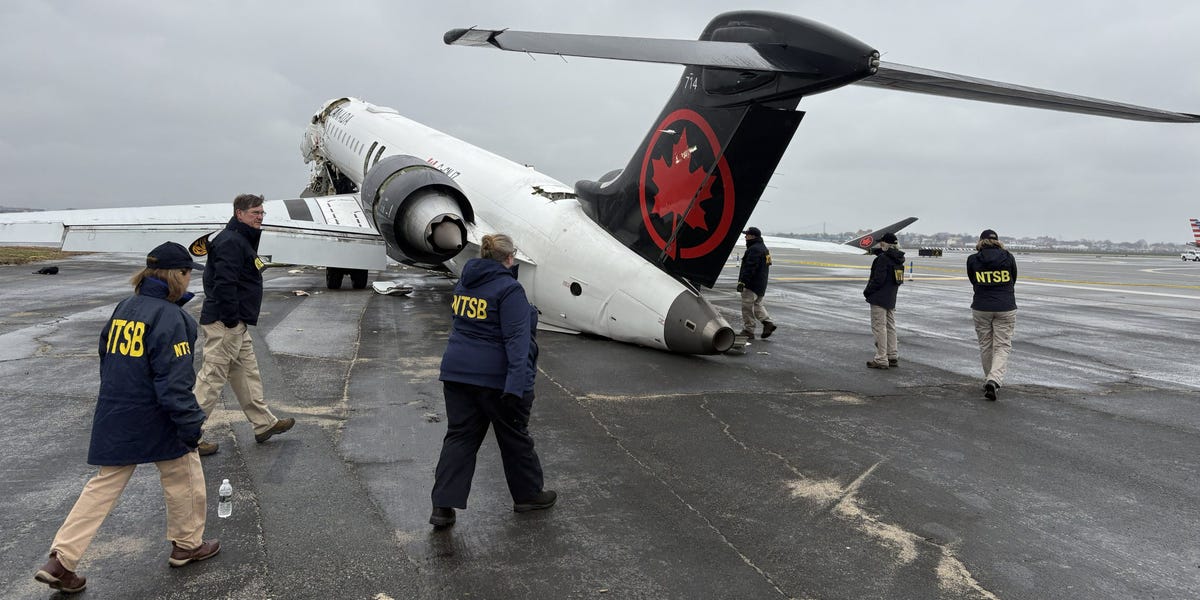
The head of the National Transportation Safety Board said a critical alert designed to prevent runway collisions didn’t trigger before the deadly Air Canada crash Sunday night.
The Airport Surface Detection Equipment, Model X, rolled out between 2003 and 2011, is a ground surveillance system that uses radar and satellite data to track aircraft and vehicles and alert air traffic control of potential conflicts.
It’s deployed at 35 major airports across the US, including LaGuardia in New York, where a regional Bombardier CRJ-900 jet operated by Jazz Aviation as Air Canada Express collided with a fire truck around 11 p.m. Sunday, killing two pilots and hospitalizing 41 others, though many have been released.
NTSB Chair Jennifer Homendy said this system, known as ASDE-X, however, didn’t activate that night “due to the close proximity of vehicles merging and unmerging near the runway, resulting in the inability to create a track of high confidence.”
She later said that the fire truck’s lack of a transponder contributed.
“In order for ASDE-X to work, well, you have to know where ground vehicles and aircraft are,” she said. “So, in this case, that ground vehicle did not have a transponder.”
A truck without a transponder might appear on ASDE‑X radar, but it may not trigger the system’s automatic alert that’s designed to notify the controller.
Videos shared online show several emergency vehicles holding short of Runway 4, where the collision occurred, and one truck moving forward. The truck had been responding to a separate plane on the airfield with an odor issue and received clearance to cross the runway less than a minute before the CRJ touched down.
Audio tapes from ATC Live reveal the controller repeatedly told the truck to “stop” before the crash. It’s unknown why the driver, who was reportedly injured but alive, didn’t respond to the controller’s instruction.
Homendy said there is still a lot of data to collect and interviews to conduct, so it’s impossible to say whether the ASDE-X system could have provided the controller enough time to react and prevent the crash. She added that there may be multiple root causes.
“We rarely, if ever, investigate a major accident where it was one failure,” she said. “Our aviation system is incredibly safe because there are multiple, multiple layers of defense built in to prevent an accident, so when something goes wrong, that means many, many things went wrong.”
Reliable warning and detection systems have long been a focus of the NTSB. The agency has called for improvements to ASDE-X, like sending the alert to pilots, not just controllers. It has also previously recommended expanding the safety technology to more airports.
Along similar lines, the NTSB recently recommended equipping certain military aircraft with a detection system that could display nearby traffic to pilots — technology that it said may have helped prevent the January 2025 midair collision between an Army helicopter and an American Airlines regional jet in Washington, DC, that killed 67 people.
Industry analysts have been warning about runway collisions for years. In 2023, the Federal Aviation Administration convened a panel to address several close calls at US airports. FAA data shows that 1,760 runway incursions, as these close calls and accidents are known, were reported in that fiscal year.
Those numbers were 1,758 in 2024 and 1,636 in 2026. There have been about 500 reported so far in 2026 — including a close call a week before the Air Canada crash, when an Alaska Airlines plane almost collided with a FedEx plane on crossing runways in nearby Newark, New Jersey, on March 17.
Read the full article here