The White House has a new helipad on the South Lawn.
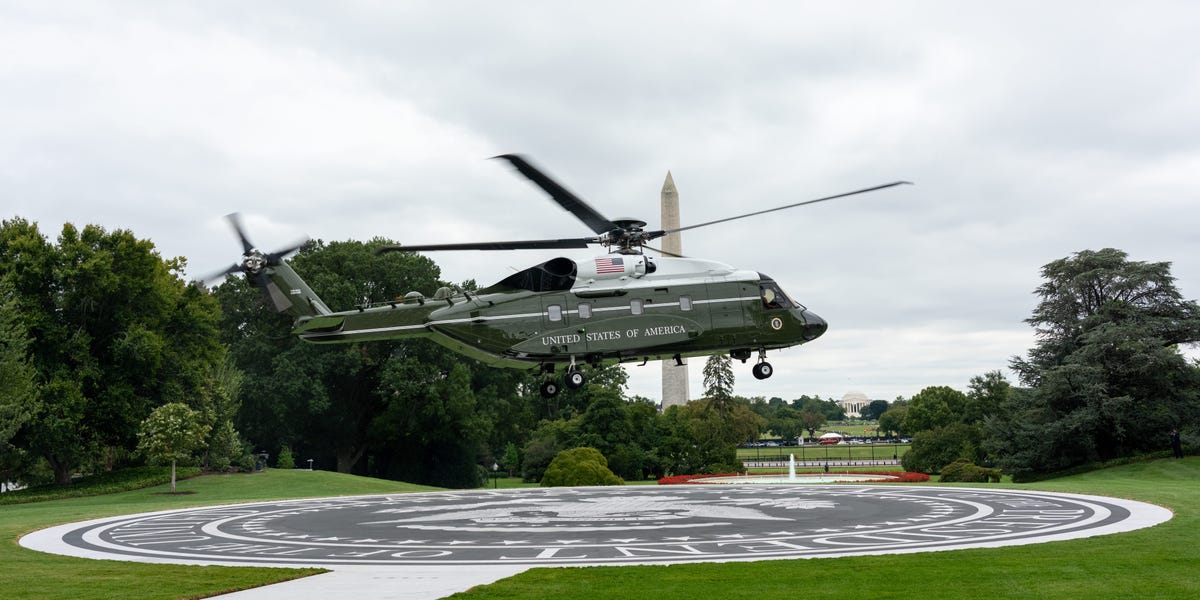
President Donald Trump took off in Marine One from the helipad after an official ribbon-cutting ceremony on Monday.
Trump previously said the White House would receive the granite helipad, paid for by Sikorsky Aircraft — a subsidiary of Lockheed Martin — to support the new fleet of helicopters used as Marine One.
A Lockheed Martin spokesperson confirmed the contribution and told Business Insider it was being made to the National Park Service.
Trump previously said the permanent fixture would help protect the South Lawn’s grass.
The newer helicopters from Sikorsky are about “two and a half times more powerful than the old ones,” Trump said.
“When you land on the grass, it’s not that the grass gets discolored. It gets ripped out,” he said.
The helipad bears the White House seal and cost between $5 million and $6 million.
“Sikorsky is paying for it. You know why? Because they didn’t tell us how powerful these helicopters were,” Trump said. “And they felt a little bit guilty.”
A Sikorsky spokesperson said that the new model for presidential transport — the VH-92A Patriot — delivers “increased performance and reduced maintenance costs and time over the current fleet of presidential helicopters.”
A White House spokesperson did not respond to a request for comment.
Photos have shown the helipad being built amid other massive construction projects the administration is undertaking to transform the White House in line with Trump’s vision.
The helipad faced at least one setback when Trump ordered contractors to redo portions of the work, resulting in crews having to dismantle the nearly 100-foot-wide granite seal that was already in progress, The Washington Post reported.
During construction, Marine One relied on the Ellipse, the park south of the White House, as its landing zone.
Below are photos tracing the history of presidential helicopter landings at the White House and the results of the new helipad.
Aviation pioneer James Ray landed an autogyro, an aircraft with a spinning rotor on top, on the White House South Lawn for the first time in 1931.
James Ray parked a Pitcairn-Cierva PCA-2 autogyro on the South Lawn as part of an award ceremony, according to the National Air and Space Museum. It was the first recorded instance of a rotary-wing aircraft landing on the lawn.
In 1957, President Dwight D. Eisenhower became the first US president to use helicopter transport from the White House lawn.
The first documented instance of Eisenhower boarding a helicopter from the South Lawn was on July 12, 1957, according to The History Channel.
The Marine Corps website states that helicopter transport helped turn a two-hour motorcade into a seven-minute helicopter ride.
Helicopter transport for the US president to and from the White House South Lawn later became standard operating procedure for short-distance travel.
The White House helicopter transport was named Marine One, a call sign for a Marine Corps aircraft carrying the president.
The fleet is operated by Marine Helicopter Squadron One, known as HMX-1 or the Nighthawks.
Marine One has become one of the most visible symbols of presidential travel, next to Air Force One.
Instead of a permanent helipad, White House personnel would place large landing disks on the South Lawn for Marine One helicopters.
The landing targets provide the aircraft with a stable contact point and could reduce turf damage.
The South Lawn is no match for the new Sikorsky aircraft.
In 2024, Lockheed Martin’s Sikorsky formally delivered the VH-92A helicopter to the US Marine Corps to replace the older fleet of aircraft used for Marine One.
The government spent $5 billion on the new fleet.
Bloomberg previously reported in 2024 that issues with the VH-92A scorching the South Lawn have delayed the aircraft’s ability to transport the president.
Trump says construction of the presidential helipad is underway.
Photos show that the grass on the South Lawn has been removed to make way for the construction of the permanent granite helipad.
“For 50 years, we’ve been landing helicopters on grass,” Trump told reporters in July. “The grass is wet, soggy.”
The most eye-catching part of the White House helipad project is already being torn apart.
In early August, contractors were photographed removing the roughly 100-foot-wide granite presidential seal.
According to reporting by the Washington Post, the redesign came after Trump questioned the helipad’s appearance and the South Lawn’s slope.
It’s unclear how much the revisions will add to the project’s price tag.
Trump has repurposed the Ellipse until the helipad construction is completed
While construction continues on the White House’s new helipad, Trump has temporarily shifted Marine One operations to the Ellipse, a park south of the White House.
The Washington Post reported that Trump has pushed to have the helipad finished before China’s leader, Xi Jinping, is expected to visit later in September.
The helipad is only one of the construction projects the White House is going through under Trump 2.0.
Other renovation projects pursued under the second Trump administration include the demolition of the East Wing to make room for a 90,000 square-foot White House ballroom.
The project is estimated to cost $400 million.
The administration also hosted a UFC fight at the White House in June, temporarily turning the South Lawn into an arena.
By September, the granite presidential seal of the helipad was in full view.
The construction project began around June, according to The Washington Post.
On September 6, Trump announced in a Truth Social post that the helipad was completed.
Trump departed from the White House helipad after a ribbon-cutting ceremony
Trump boarded Marine One en route to New York following a ribbon-cutting ceremony on September 21.
Trump’s remarks from the ceremony were largely drowned out by the helicopter and other background noises. Major TV networks also pulled coverage of the event after some news outlets were banned from the White House, making it nearly impossible to hear what Trump was saying.