





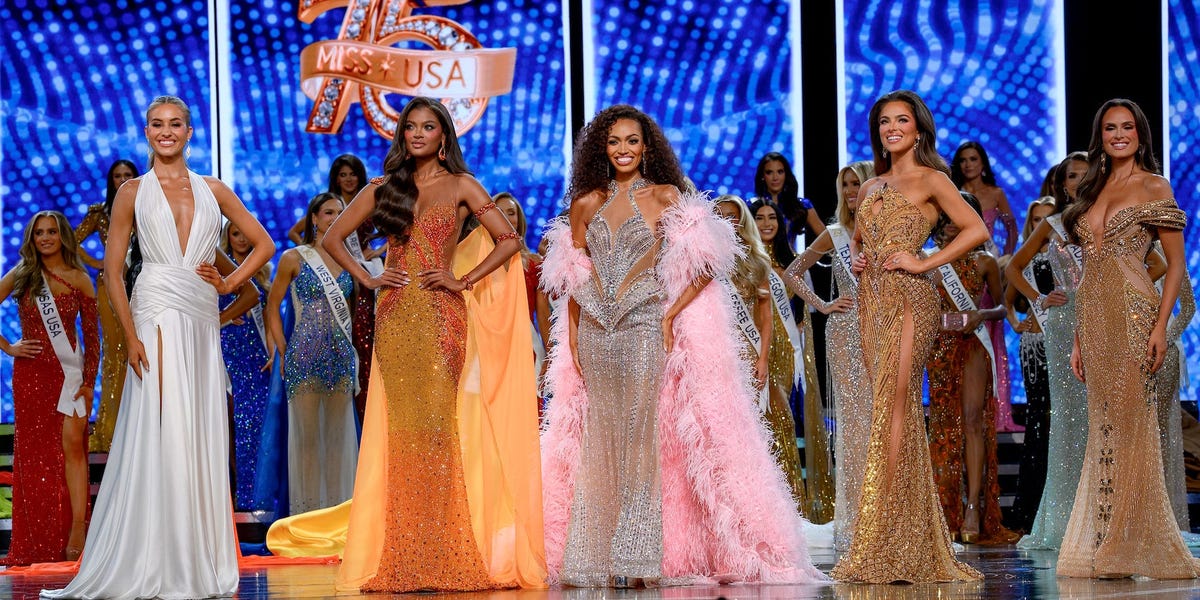
The 2,400-seat Miami theater lit up like a Coldplay concert when the QR code dropped at the Miss USA pageant. A sea of phones — held up by supportive parents, partners, and past pageant queens — trained their cameras on the massive barcode being projected from center stage, ready to vote for their favored contestant.
Twelve minutes on the clock: The countdown was on.
Fingers tapped rapidly as the audience used their free vote or purchased more in bundles — $50 for 50, $250 for 250, $500 for 500 — alongside viewers at home. The top 20 contestants’ headshots shifted around the leaderboard as the votes tallied live on the pageant’s website, revealing exactly how far each woman was from the top spot.
Two minutes left on the clock, a banner flashed across: Now, votes counted double. As the seconds ticked closer to zero, the votes burst in like a flash flood. The gap between first and second place was 1,794 votes at the 36-second mark. When the clock struck zero, it was more than 14,000.
Fans have never had more of a say at Miss USA — especially if they’re willing to pay. At last month’s pageant, paid voting helped determine three top 20 spots, while a fourth went to the contestant who sold the most Westgate Resorts vacation packages, an unprecedented incentive that tied a contestant’s placement to sales for a pageant sponsor. The winner was determined by a panel of six judges, including a mix of Miss USA and Miss Universe winners, but fans also had the opportunity to vote for the top 10 as the “seventh judge.”
Nearly a dozen of this year’s Miss USA contestants spoke to Business Insider about the changes. Some believe it’s a savvy strategy by CEO Thom Brodeur, who took over the pageant in September 2025, to keep the business afloat and increase fan engagement, especially at a time when pageants struggle to remain relevant. Others worry the competition is turning into what one called a “pay-to-play” model, making it less accessible to women who don’t have money or big social media followings.
Nobody is arguing with Beyoncé or Taylor Swift’s teams over the standing-room ticket prices of four-figures and higher, and we’re not going to apologize either.Miss USA CEO Thom Brodeur
“There’s a lot of fatigue,” Miss Arizona Kaitlyn Humphrey told Business Insider. “It’s an expensive sport already, and it breaks my heart that a lot of people can’t compete purely because there’s such a barrier to entry in the financial aspect of things. And then we’re just adding layers to that.”
The bygone days of network TV
Nearly 40 million people tuned in to watch Miss USA in the 1960s and ’70s, but viewership dwindled over its 60 years on television. In 2023, the Miss USA final peaked at 1.1 million viewers on The CW. It was a far cry from its heyday, but still enough for a multiyear deal. The network ultimately dropped the pageant in 2025 amid fallout from former CEO Laylah Rose‘s tenure, during which Miss USA 2023 Noelia Voigt and Miss Teen USA 2023 UmaSofia Srivastava relinquished their crowns due to her leadership.
This year, the competition was set to return to The CW, but, as Business Insider first reported, the network dropped the show on August 20, a week before the final. Miss USA cited a “contractual issue with our production arrangements” and moved it to Queen Beauty Network, a streaming service focused on the pageant industry, where Brodeur is listed as vice president and chief marketing officer.
When the crown was placed on Justus Kelley’s head on August 27, making her the first married woman and mother to win the title, a live viewer counter on the Queen Beauty Network showed around 4,000 people watching.
Shrinking viewership hasn’t only affected Miss USA’s ratings — it’s put a serious dent in the pageant’s coffers. Paula Shugart, who oversaw Miss USA from 2001 to 2020 as president of the Miss Universe Organization, told Business Insider that the pageant once received $3 to $5 million in licensing fees from the networks. Those days are gone.
“Network television has completely changed,” Shugart said. “You don’t have the viewership, and you’re not going to get the license fees that you used to get. You have to figure out different ways to pay for it and defray the costs.”
It’s a reality that Brodeur knows well.
“The days of ‘free lunch’ for pageants and pageant fans are over,” he told Business Insider last week. “They’ve been over for some time. Introducing new revenue streams — whether that’s through fan voting, contests, or other unique opportunities we’re exploring — are the way this industry lives to see its next 75 years.”
Competing at Miss USA wasn’t cheap to begin with, although the cost varies widely depending on who you ask. Contestants who spoke to Business Insider estimated costs ranging from $3,000 to $50,000.
Brodeur compared the investment to that of any competitive sport. “There is nothing new under the sun about creating opportunities and spaces for all of us to exercise our God-given gifts in this world,” he said. “Unfortunately, there are also costs attached to the creation of those opportunities and spaces, and that’s the reality of life.”
A new way to engage fans
Traditionally, contestants make it to Miss USA by winning a state pageant.
Those are organized and funded by individual directors, who pay the organization a franchise fee. Contestants must live, work, or study in the state for at least 90 days prior to the competition and are allowed to compete in two state pageants a year.
When Brodeur took over as CEO, he had five weeks to put on the Miss USA 2025 pageant. Some departed state directors had not been replaced, and eight states were missing titleholders. His solution: an open casting call in which women from any state could apply for a state title. Five judges selected the titleholders.
This year, 16 states were left without directors. Brodeur said only the Miss Universe Organization can legally issue franchise agreements to new state directors, so the open casting call returned — this time with fans getting a say.
Before the applicants could be seen by a judging panel of former Miss USA winners, they had to make it through three rounds of fan voting over the course of a month. People could use a daily free vote or purchase bundles that ranged from $4.99 for 10 votes to $499 for 2,000 votes on a third-party website. The votes did not roll over from round to round, so each contestant started each round back at square one.
“It was crazy,” said Amber Uhler, who was selected to represent Michigan through the casting call. “I had to get everyone I knew to put in paid votes for me. [I said], ‘If you were ever going to buy me a Christmas gift, just make it this.'”
Miss USA split the 16 states into two casting calls. Women who didn’t get selected in the first, which ran from May 20 to June 30, were automatically entered into the second, from June 29 to July 28. That meant some women were campaigning for votes for two months.
Malory Hudson, who has competed at 12 Miss USA state pageants since 2017, was one of them. “I love competing, but I hated this open casting call,” said Hudson, who did not make it through the judges’ panel. “There was just anxiety every single day. You have to post so much, and it’s exhausting.”
Other contestants, like Uhler, enjoyed the process because it “made it more fun” as people were invested in the contestants’ journeys. Jordyn Owen, who won Miss Colorado through the open call, said it brought “a lot more buzz and attention” to Miss USA.
“Last year, it was completely anonymous. No one knew if you submitted in the open call or not,” she added. “Having it be very public this year, I actually kind of liked it because it did make it feel a little bit more invested.”
Brodeur said that the multiple rounds of voting were designed to engage fans and give contestants the “absolute best chance and most opportunity for their fans to advance them into the final judging round.”
“We recognize that both open casting and fan voting are ‘new ways’ of thinking about and approaching this journey in pageantry,” he added. “Not everything that is innovative is accepted universally right away.”
Some contestants worried that the process was a barrier for women who didn’t have generous sponsors via their family, friends, or followers. Uhler said her family spent $4,000 to $5,000 in votes during the last round; Hudson said she had a sponsor who bought around $30,000 worth of votes.
Brodeur disputed that the new fan voting made Miss USA less accessible, saying nearly 70% of the open-call winners advanced with a “much higher ratio of free votes from their fans than paid votes.”
“There are two types of competitors in this sport,” he said. “The first… has such a deeply engaged fan base she could repeatedly encourage her fans to ‘vote for me for free’ and she advanced. The other was the candidate who wasn’t afraid to seek the financial support of her friends, family, and fans to drive their participation.”
“How is this any different than Instagram and TikTok influencers monetizing their content or their ‘journeys/stories’ through fans on behalf of the brands they’re repping?” he added. “It’s absolutely the same process.”
Brodeur said the open casting call is here to stay for at least another year. “As we work through this next season’s contract process, we are likely going to be forced to execute a similar strategy as we did during this last cycle,” he added.
The People’s Choice(s)
The campaign for votes wasn’t over after the open casting call. Next, contestants had to go through People’s Choice, which let fans vote for their favorite among all 51 Miss USA 2026 contestants. As with the casting call, fans could use a daily free vote or purchase them in bundles.
Most pageants — including Miss Universe and Miss America — have traditionally allocated one spot in the semifinals for the contestant who receives the most fan votes. Under Brodeur’s leadership, that single spot in Miss USA’s top 20 expanded to four in 2025, and three this year.
It’s been a controversial decision among contestants, including Miss Kansas Madilynn Becker, who won this year’s People’s Choice award with Miss Louisiana Ella Clark and Miss Colorado’s Owen.
“People’s Choice is a path, but it’s almost like the shortcut, in a sense,” said Becker. “I think I would have felt even more proud if I got in on my own merit.”
“I would love to see the voting become a free thing because, essentially, it comes down to who has the most money to champion for them,” said Miss California Acacia McBride.
Brodeur said he expanded the number of People’s Choice contestants to give fans a larger say. “One of the rallying cries for the better part of a decade has been, ‘We want more of a voice in who makes it and where,'” he added.
He said that’s why fans were also given the chance to vote for the top 10 on finals night. The Miss USA website said these votes were “combined into a seventh score and counted with the judges’ six when the top 10 is decided.” Brodeur confirmed that the fan voting counted as 14% of the contestants’ overall score.
While a number of contestants who spoke to Business Insider thought the voting was a great way to keep the audience engaged, comparing it to the real-time voting on “Love Island” or “Dancing with the Stars,” others were surprised to learn that fans could purchase votes.
“It definitely stirred up a lot of feelings backstage,” Arizona’s Humphrey said. “Some of the girls have different financial situations than others, and you feel like things are getting ripped away from you for factors that you can’t control, and we’ve already spent so much money to be there.”
Tens of thousands of votes poured in, but, in the end, the three women who received the most votes — Humphrey, Miss Louisiana Ella Clark, and Miss Montana Lisbeth Fernández — did not advance to the top 10.
“I feel very blessed to know that I have a big audience that is willing to show up for me,” said Fernández, who received the most votes. “But at the end of the day, the judges are the ones who make the ultimate call.”
Parents and pageant fans tossed around the phrase “money grab” throughout the weeklong 2026 competition in Miami.
Brodeur said the organization made “five or six figures” from fan voting but declined to share an exact number. He also noted that some revenue from fan voting was used to fund new cash prizes — ranging from $3,500 to $15,000 — for every contestant who made it into the top five. The salary for this year’s Miss USA winner also increased to $150,000; it was $75,000 in 2025.
“There were a lot of different aspects where I was like, ‘OK, you have to pay to play,'” said McBride. “However, I do think, on the flip side of that, incorporating the cash prizes and the salary balanced it out.”
A new top 20 incentive
An additional top 20 spot was reserved for the contestant who sold the most Westgate Resorts vacation packages: $99 for a two-night stay at one of six US properties.
Miss USA announced the new partnership in April. Brodeur told Business Insider that it was a way to tap into what he calls “one of the largest micro and nano-influencer networks of women aged 14 to 45 in the United States.”
Some women dove headfirst, traveling to a Westgate property to film Instagram content. Fernández, who secured the “Westgate Brand Ambassador” title, said she sold almost 200 packages and will now have the opportunity to interview for a six-figure position at the company.
“A lot of the girls were focused on the People’s Choice, but I really didn’t give it any thought at all because I wanted to win the ‘Westgate Brand Ambassador,'” she told Business Insider. “I put my selling skills in action, and I promoted that all over with my friends, family, and community. I also sold some corporate packages.”
Uhler, who estimates she sold 103 packages, was also a fan of the incentive. Although she didn’t make it into the top 20, she appreciated that Miss USA offered a new avenue for contestants to advance.
“It’s great that you can work hard and earn something rather than just, you know, being the prettiest, or having the best walk, or having the best body,” she added. “I don’t think that I have any of those things, but you almost can’t outwork me — except for this time, someone did! I really thought I was going to nail it with 100.”
Some contestants who spoke to Business Insider worried that the placement was out of reach for those without built-in social media followings. Others, like Miss USA 2004 Shandi Finnessey, didn’t think it fit the brand.
“I don’t think they should be selling real estate,” Finnessey said. “Miss USA is not a salesperson; she should be a spokeswoman.”
Brodeur said he believes that it’s part of Miss USA’s job to be a “brand ambassador, a salesperson, a spokesperson… for brands that are willing to test their skills and see who rises to the occasion.”
The $99 Westgate resort deal was also included in the $500 ticket for this year’s Miss USA competition, a steeper price than in years past. One contestant said her parents spent $2,000 on tickets for the preliminary, final, and state costume shows this year. Others told their relatives to save their money and watch from home.
“At the end of the day, I would rather my dad be in the stands than go on a vacation,” Becker said.
Brodeur defended the cost, saying he wanted to “elevate the Miss USA brand.”
“We’re not a high school musical production. We’re not a prom or homecoming queen event,” he said. “Nobody is arguing with Beyoncé or Taylor Swift’s teams over the standing-room ticket prices of four-figures and higher, and we’re not going to apologize either.”
Brodeur hopes the changes can catapult Miss USA into its next chapter after years of scandals. The challenge is proving to prospective contestants that there will be a return on their investment.
Is it enough for Miss USA to be another influencer? The stage used to be a launching pad for stars like Halle Berry and Kenya Moore. Some pageant queens aren’t convinced it still has that power.
“Anyone these days can pick up your phone and go on TikTok,” said Owen. “I’m not saying it’s easy. It takes a lot to build followers and a brand, but what pageants used to have were a household name. Miss USA needs to have that celebrity quality again.”
Read the full article here