



Rachel Pohl and Charles Post had a phrase they kept in mind when they decided to move to the Arctic.
“If dreams were easy, they wouldn’t be dreams,” Post, a 38-year-old marketing strategist and conservationist, told Business Insider.
Post and his wife, Rachel Pohl, a 34-year-old artist, leaned into that phrase as they moved out of Bozeman, Montana, and purchased a home in Flakstad, a village on Norway’s Lofoten Islands, in a sparsely populated area with fewer than 20 residents.
They returned to the idea as they launched businesses in a foreign country, learned a new language, built friendships, and adapted to Norwegian culture.
Now, after living in the Arctic for four and a half years, the couple says they accomplished what they set out to do. It’s time to move on to the next adventure — one that hopefully won’t have them saying the phrase nearly as often.
“The beauty of perspective is to go, do it, and then look back and say, ‘OK, is this dream still the dream?'”
For Post and Pohl, Norway is no longer the dream. They’ve put their remote farmhouse on the market, and this fall, the pair plans to head back to Montana.
They moved to Norway in search of a place they could call home — and found it
Six years ago, Post and Pohl had a feeling that they had settled down too quickly. Despite having a community, steady routine, and home in Bozeman, the couple “still had that itch to look over the fence.”
That itch led them to Norway. They both had distant family ties to the country and an affinity for the remote landscapes of the Lofoten Islands, which they’d visited together in 2019.
More importantly, there was a path to get there. The couple met with an immigration lawyer, who helped them begin the process of applying for Norway’s skilled worker visa.
To qualify, Post said, they both had to prove they ran successful US businesses that they could replicate in Norway.
Post would do marketing, and Pohl would start a fine-arts business. After securing work and residence permits, they arrived in 2022 — two and a half years later.
The couple returned to the Lofoten Islands, the place that had inspired them years ago. Post said they appreciated that the remote and otherworldly islands had everything from surfing and skiing to birds and breathtaking landscapes.
They rented a tiny cabin perched on stilts over the ocean their first year on the islands. It was picturesque but cramped.
Running two businesses from the space made it clear that if Norway was going to be more than an extended adventure, they needed a permanent home.
They spent years looking through limited options in the area amid a competitive real-estate market. Less than 25,000 people live across the Lofoten Islands, and houses are often passed down from generation to generation.
Few residents meant not many homes, and none caught their eye until 2023, when the three-bedroom, two-bath farmhouse of their dreams hit the market.
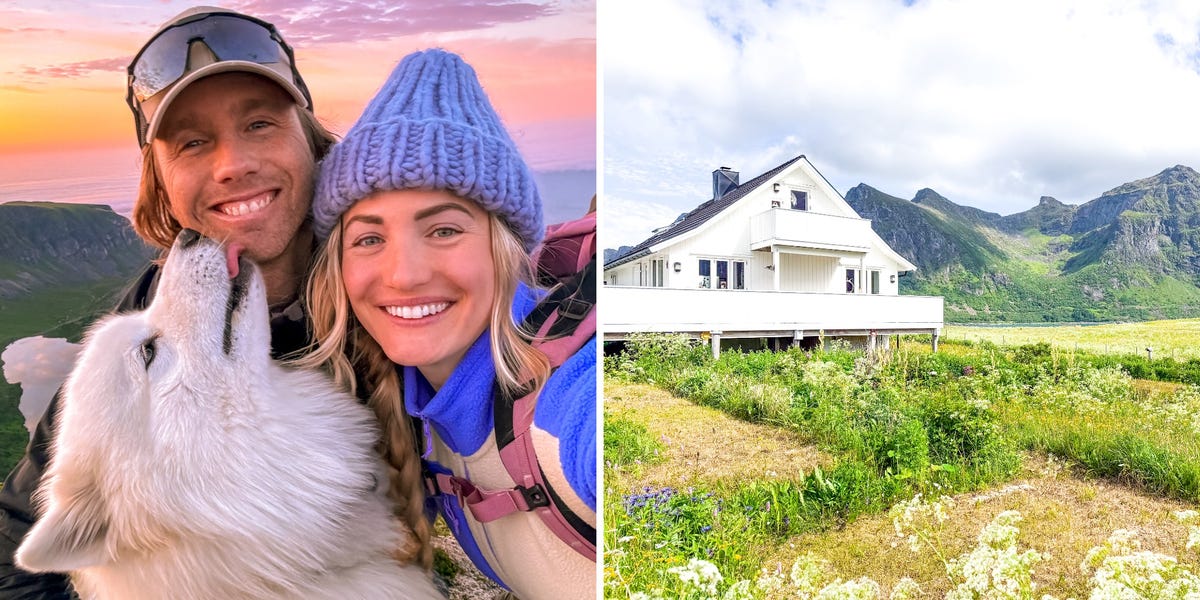
It was a 1,800-square-foot home with enough room for Pohl to have a painting studio and Post to have an office. There were plenty of windows, a welcoming porch, and an open kitchen.
But what sold the pair was the land. The 2.9-acre property sat at the end of a quiet road. It’s surrounded by gardens, wildflower meadows, wildlife, and a remote beach.
Post remembers thinking, “This is what the team needs. This is our dream.”
In Norway, homes are typically put up for auction. Due to the house’s desirable size and location, Post knew the property would draw local and international attention, likely driving the price beyond the couple’s budget.
So, minutes after seeing the listing, Post said, he was in the car, driving to the address. He found the sellers out front in their garden.
“I walked up, and I said, ‘I saw your house just posted online for sale like 30 minutes ago,'” he recalled. “‘What would be the price for us just to do this right now?'”
They informed him that they were planning to sell the home the traditional way, but he stayed persistent.
In between asking them to name their price, he promised them he and his wife would “continue the tradition of loving this place” and be “great caretakers of it.”
After a long discussion, plenty of back-and-forth, and a few cups of coffee, Post convinced them to sell the home off-market for about $669,000 after the exchange rate — nearly $200,000 above asking.
A lot of the process was unconventional, but it worked.
“Rachel was up in Alberta at her brother’s wedding,” Post said. “She’d never even seen the house before we bought it.”
A month later, they moved in, and Post’s instincts about this being the perfect place were right.
The property, with its meadows and beach, helped the Lofoten Islands no longer feel like a temporary stay.
They finally had enough space to unpack a tiny shipping unit they had sent from across the world. Post placed books and bird guides onto his childhood bookshelf. Pohl unwrapped her paintings and artworks and set up her studio.
Young neighbors down the street helped them build community — mornings were spent sipping coffee together on porches as their dogs also became friends.
In time, they settled in and made renovations and adjustments, including painting the interior, adding a new energy-saving heat pump, and building a free-standing sauna in the backyard.
“It took two years to really have Norway feel like home,” Post said.
Small factors added up and put stress on their Norwegian dream
Building their life in Norway came with a steady stream of challenges.
During my video call with Post, he turned his camera toward the backseat of his car, showing two grocery bags that cost nearly $300.
He said he’d spend much less back in Montana for similar, or even higher-quality items. The gas to get him to the grocery store is also expensive, costing about $8.50 a gallon.
Beyond day-to-day expenses, the couple pays about $15,000 each year for international tax compliance.
Cost wasn’t the only adjustment. Even after four years, living abroad required extra effort they hadn’t anticipated.
Although English is widely spoken in the area, Norwegian is the primary language, adding another layer of difficulty to navigating vet visits, emergencies, and even day-to-day tasks.
“The culture and the language are different, and so you’re allocating 5, 10, 15% of your brain power just to read the mail, read the food label,” Post said. “To do all the simple things that we all take for granted.”
When Pohl had a planned abdominal surgery, they had an especially challenging time navigating a new healthcare system and the language barrier. They didn’t have family and friends nearby to help during the recovery process.
Given their remote location, even routine errands — doctor visits, pharmacy runs, shopping sprees — often involved hours of driving.
When I spoke to Post, he was in the midst of a two-hour round-trip pharmacy run to pick up a prescription for one of their dogs.
In the Lofoten Islands, they’re on the other side of the world from most of their people and are still navigating a culture and language that’s fairly new to them.
“When you have your worst days, your hardest days, it’s 10% harder here just because of everything that comes with life here,” he said.
For example, it’s hard to know who to call or what to do when it’s 1 a.m., and you get a flat tire in the middle of Norway.
Meanwhile, he said, he has no anxieties about navigating challenges back in Montana, where there’s no language barrier and “we have like 100 people we can call for help.”
In the end, it wasn’t wanting cheaper gas or more convenience that eventually called them back to the US: It was community.
“So many people back home call you less ’cause it’s just hard to get in touch with the time zone,” he said. (The difference is about eight hours.) “There’s like this gradual disconnect that’s a function of time and distance. It added up more every year.”
When a family member unexpectedly died last October, it felt like another wake-up call.
A trip back home — consisting of four or five flights costing over $3,000 and taking more than 25 hours — proved too expensive and too complicated, so the couple stayed in Norway and grieved thousands of miles away from family.
By this past winter, the couple reflected on the past four years abroad and what they had missed: holidays spent without their family, friends’ weddings missed, birthdays and baptisms celebrated over FaceTime.
“You’re just watching your parents get white hair over the phone,” Post said.
After months of discussion, Post said, they decided the trade-offs weren’t worth it. They wanted to spend their time back in Montana surrounded by their loved ones.
After 4 years, they’re heading back to Montana and selling their Norway home
As the couple plans their return to Montana in October, they’re looking for the next person eager to call their remote slice of the Lofoten Islands home.
Currently, their house is listed at about $1.2 million, almost double what they originally paid for it.
Post said he’s not worried about the property selling — they’ve had a lot of interest so far — but he and Pohl are focused on finding a buyer who’s the right fit.
They feel obligated (and privileged) to find someone who will care for the land and appreciate the region as they did. As the couple ties up their time in Norway, Post said he can’t help but look forward to the small parts of Montana he missed.
“It’s a thunderstorm in June with your brother. For Rachel, it’s the wildflowers of the West that are ever-present in her work … it’s your best friends that can read your mind,” he said.
In the end, they also don’t regret taking a chance and spending several years living abroad in such a remote, beautiful place.
Norway was one dream. Now, they’re heading home to chase another.
Read the full article here