





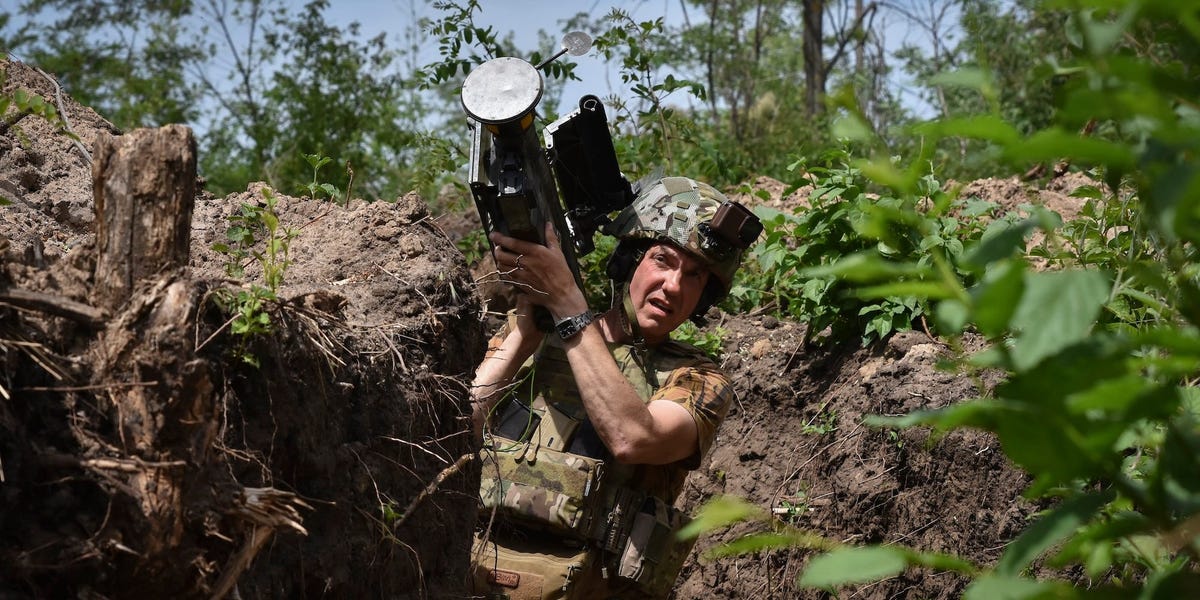
The hardest shortage facing one Ukrainian shoulder-fired air-defense unit isn’t necessarily missiles, its battery sergeant told Business Insider. It’s some of the equipment that helps crews find targets and keep their systems running.
The soldier, who uses the call sign Yankee, serves in a front-line unit equipped with man-portable air-defense systems, or MANPADS, which fire shoulder-launched missiles able to engage low-flying aircraft, as well as cruise missiles and drones.
Weapons like these, which include the US Stinger, Polish Piorun, and Soviet-designed Igla, have been a key part of Ukraine’s short-range air defense in front-line areas, protecting troops and operations from attacks.
Yankee said that for him, at least, one of the hardest things “is finding resources. Secondary resources, not the weaponry, but electronic warfare stuff.”
He said some of the devices that help his team detect threats and keep its equipment working are “hard to get.” What is hardest to find is “mostly electronics.”
“I’m talking more about devices that locate the drones and warn you,” Yankee said. “I’m talking about stuff like EcoFlows, batteries, big batteries, because we have a shortage of them, just in general, just a mass shortage.”
Ukrainian soldiers are increasingly using drone detectors, including small handheld or vehicle-mounted models, to warn of certain incoming enemy drones by detecting their radio frequencies.
EcoFlows are portable power stations that can power or recharge essential gear such as radios and communications equipment, Starlink terminals, laptops and tablets, drone equipment, electronic warfare systems, and sensors.
These, and batteries in general, are especially important because soldiers are often far from power outlets, and Russian attacks often shut down energy infrastructure. Running a portable generator would be much louder and might reveal their positions.
Electronic warfare systems are also vital for Ukraine as it tries to disrupt Russia’s communications and jam its drones.
Despite their importance, this equipment isn’t always easy for units to obtain in sufficient quantities. Some of the gear is much newer and less readily available than supplies like ammunition. And while demand is high, some equipment still isn’t being produced in large quantities. In some cases, there are also distribution bottlenecks that affect availability.
Unlike many Western militaries, Ukraine’s military doesn’t have a highly centralized system for weapons procurement. Units often buy or receive gear themselves, including through crowdfunding.
There are advantages to this setup for rapid innovation because units engage manufacturers directly, but the system can also result in uneven distribution, leaving some units facing shortages.
Ukrainian foundations, units, and other groups that are involved in sourcing and crowdfunding equipment for troops often ask for gear like batteries and detectors, with some describing them as items that air defenders regularly need.
MANPADS and the units that operate them are important for Ukraine. Units, service members, and officials have reported missiles taking down Russian drones, helicopters, and aircraft, and Western analysts have credited MANPADS with making penetrating low-altitude Russian fixed-wing and helicopter sorties too costly for Russia to continue.
A report last year from the Center for Strategic and International Studies, a US think tank, said that Ukraine’s integration of MANPADS operators into its air defense teams forced Russian pilots to choose between flying high and being targeted by ground-based air defenses or flying low and facing MANPAD missiles. These short-range defenses relieved the pressure on Ukraine’s ground-based systems, allowing them to “survive and eventually recover.”
Yankee’s unit provides air defense for infantry who need to get to the zero line, the far edge of the front line, and, as a result, “we participate in battle,” he said.
He said that conditions there can be so dangerous that moving just 300 meters can take 7 days of waiting for safe conditions and protection. Moving even that short distance, he said, “can be like a question of life and death.”
Yankee spoke with Business Insider at Operation Legio, a Norway-led multinational program that trains and equips Ukrainian forces, including at a purpose-built camp in Poland. He said he was learning NATO standards and tactics, combining Western practices with his existing battle-won skills before returning to Ukraine.
Yankee said he uses the Stinger and Igla systems. Ukrainian soldiers have, at times since Russia’s full-scale invasion began in February 2022, reported shortages of MANPADS missiles, saying those shortages allowed Russian forces to be bolder because they knew the Ukrainians couldn’t try to stop as many of their attacks.
But Ukraine’s military has not suffered critical shortages of them the way it has with larger, surface-to-air missiles, and allies have announced new deliveries throughout the war.
Not everything is consistent across the force though. Ukraine’s military disseminates weapons and ammunition according to operational need, so one unit could be well supplied for critical missions while another comes up short.
Read the full article here