



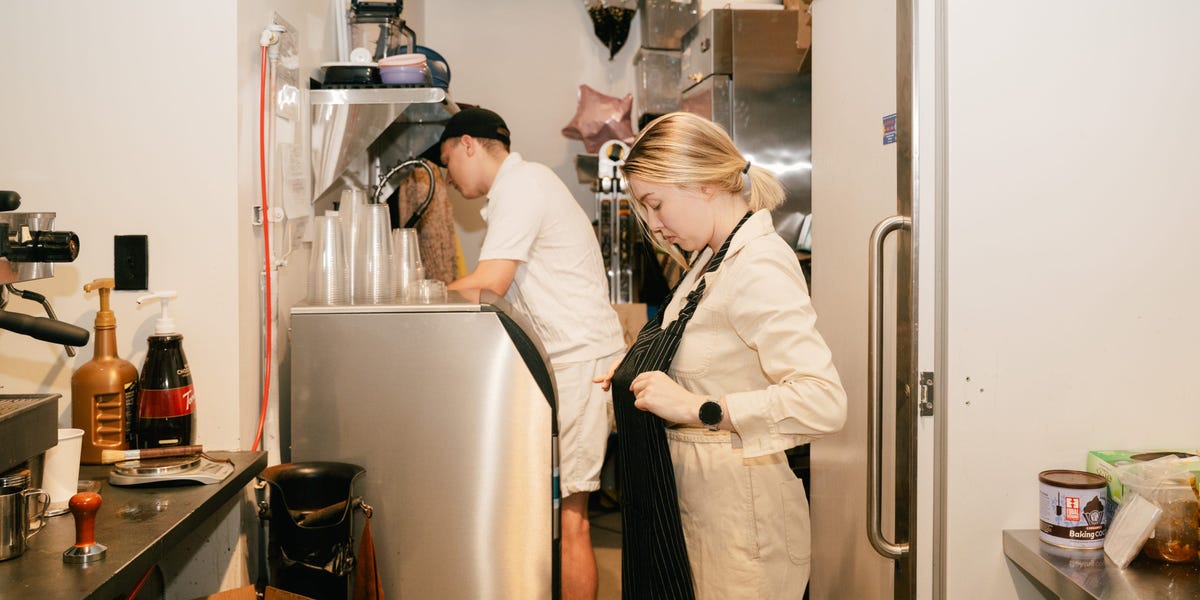
Ilia Penzin and Liliia Penzina call their café and art gallery their baby.
“A big baby,” Penzina said, laughing. The entrepreneurs’ first year running T.O.L.K. in the Brooklyn neighborhood of Bushwick has been defined by the personal sacrifice and precarity of running a small business in one of the most expensive cities in the US. To fund the startup costs, they moved in with roommates to save on rent, took a $30,000 loan from family, and went into credit card debt. Still, they remain optimistic and would encourage other would-be entrepreneurs to follow their dreams.
“The United States is the best country to try a business,” Penzin said. “We love coffee, we love hospitality. We decided to open a café.”
For Business Insider’s Cost of the City series, the couple detailed what it took to get off the ground, the day-to-day costs, and why they have yet to turn a profit.
Managing the costs of a business in NYC
Penzin and Penzina, who met in school in Russia 15 years ago, applied for asylum in the US after the start of the Russia-Ukraine war. Knowing little English, they worked in hospitality and cafes to get by, but they desired to build something for themselves.
With a dream in mind, they cut personal expenses, including moving from a one-bedroom apartment into a $1,150 room in a three-bedroom apartment. Penzin spent three months building the space that would become T.O.L.K. while Penzina worked three barista jobs.
Now that they’re open for business, Penzin handles management, vendors, budgeting, and banking, while Penzina handles the café and art gallery’s daily operations. The café’s white walls are normally covered with local artwork, and the rest of the open space is taken up by a sofa, a few circular tables, and a dog station with water and treats.
Nearly a year in, the coffee shop is not making enough to cover its costs. Records provided by the owners show the café generated an average of about $5,600 net sales a month from January to June and paid $2,700 in monthly rent, almost half of the monthly net sales. After paying rent, food expenses, and additional costs, the café was left with a cash shortfall of roughly $900 a month.
Penzin said the main challenge is getting more customers. The café has averaged 24 checks per day at around $8.76 each, totaling roughly $212 in gross sales per day — not enough to have the business pay for itself.
To supplement the income, Penzin works as a handyman, assembling furniture, doing small renovations, and painting. He uses the same tools and the 2008 Toyota Highlander he bought for the coffee shop.
The couple has only taken three days off this year and put all their energy into running the café, but they consider it worth it.
“It’s not making us unhappy. We’re just working; it’s our job to make this business operate,” Penzin said. Penzina added, “You are motivated already because you try to survive. If you don’t have money, it’s your motivation.”
Think, Observe, Listen, Know.
T.O.L.K. stands for: Think, Observe, Listen, Know — reflecting how the couple wants customers to experience the space. The name also transcends its English acronym. In Russian, tolk means “meaning, understanding, and having a sense or purpose,” while in various Scandinavian languages it refers to an “interpreter,” someone meant to translate and understand ideas for others — something T.O.L.K. strives to do by being a community space.
“That felt especially fitting for a space built around art, coffee, conversation, and community: a place where people can exchange perspectives, discover new ideas, and find meaning in what they see and experience,” he said.
The café strives to be a place where beginner artists can display their work affordably; T.O.L.K. doesn’t take commission. At the same time, guests who may not have time to visit galleries can enjoy art on their daily coffee runs.
“Everybody has the time at least once a day to go to any coffee shop and get coffee,” Penzin said. “But they never go to see the local arts.”
Penzina usually creates a special drinks menu inspired by the current artist and exhibition at the coffee shop.
“I try to find how to combine coffee and art,” she said. “It’s like a liquid version of the person and a liquid version of their art.”
With all the money, energy, and time the couple has put in, they don’t see quitting or burning out as an option. Their dream is to expand their business and open more spots in the future, possibly moving upstate or to Long Island.
“We definitely will not give up on our entrepreneur journey — we definitely will fight until we succeed.”
For them, the cost is worth it to live in NYC. They find the business and cultural opportunities in the five boroughs unmatched.
“You pay for those opportunities, for convenience, for your dream,” he said. Referencing a popular Russian phrase that alludes to the feeling of relief, he emphasized: “When we drive back from different states, and we see the sign ‘New York City,’ we feel a stone, a rock, fall from our soul.”
Read the full article here