




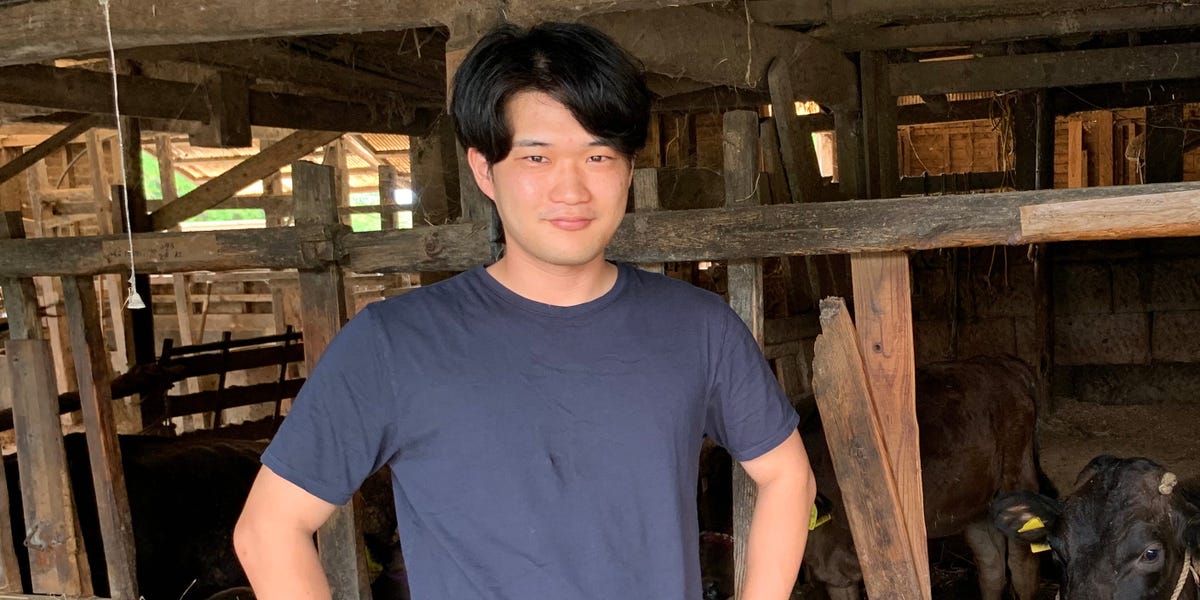
This as-told-to essay is based on a conversation with Masashi Nakamura, 29, who is running Nakamura Farm, a small Wagyu farm in Kagoshima Prefecture, Japan. His words have been edited for length and clarity.
I was working at a meat processing facility in Tasmania when my interest in Wagyu began. It was 2024, and I had just moved from Vancouver after my plans to study web development fell through.
One day, I noticed the word “Wagyu” written on the hanging beef carcasses. Having grown up in Japan, I’d always taken this kind of beef for granted. But seeing how highly people overseas regarded it changed my perspective. I began to understand that Wagyu was more than just beef — it had deep roots in Japan and was valued around the world.
I was 27 and living in a rural area surrounded by cattle. The experience made me realize how strongly I was drawn to the quiet lifestyle. I began reflecting on my future.
Last year, I decided to pursue a career in the Wagyu industry. I moved back to Japan to help restore my grandfather’s aging Wagyu farm in Satsuma, a town in Kagoshima Prefecture.
From IT to the countryside
I grew up in a town near Kansai International Airport in Osaka Prefecture. Unlike the image of Osaka as a crowded city, my hometown has many fields and rice paddies.
I graduated from a Japanese university with a degree in English language and communication, hoping English would help me work internationally and experience different cultures.
By graduation, though, I realized English alone wasn’t enough. I got a job as an IT engineer in Osaka, monitoring and maintaining servers. After two years, I decided I wanted to build digital products and systems myself.
I moved to Vancouver to study web development, but after a year, I realized it wasn’t the right path and dropped out. Next, I headed to Australia on a working holiday visa.
Around the same time, I found out that my grandfather was planning to close the Wagyu farm after selling all of his cattle. My grandparents were getting older and could no longer run it.
I used to visit the farm as a kid. During the summer, I’d ride in the back of my grandfather’s truck as he drove around the rice fields. When I told him I wanted to take over the farm, he was surprised. He worried I wouldn’t be able to make a living from farming, but he supported my decision.
For years, I’d been so focused on life overseas that I constantly looked outside Japan for my future. Now, I hope my IT and language skills will give me an edge in farming and help me do things differently while still respecting tradition.
Embracing a simple life
I moved back to Japan in late 2025 and took over the farm’s daily operations as my grandfather began stepping back. These days, I wake up at 6 in the morning to feed the cattle and clean the farm.
I’m still rebuilding the business, and it doesn’t generate enough income to hire workers. My grandmother continues to care for the cattle, and I’ve used savings from my IT career and overseas jobs to pay for renovations, maintenance, feed, and the farm license.
To support myself, I work part-time at an artificial insemination center, where I help with calf management and public relations. I also work at a neighboring Wagyu farm, which gives me a chance to learn more about cattle care.
I also earn income online through Buy Me a Coffee donations and Instagram subscriptions, where I share behind-the-scenes videos of Wagyu farming. I also manage social media for the Wagyu farm where I work part-time.
I earn less than half of what I made when I was starting out as an IT engineer. But I’m happier living in the countryside. I feel like I have a greater sense of purpose.
Rebuilding with a purpose
Working in the IT industry came with mental stress, but in farming, it’s physical and financial stress and constant pressure. When you’re responsible for living animals, there’s no such thing as a day off.
Despite that, restoring my grandfather’s farm motivates me. It has a history of over 60 years and is something he has devoted his life to. This experience isn’t something I could gain by working in front of a screen.
My goal isn’t to follow the traditional model of increasing the herd size to grow revenue. I’ve seen how that can turn into a cycle of constant survival, from balancing cattle with rice farming to pushing people to their limits.
Instead, I want to build a sustainable business by diversifying my income streams. Right now, I’m creating a management application to help with the farm and hoping to develop a farmstay. My focus isn’t on raising more money, but creating a structure that can last and grow over time.
For now, my focus is on keeping the farm alive, at least while my grandfather is alive
Read the full article here