

Warning: Major spoilers ahead for “House of the Dragon” season three.
As season three of “House of the Dragon” comes to a close with characteristic fire and blood, showrunner Ryan Condal is already anticipating scrutiny of the next one.
In an interview ahead of Sunday’s season three finale, Condal confirmed that HBO’s tentpole “Game of Thrones” spinoff will end with its fourth season. As Condal and his team map out a final eight-episode arc for the Targaryen dragonlords embroiled in a civil war, the franchise’s history and its fiercely devoted fans loom large.
“It’s hard enough to make a season finale,” Condal told Business Insider. “Try making a series finale that tries to be all things to all people, and also have a distinct point of view and thing to say and place to leave off all the characters.”
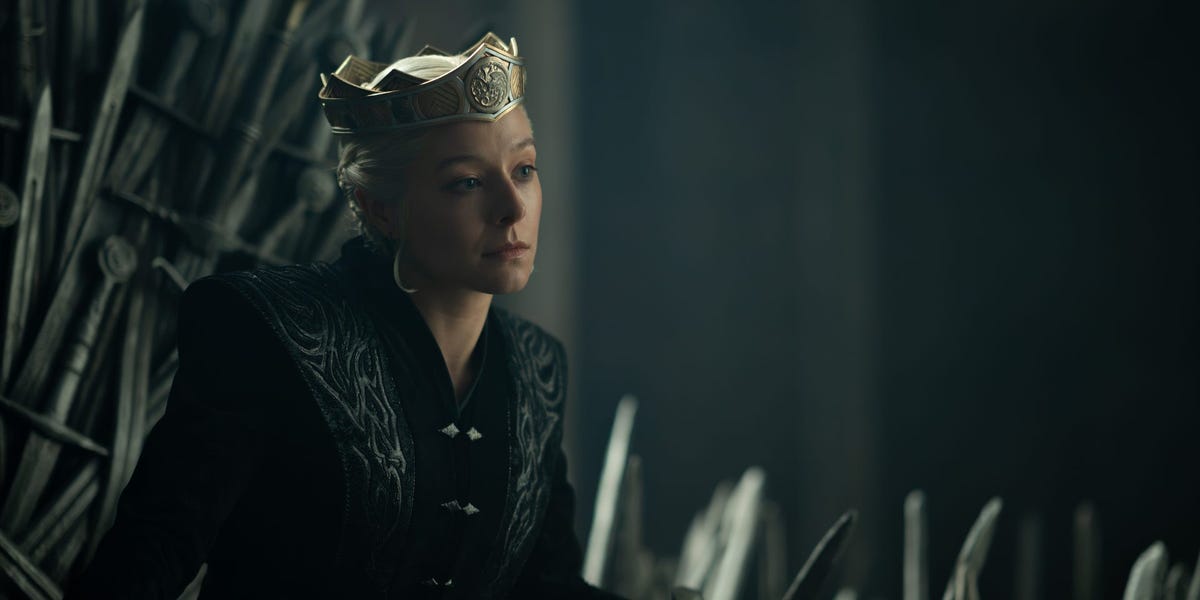
Based on George R. R. Martin’s fantasy book “Fire & Blood,” “House of the Dragon” follows the dynastic struggle between Rhaenyra Targaryen (Emma D’Arcy) and her younger half-brother, Aegon II (Tom Glynn-Carney), which ultimately devastates the royal family and decimates the dragon population.
In the season three finale, Queen Rhaenyra descends further into tyranny and messianic delusions, while Aegon II rises from the literal ashes with a resurrected dragon and a plot to retake the Iron Throne. Elsewhere, Rhaenyra’s Hightower enemies and loyal allies alike are massacred in the big-budget, game-changing Battle of Tumbleton; a dangerous dragonrider deserts her cause; and a beloved former queen plummets to her death.
With plenty to unpack (and even more death and destruction to expect in season four), Business Insider caught up with Condal to discuss season three’s biggest scenes, central themes, and the one character he found especially hard to kill.
On executing the Battle of Tumbleton and expanding Ormund’s character for the screen
Aside from the Battle of the Gullet, were there any scenes from the book that were extra challenging or labor-intensive to bring to life?
Ryan Condal: The two this season definitely were the premiere and the finale — the two mega-battles. Each was its own challenge in its own right. But those were definitely the two that got the most attention in terms of planning, consternation, resources, anguish, despair, all that, and then hopefully victory at the end.
What were the particular challenges of filming the Tumbleton battle?
Unlike the Gullet, which was an engineering challenge of, “How the hell are we actually going to do this?” this was more of, “What can the schedule and the budget absorb in terms of the ambitions of the script?” So that was more of a classic negotiation between creative ambition and what is actually practical and can happen, while holding onto the subjective element of the storytelling — meaning all of the POVs of the characters that we’re with down there on the ground in Tumbleton.
One of the things I’m proudest of is how we were able to bring so many POVs that we’ve been following across the season all together in this one place, and then blend them in a way that felt earned and organic: Black and Green coming together and interacting with each other in a way that was paying off these eight episode-long arcs that we had been exploring across season three.
A big part of that narrative payoff is watching Ormund Hightower get his comeuppance. In the book, he doesn’t get much characterization beyond being a military leader. Tell me about expanding his character for the show and giving him so much texture — the religious fanaticism, the smell sensitivity, all these details.
That’s the great fun of an adaptation of a book like “Fire & Blood.” Because so much of it is a sketch, particularly in the character realm, just because you’re not inside the characters’ heads the way you are in the “A Song of Ice and Fire” novels.
Those are all written in POV, whereas this book is written — it’s an anti-POV. It’s written in the POV of these three historians who are sort of arguing over what happened when to whom, and over whose account ends up being the more accurate account. So you just don’t get the internal thoughts of these characters, which creates a ton of latitude to be creative and create, and to honor the book.
Ormund, we know, is a great military leader. He led the Hightower host. He was with Daeron the Daring, and he planned and tried to win valiantly in this very epic, table-turning Battle of Tumbleton, and then ultimately came up short in the end.
So we knew all of that, and then we were very free to design a character around him. And it really opened us up to being able to go in and do something really interesting and “Thrones”-y, I think, in a way, where he’s flawed and complicated and this master operator who has two core weaknesses — one being something he can’t help, which is his oversensitivity to smell and texture and all that, and then two being his rage issues, which maybe is something that he could do something about with a little therapy and breath work.
I love the throughline that begins chronologically with Ormund, reappears in “A Knight of the Seven Kingdoms,” and then pays off at the beginning of “Game of Thrones,” which is this anti-Targaryen, anti-dragon suspicion breeding among the people of the realm. Did you consider this theme while writing his character?
Yes, very much. It was sort of built into who Ormund was.
This is a theme that we’ve set up that you’re going to see continuing to play out over the final chapter, the final acts of our show — this idea of the Faith.
Essentially, most of the realm holds to the Faith. It’s the Catholicism of this era. And then you have the Targaryens, who come in as this pagan race, who believe in blood magic and fire and their own godlike supremacy. Their gods are gigantic nuclear lizards that you can smell, touch, see, and hear.
I loved what Ira [Parker] did with that very subtly in “A Knight of the Seven Kingdoms,” because even though we didn’t really talk about it, it was clearly in the ether — this idea that the Targaryens were, by a lot of people, looked on with fear and suspicion because of their outsize power. And their alienness, their otherness, the way that they marry amongst themselves, and they don’t hold to the traditions that everybody else holds to — traditions and morals that everybody else in the realm holds to. So there is a natural divide there.
On the ‘natural parallels’ between Rhaenyra and Daenerys
I noticed a parallel between the speech Rhaenyra gives at the Sept and the final speech Daenerys gives in the last season of “Game of Thrones,” when she feels she’s fulfilling her purpose, but in reality, she’s doomed. Was that intentional?
We’re certainly aware of it. I think it’s important that the show has echoes of the original series in it, in some ways, so that they remain connected. Because they are very much connected.
This is the reason that Daenerys is begging for a crown across the Narrow Sea, and the dragons are all dead. Because of this story. So I think those connections are important to make to remind people that these two periods in history are intimately connected with one another.
Daenerys and Rhaenyra find themselves on parallel tracks, in a way, as dragon queens that are trying to establish their own legitimacy and their destination to sit on the throne; there are going to be natural parallels that appear in those stories.
I also noticed echoes of Daenerys burning King’s Landing in the scene of Ulf burning Tumbleton. They’re both the blood of the dragon, of course, with that fiery temper — but with Ulf, we get a lot more context and buildup for that decision. Did that occur to you while adapting Ulf’s turn, or did it motivate you to give him more character development ahead of that scene?
I think the way it all came together, and thanks to Tom Bennett’s incredible performance, it feels like a really, really subtly drawn and really earned arc that — even though it’s tragic and horrifying — feels completely earned in the end.
Ulf is not a great person with a high moral character, but he was also just another guy who was enjoying his time at the pub until the Targaryens drew him into a world he was not prepared to be in, and then sat him on a nuclear weapon and said, “Go win this war for us” — and promised him all these things they never delivered.
So in a way, everybody on all sides — Rhaenyra, Daemon, certainly Ormund, the feudal structure of the political system in this particular time and era — are all responsible for Ulf as much as Ulf is responsible for Ulf. I think it’s a great payoff for that character over his two-season arc to bring us to this point. And I think it’s, again, horrifying, but totally credible.
On Helaena’s death, Aegon’s underdog arc, and Daeron’s relationship with Alicent
Which death did you find most gutting to write or film this season?
It was Helaena. I love Phia Saban so much as a person that she’s just such a joy and a presence to have around set. And look, I really love my cast. I’m very fortunate to work with all of them. But there’s just something about Phia and the character that she plays that’s so delightful and innocent.
It’s almost like she’s a character from a different fantasy story that’s been trapped inside this one. Helaena had no ambitions outside of just raising her chickens and collecting her bugs and noting the natural world — to have her also dragged down into the abyss that is the Game of Thrones was really, really, really tragic and hard to watch and hard to dramatize, and then hard to see being dramatized for all those reasons.
And I’m just really sad to say goodbye to her, just because we adore her and having her around.
Over the course of the series, which actor’s performance has surprised you the most, or differed the most from how you originally envisioned their character coming alive onscreen?
There’s so many. God, it’s so hard. I wish I could do an interview on everybody.
I’m so impressed with Tom Glynn-Carney across this season, because for relatively little screen time, he plays this very, very central role in the season, and did such an incredible job in selling this arc of somebody that we find in the throes of opium withdrawal. And then at the end, you’re rooting for him to get his dragon back and then go challenge the main character of the show for the throne with his brother. Batman and Robin get back together at the end.
I just feel like the way that Tom sold that — and the feedback that I’ve gotten from people watching the show, like, “I didn’t think you could do it, but I’m rooting for Aegon now” — is such a compliment to, I think, the storytelling, but also that’s a credit to Tom’s incredible performance across the season.
I want to ask you about the fan theory that Ormund was dyeing Daeron’s hair so that he resembles a Hightower more than a Targaryen. Is there weight to that?
I don’t want to say anything definitively. I think it’s a very interesting discussion. Daeron’s hair color took up probably more discussion than any single character’s hair color did in the entire making of the show.
I just think it poses a lot of interesting questions. If you presume that that is actually Daeron’s hair color — and that he’s the one that just looked exactly like his mother — the question that was most interesting to me was, “Oh my God, is that why Alicent sent him away?” In a time when she was so in need of painting the picture of the perfect blonde Targaryen family, being able to stand on her soapbox and say that Rhaenyra’s children are plain and illegitimate, and that they’re not trueborn with Laenor, and they’re unsuited to take the throne: “Look at my perfect Targaryen children that I sacrificed so much to have with a man who’s 25 years older than me, who’s literally rotting to pieces.”
It calls back to a past form of Alicent that’s very different from the Alicent that we know today.
Also, if we assume that to be true, we would see her almost rewriting history in real time — telling Rhaenyra that she sent Daeron away to protect him, and convincing herself of that.
So much of memory is emotion, right? It’s an emotional memory. It’s not the memory of actually what happened. It’s your memory of the emotion that you experienced at the time. And I can totally see Alicent really believing a different version of that story, now that she’s been through all of these horrors and tragedies.
On the ‘scrutiny’ he expects for the series finale and the pressure of ‘landing the plane’
With a story like this, presented in the book as a retrospective history, there are several possible endpoints. There’s Rhaenyra’s death or Aegon’s death, but even then, the realm isn’t exactly at peace. How do you approach the final season of “House of the Dragon” as a showrunner looking to craft a satisfying arc in a limited number of episodes?
It would be an understatement to say that ending a gigantic genre show comes with scrutiny around it.
We’ve talked about this being kind of a World War II movie: There are plenty of World War II movies that exist where you tell the story within this greater war, but the curtain drops at some point in the story, and it’s not necessarily with Japan’s surrender or Hitler dying in the bunker — these big kind of endpoints where you could say World War II truly ended. You’re telling the story within the story.
So, in no way to comment at all on how we’re planning on ending this, but I think that was the trick. Because “Fire & Blood” is a decades-spanning history, the question is really more, “Where do you drop the curtain on this particular story?”
We’re telling the story of the Dance of the Dragons — Rhaenyra’s, Daemon’s, Alicent’s, Aegon’s, Aemond’s, Helaena’s story. At what point do you drop the curtain on this, [in a way] that feels satisfying and like you’ve told a complete story, but also that leaves certain things open-ended? Telling the audience, intentionally, that history marches on. We know that the Targaryens live on and rule on from here, for many, many years, before they’re finally deposed in Robert Baratheon and Ned Stark’s uprising.
As you plan next season’s arc, what feels most daunting to you about tackling the next phase of this story?
I think it’s landing the plane, honestly. It’s a very hard thing to do.
We’ve seen a lot of big series come to an end over the last few years. You have to do service to the series, the story that you’ve been telling on a creative level — but also, you have all these fans that are watching this, whether they’re book readers or not, that are tremendously invested in the thing that you’ve made, and they’ve come to know and love these characters, or love reviling these characters. Whatever the case may be, they’ve spent a lot of time in this.
There is a struggle to say goodbye. And I think that’s where a lot of the debate, or whatever it is, comes into the picture, because I think a lot of people just simply don’t want it to end, and they all have their ideas of how it should, or what a satisfying ending is.
So I think for us, it’s really, how do we take these eight hours that we have left — eight chapters that we have left — and tell a compelling, satisfying story that ties up as many of the threads as we’re able to, but also leaves with sort of wistful open-endedness at the end of it to make you yearn for more, in a good way? That’s the thing we’re aiming for.
I always say the hardest thing about making a show like this is the first season and then the last episode, because wrapping it up, you’re going to be judged on how you leave the thing.
I forget who said this, I’m just paraphrasing, but the best endings are totally inevitable, but completely surprising. And that’s the gold standard that we’re striving for.
This interview has been condensed and edited for length and clarity.
“House of the Dragon” season 3 is streaming in full on HBO Max.
Read the full article here