

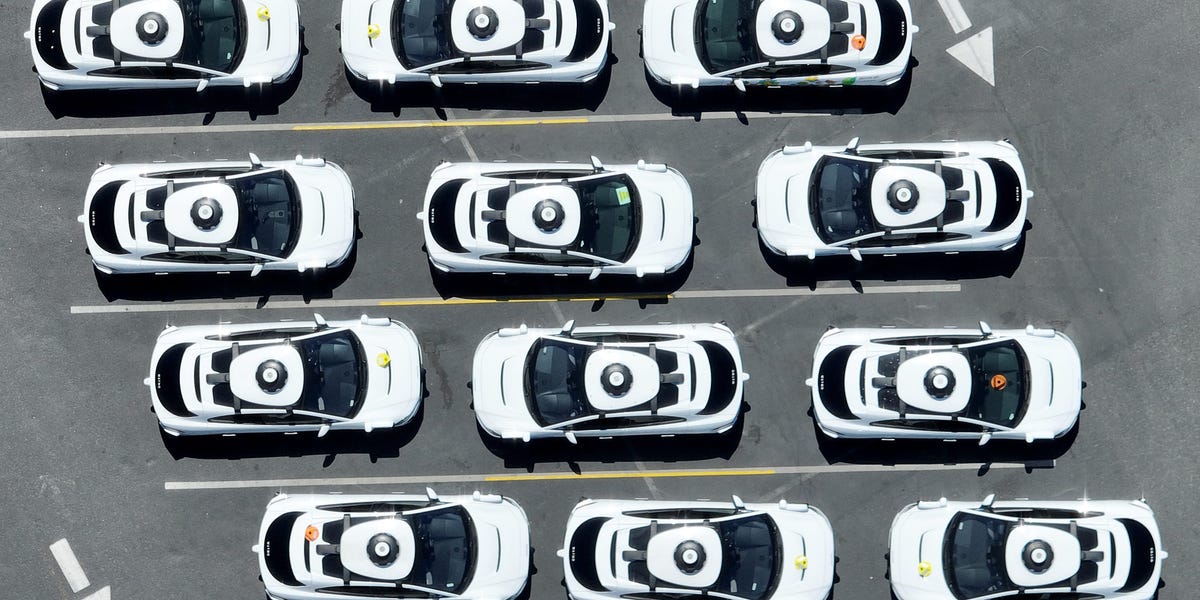
Every now and then, I entrust my life to an AI.
That AI — a Waymo robotaxi — has increasingly become a legitimate means of mobility for some here in San Francisco.
By now, I rarely worry if I’ll get home safe, but I still pay attention.
Waymo and other robotaxi companies say their data prove their AIs are much safer than human drivers. In the hundreds of miles I’ve traveled with Waymo, I’ve never encountered a safety incident that required human intervention.
That’s not to say robotaxis are perfectly safe. They’re still running into issues most human drivers are accustomed to, like navigating construction zones.
And safety is only part of the equation for a seamless ride-hailing service. I’ve witnessed firsthand the smaller quirks that come with the driverless experience.
Soon, people outside the world’s tech hubs will get a chance to see them, too.
The robotaxis are coming
The robotaxi industry in the past month has been busy scaling operations.
On Tuesday, Waymo opened its Dallas service to the public after initially limiting rides to waitlisted users. The company said nearly 150,000 people have tried Waymo since February.
Amazon-owned Zoox announced Wednesday that it plans to begin charging for rides in Las Vegas, signaling that the service is maturing as it goes commercial.
In Florida and Texas, Tesla added new service areas for its Robotaxi. In some regions, the company has started offering a limited number of unsupervised rides.
Robotaxi companies are also expanding beyond the US. Uber and UK-based Wayve said on Wednesday that they received regulatory approval to start offering supervised autonomous rides in London this summer. Waymo also plans to launch a commercial service in London by the end of the year.
Way more Waymos, way more problems?
The rapid pace of scaling can give the impression that robotaxi companies are confident that autonomy has largely been solved.
Phil Koopman, an AV safety expert and emeritus professor of electrical and computer engineering at Carnegie Mellon University, said the reality is more complicated, and the more these robotaxis scale, the more so-called edge cases they’ll run into.
“When you have a hundred cars, you’re at the threshold where stuff that used to be so rare you could ignore it, you can’t ignore it anymore,” Koopman told Business Insider.
Waymo, the leading robotaxi provider in the US, demonstrated that tension.
In May, the company suspended freeway rides after it said that it was trying to improve how the vehicles behaved around construction zones. Freeway rides are critical if Waymo wants to cash in on longer, more lucrative trips, such as airport routes.
Last week, Waymo gradually restored its freeway service following company-issued software updates, providing a stark example of how a robotaxi provider can disable a feature deployed for real-world passengers to resolve a newly discovered issue.
A Waymo spokesperson did not respond to a request for comment.
AVs also still trip up in the face of a major city’s disorder and chaos.
Videos posted online show how Waymo vehicles can sometimes obstruct emergency-response scenes. Waymos were also immobilized amid heavy traffic in San Francisco on the Fourth of July.
The problems have been persistent enough for SF’s pro-tech mayor, Daniel Lurie, to call for stricter statewide regulations last month.
Those calls have extended to the federal level, where regulators from the National Highway Traffic Safety Administration warned of the pitfalls autonomous vehicles still face in active emergency scenes.
NHTSA Administrator Jonathan Morrison wrote in a July 8 letter to AV developers that the federal agency has documented a “clear pattern of driverless AVs interfering with law enforcement and other first responders.”
“The question is, as they expand, can they fix [the problems] as fast as they find them?” Koopman said. “And with floods and construction zones and a bunch of other things, the answer is they haven’t been able to fix them.”
The small quirks of going driverless
Ensuring that a robotaxi doesn’t obstruct an ambulance is a serious issue.
There can also be smaller, mostly inconsequential quirks in a robotaxi ride that may not always warrant a formal report to a regulatory body.
In a video posted on X by Tesla fan David Moss, a human safety monitor of a Tesla Robotaxi in San Francisco could be seen waiting for the car to merge back into traffic for about a minute before eventually taking control of the wheel.
Those interventions aren’t captured under the same public reporting framework that applies to Waymo’s driverless service through the California Public Utilities Commission, the state agency that regulates passenger transportation services.
A Tesla spokesperson did not respond to a request for comment.
In an op-ed published in The Wall Street Journal on Tuesday, an attorney recounted an unsettling Waymo experience in which the robotaxi inexplicably made a turn in the wrong direction. The rider said he and his wife essentially ejected themselves from the ride after the Waymo “shuddered to a stop.”
The attorney wrote how a Waymo rep told them there was nothing that could be done.
Koopman said riders should expect autonomous vehicles to sometimes do inexplicably “weird things.”
“Anyone who expects this technology to be perfect or always do exactly the same thing, you’re in for disappointment,” he said, adding that the safety challenge is making sure those strange behaviors remain benign.
I’ve never experienced some of the serious cases that other riders have reported — being driven in the middle of a flood or creeping through an active crime scene.
On an evening last December, I hailed a Waymo to get back home from downtown San Francisco.
My ride was pleasantly uneventful, as I hope every robotaxi ride will be. Until the Waymo driver made a mistake.
The car drove past the right turn into my house and made a left up the road, taking me in a circle around the neighborhood before it got back on track and delivered me home.
It was harmless, but curious.
I have no idea why the Waymo did that. All I could do was let the AI take the wheel.
Have a tip? Contact this reporter via email at [email protected] or Signal at lloydlee.71. Use a personal email address, a nonwork WiFi network, and a nonwork device; here’s our guide to sharing information securely.
Read the full article here