






The Bank of Canada (BoC) left its policy rate unchanged at 2.25% on Wednesday, as widely anticipated. Governor Tiff Macklem leaned hawkish in the press conference that followed the announcement, as policymakers seem confident about growth and inflation perspectives. Macklem noted that the biggest risks are conflicts in the Middle East and the trade relationship with the US, while repeating decisions will be made one at a time.
BoC Macklem press conference highlights
Economic growth looks to have resumed in Canada.
The economy is projected to grow by 1.8% in both 2027 and 2028.
Longer-term inflation expectations remain well anchored.
Biggest risks are conflicts with the Middle East and the trade relationship with the US.
We will not let higher Oil prices become persistent inflation.
Inflation in Canada is poised to ease gradually, provided global Oil prices decline from elevated levels.
Q2 is looking pretty solid, will be assessing how sustainable the pickup is.
Some businesses like aluminium, are finding new markets.
Higher oil prices are adding to Oil and gas investment.
Exports adjusting to US tariffs and growing.
Signs that the economy is expanding are clearer.
The Canadian dollar weakness has not been a major factor in rate decisions.
If oil prices go higher and remain higher, there may well still be a need for consecutive hikes. This is not our base case.
We’re going to take our decisions one at a time.”
This section below was published at 13:45 GMT to cover the Bank of Canada’s policy announcements and the initial market reaction.
BoC Monetary Policy Report key takeaways
After a year of weakness, Canada’s economy is showing signs of improvement.
Growth is expected to pick up, and inflation will ease gradually from its recent peak.
Uncertainty is still high.
The Canadian economy has been adjusting to US tariffs.
Middle East war-driven inflation’s spillovers to other goods and services remain contained.
Growth in the second quarter is anticipated to be solid at 2.5%.
Inflation is expected to ease to about 2.5% in the second half of 2026 and reach the 2% target by early 2027.”
Market reaction
The Canadian Dollar (CAD) barely reacted to the anticipated outcome, and the USD/CAD pair hovers around 1.4050.
Canadian Dollar Price Today
The table below shows the percentage change of Canadian Dollar (CAD) against listed major currencies today. Canadian Dollar was the strongest against the Japanese Yen.
| CAD | EUR | GBP | JPY | USD | AUD | NZD | CHF | |
|---|---|---|---|---|---|---|---|---|
| CAD | -0.06% | -0.31% | 0.01% | -0.04% | -0.26% | -0.33% | -0.06% | |
| EUR | 0.06% | -0.27% | 0.04% | 0.05% | -0.24% | -0.25% | -0.00% | |
| GBP | 0.31% | 0.27% | 0.28% | 0.31% | 0.02% | -0.00% | 0.26% | |
| JPY | -0.01% | -0.04% | -0.28% | 0.00% | -0.25% | -0.27% | -0.05% | |
| USD | 0.04% | -0.05% | -0.31% | -0.01% | -0.25% | -0.26% | -0.05% | |
| AUD | 0.26% | 0.24% | -0.02% | 0.25% | 0.25% | -0.05% | 0.19% | |
| NZD | 0.33% | 0.25% | 0.00% | 0.27% | 0.26% | 0.05% | 0.26% | |
| CHF | 0.06% | 0.00% | -0.26% | 0.05% | 0.05% | -0.19% | -0.26% |
The heat map shows percentage changes of major currencies against each other. The base currency is picked from the left column, while the quote currency is picked from the top row. For example, if you pick the Canadian Dollar from the left column and move along the horizontal line to the US Dollar, the percentage change displayed in the box will represent CAD (base)/USD (quote).
This section below was published as a preview of the Bank of Canada’s (BoC) monetary policy announcements at 09:00 GMT.
- The Bank of Canada is expected to keep its interest rate at 2.25%.
- The Canadian Dollar extends its recovery vs the US Dollar.
- Markets pencil in just over 15 bps of BoC tightening by year-end.
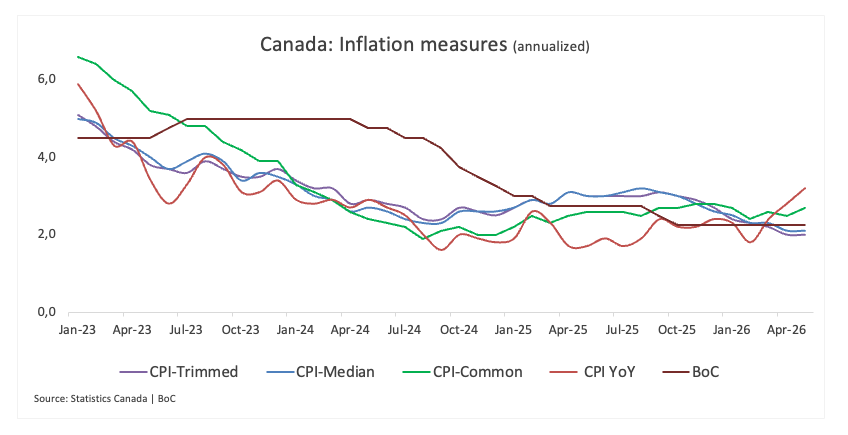
The Bank of Canada (BoC) is widely expected to keep its policy rate unchanged at 2.25% on Wednesday. This would be the sixth consecutive event with the central bank keeping its hand steady.
The BoC left its policy rate unchanged at 2.25% last month, as widely anticipated. The statement and Governor Tiff Macklem’s press conference reinforced a patient approach, as policymakers continue to balance lingering inflation risks against an economy that remains in excess supply.
The central bank expects inflation to hover around 3% in the near term before gradually easing back toward its 2% target. In addition, policymakers also reiterated that they are largely looking through the impact of the Middle East conflict on headline inflation, noting limited evidence that higher energy prices are feeding through more broadly into consumer prices.
While the board stressed it would not allow higher energy costs to become a source of persistent inflation, it gave little indication that a policy response is imminent. Additionally, rate setters also pointed to a likely rebound in growth during Q2, although they cautioned that economic activity remains weak and uncertainty surrounding US trade policy persists.
During his press conference, Governor Macklem emphasised that any future policy move will depend on economic conditions rather than on a predetermined timeline. He noted that core inflation has edged lower, reiterated that economic weakness continues to weigh on prices and argued that little has changed since the previous meeting, with incoming data broadly evolving as expected.
Inflation, however, remains the key watch point after the headline CPI rose by 3.2% in the year to May, above the previous month’s print of 2.8%. In the same direction, the BoC’s core inflation ticked higher to 2.2% from a year earlier. The bank’s preferred measures — CPI-Common, Trimmed and Median — came in mixed. But at 2.7%, 2% and 2.1%, respectively, they still remain above target.
When will the BoC release its monetary policy decision, and how could it affect USD/CAD?
The Bank of Canada will announce its policy decision on Wednesday at 13:45 GMT, followed by a press conference with Governor Tiff Macklem at 14:30 GMT.
Markets anticipate the central bank maintaining its current stance, with a projected tightening of nearly 17 basis points by the end of 2026.
Pablo Piovano, Senior Analyst at FXStreet, points out that further gains in USD/CAD now appear limited by the 1.4250 zone, forcing the pair to recede and revisit the area of multi-week troughs near 1.4050.
“In case the selling pressure gathers traction, the pair’s next relevant support is expected at the provisional 55-day Simple Moving Average (SMA) near 1.3930, while the loss of this region exposes a move toward the critical 200-day SMA around 1.3850, closely followed by the interim 100-day SMA. A deeper and sustained retracement from here should see the next contention at the May floor at 1.3549 (May 1),” Piovano adds.
On the upside, Piovano sees the next hurdle at the YTD peak of 1.4248 (June 24 and 25). The break above the latter could prompt the pair to attempt a move toward the April 2025 ceiling at 1.4414 (April 1).
“Momentum favours extra losses,” he adds, noting that the Relative Strength Index (RSI) is receding further and is revisiting the 44 region, while the Average Directional Index (ADX), just over 43, suggests the underlying trend remains pretty solid.
Economic Indicator
BoC Interest Rate Decision
The Bank of Canada (BoC) announces its interest rate decision at the end of its eight scheduled meetings per year. If the BoC believes inflation will be above target (hawkish), it will raise interest rates in order to bring it down. This is bullish for the CAD since higher interest rates attract greater inflows of foreign capital. Likewise, if the BoC sees inflation falling below target (dovish) it will lower interest rates in order to give the Canadian economy a boost in the hope inflation will rise back up. This is bearish for CAD since it detracts from foreign capital flowing into the country.
Read more.
Next release:
Wed Jul 15, 2026 13:45
Frequency:
Irregular
Consensus:
2.25%
Previous:
2.25%
Source:
Bank of Canada
Canadian Dollar FAQs
The key factors driving the Canadian Dollar (CAD) are the level of interest rates set by the Bank of Canada (BoC), the price of Oil, Canada’s largest export, the health of its economy, inflation and the Trade Balance, which is the difference between the value of Canada’s exports versus its imports. Other factors include market sentiment – whether investors are taking on more risky assets (risk-on) or seeking safe-havens (risk-off) – with risk-on being CAD-positive. As its largest trading partner, the health of the US economy is also a key factor influencing the Canadian Dollar.
The Bank of Canada (BoC) has a significant influence on the Canadian Dollar by setting the level of interest rates that banks can lend to one another. This influences the level of interest rates for everyone. The main goal of the BoC is to maintain inflation at 1-3% by adjusting interest rates up or down. Relatively higher interest rates tend to be positive for the CAD. The Bank of Canada can also use quantitative easing and tightening to influence credit conditions, with the former CAD-negative and the latter CAD-positive.
The price of Oil is a key factor impacting the value of the Canadian Dollar. Petroleum is Canada’s biggest export, so Oil price tends to have an immediate impact on the CAD value. Generally, if Oil price rises CAD also goes up, as aggregate demand for the currency increases. The opposite is the case if the price of Oil falls. Higher Oil prices also tend to result in a greater likelihood of a positive Trade Balance, which is also supportive of the CAD.
While inflation had always traditionally been thought of as a negative factor for a currency since it lowers the value of money, the opposite has actually been the case in modern times with the relaxation of cross-border capital controls. Higher inflation tends to lead central banks to put up interest rates which attracts more capital inflows from global investors seeking a lucrative place to keep their money. This increases demand for the local currency, which in Canada’s case is the Canadian Dollar.
Macroeconomic data releases gauge the health of the economy and can have an impact on the Canadian Dollar. Indicators such as GDP, Manufacturing and Services PMIs, employment, and consumer sentiment surveys can all influence the direction of the CAD. A strong economy is good for the Canadian Dollar. Not only does it attract more foreign investment but it may encourage the Bank of Canada to put up interest rates, leading to a stronger currency. If economic data is weak, however, the CAD is likely to fall.
Read the full article here