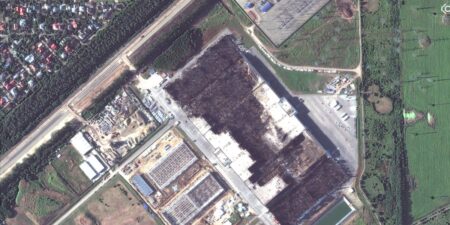





In a future war, an enemy could attempt to target US bases with cyber attacks and drone strikes to cripple American forces before the fighting even really begins.
It’s a challenge that the US Army recently assessed during a tabletop exercise, drawing inspiration from real-world action, including Ukraine’s Operation Spiderweb attack against Russia. There were important lessons on defending infrastructure from drones, including certain counter-drone systems, but also a reminder that no single system will be a silver bullet.
Last month, the Army gathered federal and local partners for its first summit on defending critical defense infrastructure at Fort Bragg, North Carolina.
The featured threats included attacks that could disrupt Army data and communications, shut down electricity and other essential utilities, and degrade the Army’s ability to quickly gather forces in preparation for a conflict.
Brandon Pugh, the Army’s principal cyber advisor, said the challenge is turning “best practices and lessons learned” into “a playbook” that “a local garrison commander,” who “is not a cyber or physical protection expert,” can use at “their garrison and their camps, posts and stations.”
While many of the threat scenarios weren’t tied to specific adversaries or enemies, the counter-drone element was specifically inspired by Ukraine’s June 2025 Operation Spiderweb, which saw Kyiv sneak over 100 drones into Russian territory and launch them at nearby air bases. They struck dozens of grounded aircraft and destroyed others.
A similar threat to a US base or installation would need to be defended by a layer of counter-drone systems, officials said, including kinetic and non-kinetic options that can handle specific threats.
“Effective C-sUAS [counter-small uncrewed aerial systems] requires a tailored approach, employing capabilities that match the likely threat and take into account what needs to be protected,” Lt. Col. Adam Scher, spokesperson for the US Army-led Joint Interagency Task Force-401, told Business Insider.
A kinetic counter-drone solution is the Bumblebee, made by Perennial Autonomy, a low-cost attritable platform that uses artificial intelligence to physically intercept and destroy hostile small UAS. JIATF awarded Perennial Autonomy a $5.2 million contract for Bumblebee systems earlier this year.
Non-kinetic options, like electronic jamming, and passive defenses, such as netting or hardening, are also needed.
JIATF-401 is an Army-led task force that includes the Department of Defense and other federal agencies and works across the government to detect, track, and stop drone activity in and around military installations, as well as the broader US.
JIATF-401 replaced DoD’s previous counter-drone task force. It recently tested a non-kinetic platform for detecting, tracking, and non-kinetically destroying drones at the US southern border.
During the training summit, teams examined how current counter-drone capabilities could best be used to defeat an attack like Ukraine’s Operation Spiderweb. While the environments, infrastructure, and threats differed, the experience still prompted data that could improve counter-UAS tactics, officials said.
Scher told Business Insider that one key takeaway was the need for a common user interface that streamlines the use of counter-drone systems, reducing the time it takes soldiers to identify drones and decide which systems are best for neutralizing them.
Beyond Operation Spiderweb, US Army officials are drawing broader counter-drone lessons from Ukraine, where systems for detecting and defeating drones can become outdated within months as Russian tactics and technology evolve. One important takeaway for JIATF-401 is the need for defenses that are cheap, scalable, and adaptable enough to keep pace with a fast-changing threat.
Read the full article here