



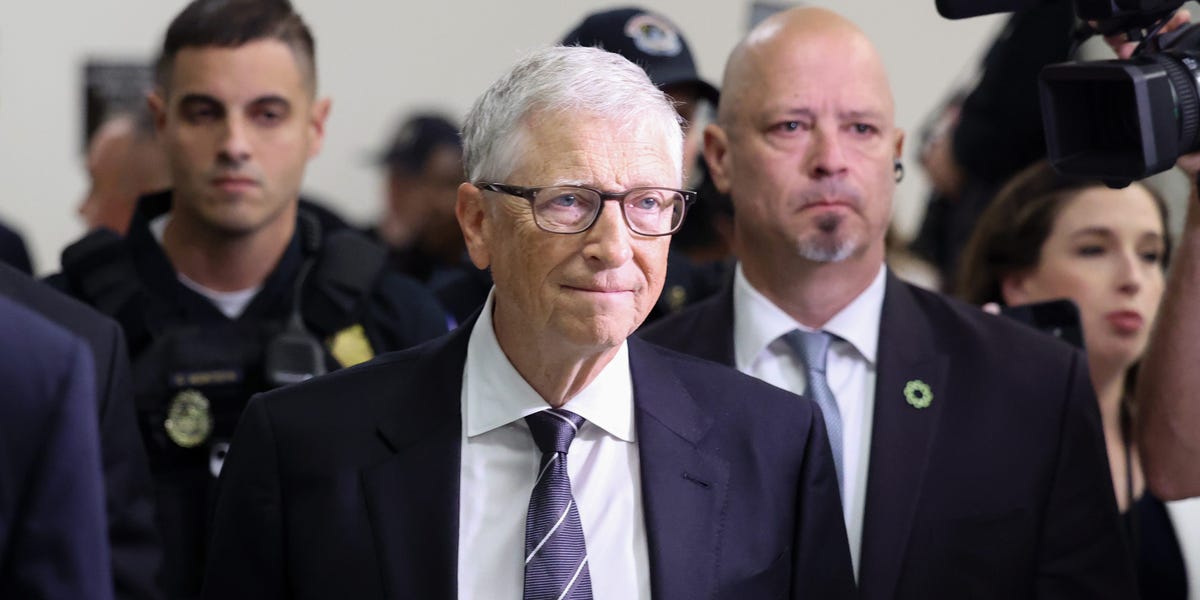
Microsoft founder Bill Gates on Wednesday is sitting before a congressional panel to testify about his relationship with late convicted sex offender Jeffrey Epstein.
In a prepared statement to the House Oversight Committee investigating the Justice Department’s handling of the Epstein files, Gates expressed regret for his association with Epstein and said he was “deeply sorry” if the time he spent with the disgraced financier “lent him any credibility.”
“I should never have met with Epstein in the first place,” Gates told the committee in his opening remarks during the closed-door interview, according to a copy posted by Gates online. “Based on what I know now, I understand that even if he had delivered the new donors he promised, it would not have justified associating with him.”
Gates, who has not been accused of any criminal wrongdoing in connection with Epstein, said that meeting with him “was a grave error in judgement” and put Gates’ work “at risk.” He said he didn’t witness any criminal conduct by Epstein, nor did he have any indication that Epstein was engaged in criminal activity.
“I never went to his island, his ranch, or his Florida home. I have never victimized anyone,” Gates said. “While he may have sought to foster a personal relationship, I was never interested in that and never reciprocated.”
The Microsoft founder said that, at one point, “Epstein had become aware of sensitive information about my personal life, including the fact that I had been unfaithful in my marriage.”
“These affairs had nothing to do with my interactions with Epstein, but they were painful for my family. As the public can now see, based on what has been released in the files, Epstein was working to use information about my infidelities—in addition to many lies that he layered on top—to pressure me to re-engage with him,” Gates said. “He was unsuccessful in this effort, but it shows some of the ways he tried to leverage his interactions with me to further his agenda.
A spokesperson for Gates told Business Insider in an email on Wednesday that the billionaire “welcomes the opportunity to appear before the Committee.”
“While he never witnessed or participated in any of Epstein’s illegal conduct, he is looking forward to answering all the committee’s questions to support their important work,” the spokesperson said.
Below is a copy of Gates’ full opening remarks to the House Oversight Committee:
Mr. Chairman, Ranking Member, Members of the Committee— Thank you for the opportunity to appear before you today. I am here to answer your questions about my interactions with Jeffrey Epstein and to help contribute to the Committee’s important work. I support the release of all the Epstein files and sincerely hope that, through your efforts and those of others advocating on their behalf, the survivors of Epstein’s crimes can get the justice that they deserve. At the outset, I want to state very clearly: I never witnessed nor had any indication that Epstein was engaged in ongoing criminal conduct. I never went to his island, his ranch, or his Florida home. I have never victimized anyone. While he may have sought to foster a personal relationship, I was never interested in that and never reciprocated. I was introduced to Epstein in 2011 through people I trusted in my professional and philanthropic work. Epstein claimed he could raise billions of dollars for global health from people for whom he provided tax and estate services. I recall being aware that Epstein had faced prior legal issues, but I did not fully understand the extent of the crimes he committed. I accepted the introduction without applying the scrutiny I should have. For almost two decades, my full-time focus has been global health and education. I have been guided by the belief that all lives have equal value, and that every child should have the chance to live a healthy life, no matter where they were born. I have committed my resources and my time to this effort, but my wealth alone cannot fill the enormous funding gap that remains. This is why trying to encourage others of significant means to invest in global health has become such an important element of my work. My interactions with Epstein began with a limited number of preliminary meetings—three in 2011 and two in 2012—during which I talked about the goals of my work. We began more extensive conversations in 2013 and 2014. The discussions focused on identifying potential giving structures, such as donor-advised funds, and how to enroll individuals he claimed were interested in making significant contributions. I made it clear to Epstein from the outset that he would never play a role in any of the work or receive any compensation. In 2014, after Epstein brought together a group he described as potential donors, I realized that our prior discussions—which should have translated into meaningful philanthropic support—were a dead-end. It was clear that no one in the group was interested enough to move forward. At that point, I concluded Epstein would never deliver on his promises. I told him we would go no further and stopped communicating or meeting with him. No vehicle for charitable giving was ever created and no funds were raised. Our interactions ended in December 2014, four years before new reports in the press and unsealed court documents shed light on the extent of his crimes. It was during the same time period that an employee was in the process of transitioning out of my private office. This employee engaged Epstein to negotiate and advise him on the terms of the separation. I did not ask—nor did I want or need— Epstein to be involved in this matter. His involvement resulted in email exchanges, calls, and meetings with members of my team and me. However, the agreement we ultimately reached was not any different from what was previously agreed upon months in advance of Epstein inserting himself. It was after this that I learned Epstein had become aware of sensitive information about my personal life, including the fact that I had been unfaithful in my marriage. These affairs had nothing to do with my interactions with Epstein, but they were painful for my family. As the public can now see, based on what has been released in the files, Epstein was working to use information about my infidelities—in addition to many lies that he layered on top—to pressure me to re-engage with him. He was unsuccessful in this effort, but it shows some of the ways he tried to leverage his interactions with me to further his agenda. I should never have met with Epstein in the first place. Based on what I know now, I understand that even if he had delivered the new donors he promised, it would not have justified associating with him. I see now that he sought to build an image of legitimacy around himself, using connections to reputable and powerful people to deflect scrutiny and attempt to rehabilitate his reputation. I was so focused on the possibility of raising funds for global health that I allowed that goal to override my better judgment. That is a sobering realization, and it has reinforced for me the importance of being more attentive to how access and reputation can be manipulated by people acting in bad faith. In the work I do, reputation is the basis for developing partnerships that save lives. Meeting with Epstein was a grave error in judgement and put this work at risk. His behavior was antithetical to all my efforts to contribute to a world where everyone has a chance to live a healthy and productive life. If the time I spent with Epstein lent him any credibility, I am deeply sorry. I have learned a significant lesson and am now far more careful about who I engage with even in a limited capacity. I look forward to answering all your questions about my interactions with Epstein—and the topics identified in the Chairman’s invitation to appear today. This Committee’s work is essential. It is my sincere hope that those harmed by Epstein’s crimes will receive the justice they deserve. Thank you.
Read the full article here