





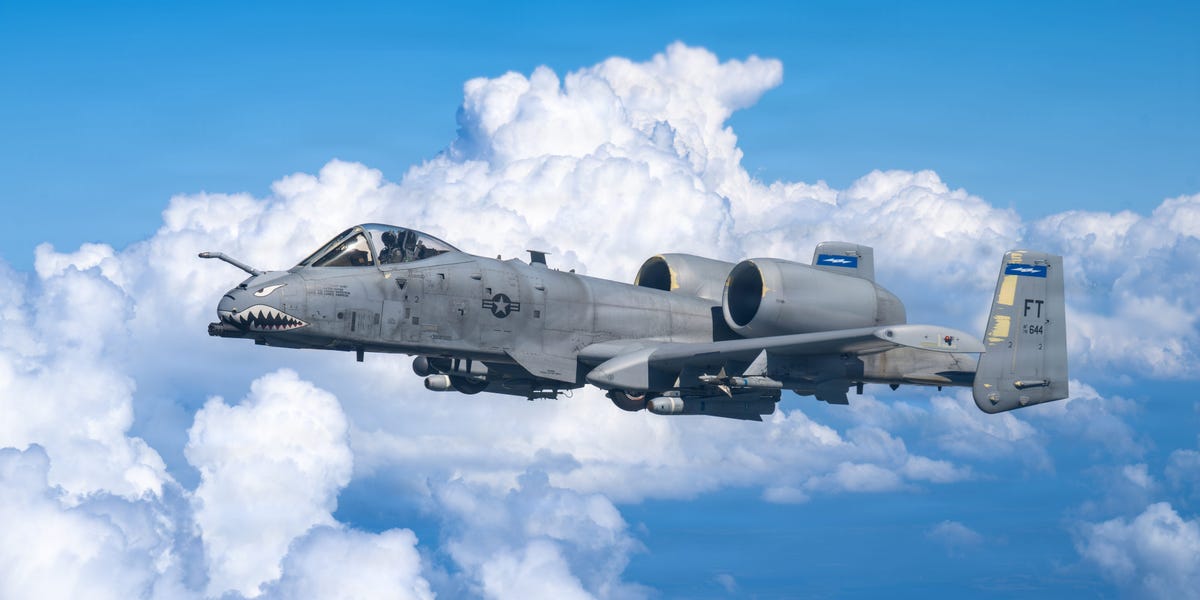
The US Air Force has delayed the retirement of its A-10 Thunderbolt II attack aircraft, but the Warthogs are still headed for replacement, with F-35s, F-15s, and other aircraft expected to take on missions long associated with the A-10 platform.
The Air Force has argued the A-10 won’t be viable in a potential future war with China, and the service is working on figuring out what certain key missions look like without them.
During this process, lawmakers have questioned whether the coming shift risks creating gaps, particularly within the combat search-and-rescue mission.
At a US House Armed Services Committee hearing, Gen. Kenneth Wilsbach, chief of staff of the Air Force, highlighted the “Sandy” role of the A-10, in which the aircraft supports search and rescue while engaging in close-in battles at low altitudes. A-10s recently supported the operation to rescue a downed F-15E Strike Eagle crew in Iran.
The Air Force has previously identified the F-35 and F-15 as successors to the A-10 for combat search and rescue support, and Wilsbach did as well. Lawmakers have, however, raised concerns that they’re not one-for-one replacements.
During the hearing, Rep. Austin Scott, a Republican congressman from Georgia, noted that “A-10 pilots are specifically trained for combat search and rescue” and asked: “Are we going to specifically train F-35 and other pilots for combat search and rescue?”
Wilsbach said the Air Force will have to. “It’s our mission,” he added.
Lawmakers pressed Air Force officials about the risk of creating a gap in search and rescue capability. At the hearing, Rep. Derrick Van Orden, a Republican from Wisconsin, asked whether any current aircraft could “match” the capability of the Warthog.
“Well, ‘match’ is probably in the eye of the beholder,” Wilsbach said. “We have other aircraft that are capable of doing close air support and can certainly support combat search and rescue.”
The Air Force has requested funding to get F-35 pilots trained on this mission, and the extension of the Warthog’s lifespan into the end of the decade helps provide time for the transition. The service officially announced last month it would keep one squadron flying through 2029 and two others into 2030.
The slowing of the A-10’s retirement will allow the service to “backfill” units with “more capable, survivable combat aircraft,” Air Force Secretary Troy Meink said.
The Warthog’s retirement news has drawn attention especially in light of its role in the US war in Iran. Beyond supporting the rescue of the F-15E crew, A-10s were also hunting Iranian fast-attack boats in the Strait of Hormuz.
Read the full article here