





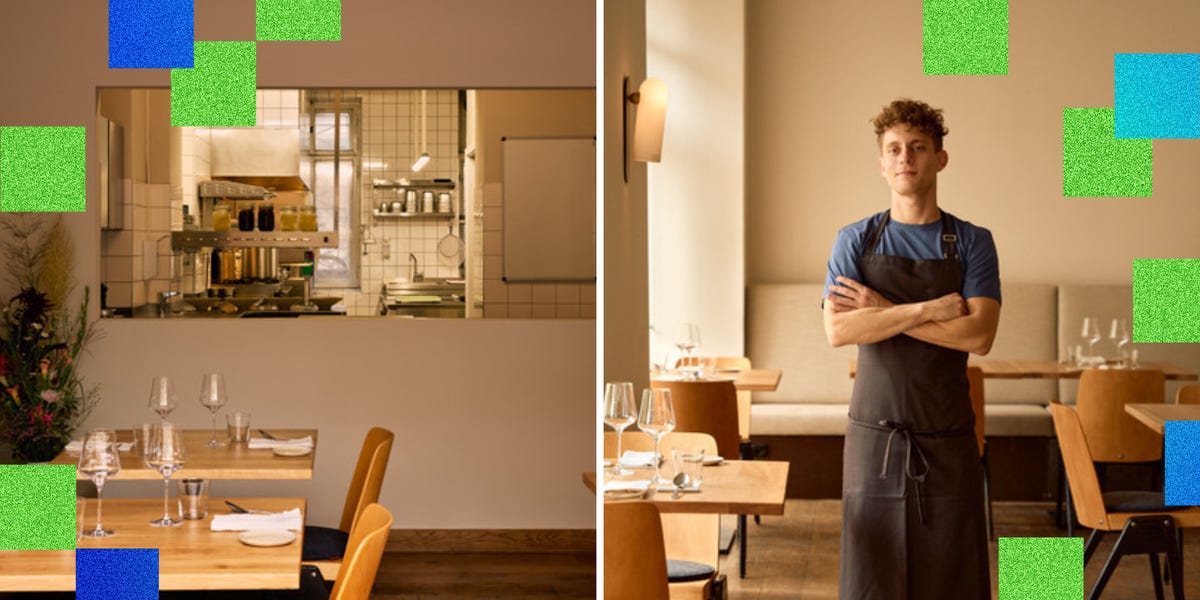
When Silvio Pfeufer first got into cheffing, he was surprised by the amount of administrative work involved.
“It’s not only the evening, sending nice plates to guests. There’s a lot of stuff to do to make that happen,” Pfeufer told Business Insider. He took long phone calls from food suppliers and producers that kept him away from the kitchen.
Sourcing and buying food is a process riddled with disorganization, since farmers, wholesalers, logistics providers, and restaurants communicate in different ways — by phone, email, text message, and PDF blast — starting as early as 4 a.m. The cost and availability of products are constantly in flux, so sellers issue frequent updates: The price of wild-caught fish could change three times a day, for example.
When Pfeufer opened his own restaurant in 2024, he wanted to streamline his food procurement process. At Matthias, which pays homage to his late grandfather, Pfeufer uses an AI-assisted platform for food business owners called Saltz to speed up food procurement and reduce phone calls.
The time savings are critical, said Pfeufer, a co-owner and head chef at the Berlin-based eatery. Using AI agents, Saltz connects restaurants directly to suppliers via a marketplace that brings together disparate catalogs, transactions, and logistics so restaurants can compare and buy fresh, high-quality, and specialty products more quickly than with traditional food procurement processes.
The platform’s standardized, real-time food data can be a game-changer for independently owned and operated restaurants like Pfeufer’s, given their limited purchasing power. Saltz said that thousands of buyers and hundreds of suppliers use its technology, though it didn’t share exact numbers. It said around 80% to 90% of its buyers are independent restaurants.
Connecting with high-quality and specialty suppliers
Pfeufer said he chose Saltz because he liked how the platform modernized old processes. In the two years he’s used it, it’s allowed him to discover new suppliers, order outside business hours, and gain better oversight on pricing, he said.
Founded in 2022, the startup uses AI agents to ingest PDFs, emails, and text messages that food sellers send to Saltz, standardize and enrich all the data, and consolidate it into a single platform. Its AI agents automatically update each seller’s listings on the platform, eliminating the need for manual updates.
Buyers, meanwhile, see once-disparate product options, information, and up-to-date prices in one place. They can also order food at a time that’s convenient for them and track their deliveries. “On a Sunday, at night, or in the morning, I can do it by myself, and don’t have to have all these calls,” Pfeufer said.
At Matthias, which was awarded its first Michelin star in 2025 after 10 months of service, meals must meet a high standard every day, and products have to be of the freshest quality. Pfeufer orders vegetables, milk, and other items from Saltz every week, plus fresh fish twice a week. Before using Saltz, the quality of his products wasn’t necessarily worse, he said, but access to new or specialist suppliers was more limited and supply chains were longer.
“The fish is now often sourced directly from the trader or farmer, without the need for intermediate storage. This allows us to avoid additional storage times that could negatively affect freshness,” Pfeufer said, adding that more oversight into the supply chain — and it being shorter — means his food is more consistently high quality.
“We’ve definitely been able to connect with better suppliers,” he told Business Insider. The chef added that he still works directly with certain local farmers, as he is often on the hunt for rare items that aren’t on the platform.
For Pfeufer, using Saltz also allows him to see more costs upfront, so he can better plan how much to charge for new dishes. “It makes all the calculations much easier, which is very important for us,” he said.
Agentic AI acts as a foundational tool
Saltz was founded by brothers Andrius and Thomas Šlimas, who previously built the Shopify-acquired dropshipping platform Oberlo. After spending four years inside Shopify’s supply chain machine, the brothers teamed up with industry veteran Reinis Štrodahs. Their goal: modernize the $9.8 trillion food procurement industry.
“It’s impossible to make sense or structure that chaos of information which lives in different places and has no common structure,” Andrius said.
The Šlimas brothers said that previous unsuccessful attempts to modernize food procurement took two approaches: either trying to force suppliers and buyers onto a single platform, which required them to change how they work, or taking on the time-consuming task of manually inputting every PDF, email, and text message.
With Saltz, AI agents upload and update product listings for sellers, so individual stakeholder workflows don’t have to change. Making agentic AI foundational to the process, Tomas said, gives their platform an edge.
“That gives us a speed advantage, and in this market, speed compounds into market share.”
Read the full article here