




My 10-year-old son Ezra was the only one in his fourth-grade class without a Nintendo Switch. His teacher had a policy allowing students to pull out their electronics at the end of the day, so Ezra often felt left out when his friends played.
This led to relentless begging. Some of Ezra’s classmates even offered to donate to a fund to help him get one.
I was a firm no. I’m not big on electronics and wasn’t going to give in to the peer pressure — and I certainly wasn’t going to let other kids buy him one.
But when my husband became a full-time teacher at a new school, I wanted Ezra to transfer there in the fifth-grade so they could be together. The dilemma was that Ezra loved his current educational environment. He didn’t want to leave his friends and the school where he felt comfortable and made memories.
So, I struck a deal with him — a “Switch for a switch.”
I regretted it almost immediately, especially after spending around $300 on the hand-held console. In the end, my husband and I let him stay at his current school for one more year instead, and rebranded the Switch as a combined Christmas and birthday gift.
We set boundaries, but still noticed a shift
My husband and I monitored what Ezra played, sticking to age ratings and avoiding shooter games. We turned on parental controls so that the device would shut off after an hour.
Even with that limit, Ezra seemed to fixate on and feel entitled to that time every day.
“When am I going to get my screen time?” he’d ask, melting down on days it didn’t happen.
Road trips were less sweet, too, since he didn’t even look up and out the window. “Yeah, cool,” he’d say, eyes glued to his screen.
I started to notice that ordinary life no longer excited him the same way. He showed less interest in being outdoors or exploring. More often, he just wanted to sink into his beanbag chair and tune out.
He realized on his own how much time he was spending with it
One day, I caught him playing a game instead of doing his homework, and I took the device away. He didn’t ask for it back. Weeks turned into months.
Then, when he was almost 12, he came to me and told me he had played games that his dad and I didn’t want him to access, followed by an apology. It’s been over a year and a half now, and Ezra hasn’t asked for his device back.
When I inquired why, he said, “I gave it up mostly because I subconsciously knew that my life started revolving around it.”
He spends his time differently
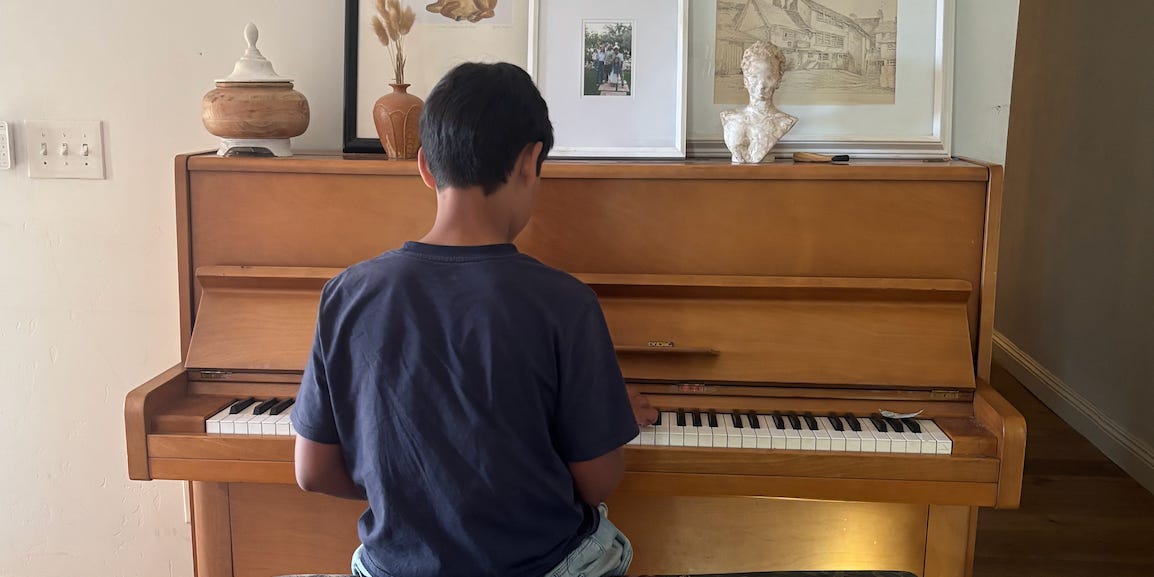
Now, he plays guitar and piano, draws, bikes, and skateboards with the kids in the neighborhood. Last week, he decided to take up pickleball.
“I have more time to do stuff. More creativity and a longer attention span,” he told me. ” I get less frustrated when trying new things.”
Most research suggests that kids do OK with about an hour of screen time a day. Ezra still gets that — usually by watching TV with his siblings. But now that screen time feels more intentional. It’s family time, something shared, rather than something that pulls him away.
We didn’t force him to give up his Switch
The fact that Ezra chose to give up his device might say something about maturity and maybe the values we’ve tried to model. We’ve talked openly about how screens can create quick, addictive hits of dopamine, and he says knowing that did influence his decision.
If I could go back, I don’t know if I would’ve bought a Switch for him in the first place. But if I hadn’t, would he always wonder what it was like? Would he have felt resentful?
Parenting is full of calls like this that you can’t fully predict and never feel entirely sure about. But I do know I’m proud of my kid for making the decision to better himself on his own.
Read the full article here