


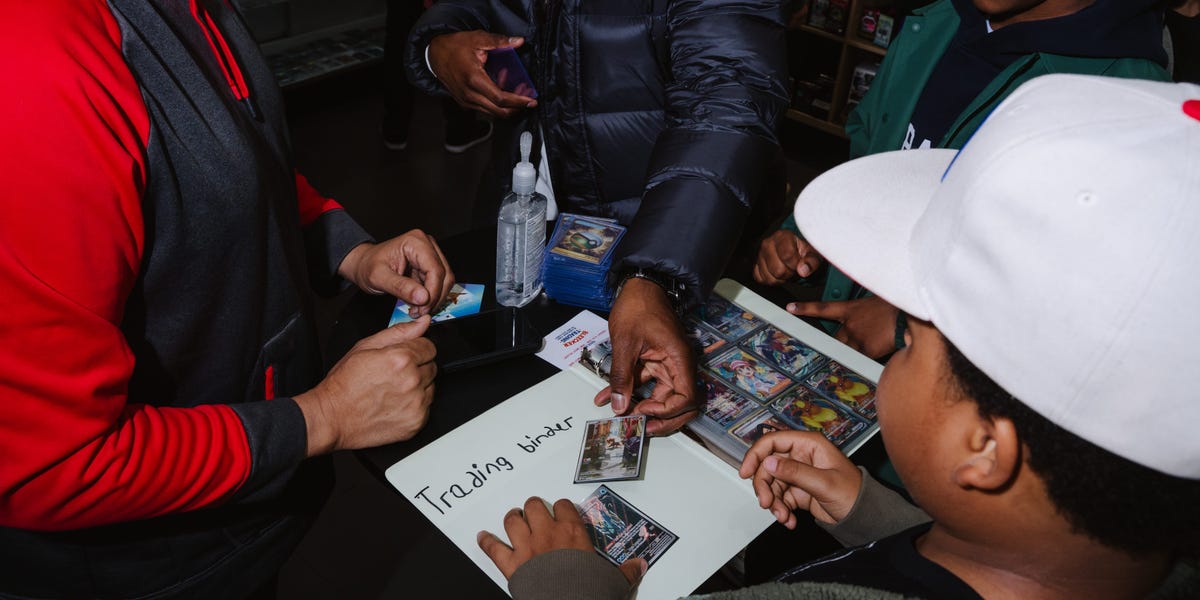
In the back corner of hobby shop Bleecker Trading on Manhattan’s Upper West Side, three teenagers were huddled around a table. It was spring break, and they were spending their afternoon wheeling and dealing Pokémon cards.
“I come here every day after school,” Mason, a 13-year-old, told Business Insider, as his friend Vincent pulled up an app to check the value of various cards.
They’ve each been collecting Pokémon cards for years, and it’s not about playing the game.
“I like making money a lot,” Mason said. “I’m able to sell some cards for hundreds of dollars.”
The next generation of business titans is training on the playground and around cafeteria tables. They’re trading cards, not stocks.
“It’s an investment,” Vincent said.
Pokémon has enjoyed a resurgence in recent years, becoming the world’s No. 1 toy property in 2025, and generating $2.5 billion in US sales — up 87% year over year, according to market research firm Circana.
It’s not the card game most millennials remember. Today’s kids treat their cards as an alternative asset class, scouring the first- and secondhand markets for deals. They trade cards — and spend cash — to build up blue-chip portfolios.
Rightfully so: Card Ladder’s Pokémon index, which tracks market performance on platforms including eBay, has grown 179% year over year. That beats both the S&P 500’s 33% growth and the Dow’s 22% rise in the same period. Over the past year, an average of $830,000 worth of cards were sold each day on the secondary market, according to Card Ladder, with a Pikachu Illustrator card selling at auction for a record $16.5 million in February.
“They’re like little business people,” Matthew Winkelried, the owner of Bleecker Trading, told Business Insider about his school-age customers. “They follow the Pokémon market. They know what they’re looking for and they know what the value is.”
The after-school hustle
Winkelried remembers when he first learned about Pokémon: He was watching Saturday morning cartoons when the original Pokémon TV series came on.
What followed was a slow roll: He saw the cards at school and learned about the Game Boy game. Living in suburban New Jersey, his mom would have to drive to their local toy store, Babyland, to see if cards had been restocked.
Things are different now.
“In the modern era, because kids are exposed to technology and screens consistently, discoverability is very easy,” he said.
A kid may see a card on the playground or at a friend’s house, and thanks to Google and YouTube, they have a basic understanding of the Pokémon language after a few hours online.
Liv, a 7-year-old expat living in Stockholm, told her dad, Andreas Harris, that she wanted to get in on the Pokémon cards that her friends were showing off during recess.
When he learned that she was interested in collecting and trading — not actually playing — the game, he turned to YouTube.
“Well, if you want to get into Pokémon business, let’s do it,” Harris told her. “We’ve got to educate ourselves.”
Together, they learned how to properly store the cards to hold their value — Liv keeps hers in a red binder with sleeves — and what makes a card valuable, including rarity, condition, and a specific collector’s goal.
Liv goes for aesthetics. Her favorite character, Minccino, is “different, cute, and furry,” she said. Still, she’s beginning to understand the basic laws of supply and demand. She has her eye on rare cards, and Japanese cards — less common in Sweden — are particularly exciting.
Like many Pokémon collectors, Liv started out with a couple of financial assists — two packs from her dad and about $10 worth of Swedish Krona from the tooth fairy. Her weekly allowance tends to go toward packs and individual cards, like one of her most valuable, a Pikachu that cost about $20.
Others take it to an extreme. Winkelried has seen parents, typically those who themselves collect or used to collect, spend as much as $5,000 on packs and cards. Most of the kids at Bleecker Trading said their parents have helped kick-start their collections with a handful of packs — about $7 each — or, for a special occasion, an Elite Trainer Box, which tends to retail for $50 to $70.
Once a kid builds a good portfolio — through the luck of the draw when ripping packs or purchasing specific cards — it can sustain itself with less risk than other collectibles like sports cards, whose value depends on human players.
“Charizard can’t tear its ACL, it can’t get pulled over for DUI,” Winkelried said. “There are ebbs and flows, like the commodity markets, and they can fall below a floor, but they usually recover pretty fast.”
Like tiny brokers, they keep their cards in mint condition in toploaders and sleeves — or even unopened — and send the most valuable to authenticators like PSA, which grade cards for a fee based on rarity and condition.
They track market value on websites like Card Ladder and the marketplace TCGplayer, and take that knowledge to the playground, card shows, and collectible shops, bartering with kids and adults alike.
“They’ll go to card shows, they’ll use it as leverage for another card that they want, and the cycle continues,” Samantha Veres, a marketing specialist at Los Angeles card shop Burbank Cards, told Business Insider.
Veres runs children’s events at the store, teaching kids as young as five what makes a good trade and how to properly store their cards. These kids, she said, know how to hustle.
“I’ve seen kids, whether it’s sports cards or Pokémon cards, with belt bags of cash, $100 bills,” Jay Coscolluela, the cofounder of West Coast Card Shows, told Business Insider. “Nothing surprises me anymore.”
Take the Warren Buffett of Bleecker Trading: a 12-year-old whom Winkelried has known for about three years.
“In the span of six months, he nailed this hobby,” Winkelried said. “Flipping cards, turning a profit, reinvesting in a new card.”
His Apple equivalent came last year, when he opened an Evolving Skies pack and pulled a Moonbreon, a super-rare special illustration card featuring the character Umbreon. To the uninitiated, this may be word salad, but he had the understanding to get the card graded for its value, which sat at a pretty $3,000.
He negotiated a sale and took most of that profit — Winkelried said his mom probably saved some — to buy more cards.
As Coscolluela said, even if you pull the ultimate character, which most agree is Charizard, there is always a better one: “A collector never gets satisfied.”
Forget catching them all
At one of Bleecker Trading’s tables, two pairs of fathers and sons were talking business after a trade.
Ten-year-old Jasper was going through his trading binder, pointing out the values of specific cards and explaining how he manages earnings from his trades: spending half on new cards and saving the other half “for a rainy day.”
His dad, Redell Armstrong, started telling a story about when the two of them bought an Elite Trainer Box at GameStop for $85.
Rondell Fleming, the other father, and his son, Rondell Jr., stepped in. That was Armstrong’s first mistake, they said, “super overpriced.”
Like many parents of today’s kid collectors, Armstrong was into Pokémon when he was younger. Now, he and his son collect together, which the elder Armstrong said is a bonding experience.
The current Pokémon craze was reignited in 2020 when millennials, some quarantined in their parents’ homes, rediscovered their old collections and realized what they might be worth.
Pokémon social accounts exploded. eBay reported a 574% increase in sales between 2019 and 2020, and stockists couldn’t keep up with demand.
As with any trend that capitalizes on nostalgia, there’s plenty of griping about “the good old days” from Pokémon purists.
Some longtime fans — or those who actually play the game — fear that the young collectors are too capitalistic in their approach.
Fleming tries to teach his son, RJ, restraint.
“It can get tricky when you’re buying packs, buying cards,” he said of the value-obsessed approach. “You can spend a lot of money really fast.”
At the kids’ events she runs, Veres tries to focus on more than value, emphasizing a card’s cool art or the fun of the game itself.
During Bleecker Trading’s kids’ day, there was a 15-minute presentation during which two employees modeled good behavior — trade fairly, be respectful, and end every deal with a handshake — and Winkelried turned down multiple trades with kids throughout the day.
“If I see a kid dropping dime after dime, I’d be like, why don’t we take a break?” Winkelried said.
Of course, not everyone is looking out for the kids they trade against.
At one show, a dealer told an unwitting 13-year-old that a card was worth $100 when it was really worth $50.
“The uncle had to explain to the kid, you have to do your research before you do a deal,” Coscolluela said.
While Coscolluela said he spoke to the dealer to try to make it right, there’s a lesson in that: “You can’t go crying because you made a bad decision. That’s called business.”
Still, most parents said there are real upsides to trading Pokémon cards, such as a basic understanding of economics and value, as well as attention to taking care of a collection.
“We want to convey financial literacy,” Armstrong said. “He fell into Pokémon, and then my wife and I, we use that as a platform for him to think intelligently about investments.”
And while trading with adults can be intimidating, Liv’s dad, Harris, said that negotiating builds confidence.
Plus, any hobby that gets kids off their screens is a win.
At Bleecker Trading, the dozens of kids that came in and out of the shop were talking to each other, laughing, and eating pizza. Their phones only came out when they wanted to check card values.
Liv used to be an avid Roblox player, playing for hours before her dad set time limits and asking for Robux for Christmas. Her 8th birthday is coming up next month, and she has one big request: more Pokémon cards.
Read the full article here